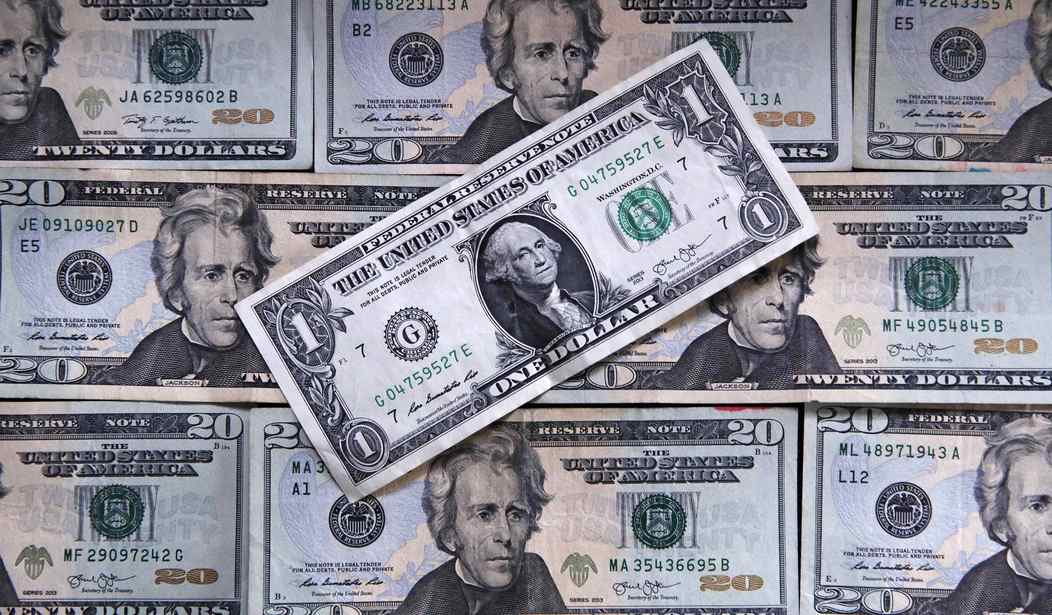

Economies are amazing things. In a nation the size of the United States, our economy is made up of millions of people making billions of financial decisions every hour of every day. These decisions range from buying a candy bar at the gas station to filling a car's gas tank, from going out to dinner to buying a house or starting a business. Almost every decision has an economic aspect, and that's why central economic planning always fails. No system, no planning process, carried out by a few dozen or a few hundred people seated in offices and conference rooms, can begin to successfully improve on the billions and billions of these freely made decisions.
There are only three ways that any economic transaction can take place: Fraud, theft, and trade. If a transaction involves deceit, it is fraud. If it involves force, it is theft. Only free trade is acceptable, a free transaction, voluntary for all parties, in which every party realizes a perceived gain in value.
That, in a nutshell, is what we call capitalism. It's what we all do when we are free to utilize our own assets, resources, skills, and abilities for our own benefit. And it works, every time it's tried.
Economist Joseph Schumpeter said of capitalism that it does not "typically consist in providing more silk stockings for queens but in bringing them within reach of factory girls." A quick look through history reveals that free trade has always done just that, sometimes in a process that Mr. Schumpeter described as creative destruction.
Case in point: Many years ago now, the Old Man had to buy tools, construction stuff, and housewares from the old Coast to Coast store in Decorah, Iowa, the nearest town of any size to his old homestead. He remembers buying a toaster-oven from there for $65, a year or so before the massive Walmart Supercenter opened on the edge of town. At first, the Old Man didn’t care for the Walmart, thinking (correctly) that it would put some small locally owned stores out of business. He was a convert when next he needed a toaster-oven, and was able to buy one at Walmart for $25.
Walmart did drive a few of the older mom-and-pop stores out of business. But as Dad observed, its offerings at lower prices, in those days mostly American-made, effectively raised the standard of living of everyone in the area, by leaving them more disposable cash once essential purchases were made. Business models change, and Walmart brought a new model to the area, not one without some costs, but one that the people of the area saw as adding value to their lives by extending their purchasing power.
Markets, given time, usually get things right. No person or body of people could ever hope to “manage” the tens of billions of individual daily decisions that make up a national economy; only the people, freely deciding for themselves what they want to do with their money, their time, their talents and abilities, can properly make up an economy. And that’s the only way an economy should exist, is just this: Free people making their own decisions freely.
That's what befuddles socialists and the political left in general; they are all about control, and just can't see how a truly free, liberty-based economic system not only can be more effective than a controlled, planned system, but that it must be more effective.
Read More: Machado to Big Oil: Venezuela Will Be Hemisphere's Wealth Beacon
Bernie Sanders Was Asked About Growth — and His Socialism Fell Apart
As I pointed out, capitalism succeeds every time it's tried, but the converse is also true: Socialism fails every time it's tried.
And here's the thing: As I’ve been saying for years, and that is that there simply is no “-ism” in what we call capitalism. There is no underlying ideology; there is no dogma. There are only free people making free choices about how to manage their own resources, skills, talents, and abilities. There are only free transactions freely agreed to by all parties, in which every participant realizes a perceived gain in value. Notice the keyword there? “Free.” It’s a pretty powerful word.
From Adam Smith to Thomas Sowell, billions of words have been spilled on the matter of economics. I've read a bunch of them myself, from Marx to Sowell, from Adam Smith to Joseph Schumpeter, from Paul Krugman to John Maynard Keynes. The conclusion I arrive at has always remained the same, for about half a century now; Liberty always works. The best economic system is the freest economic system, one that can be described as a free-enterprise system, or more succinctly, simply as liberty.
This is what makes this year's midterm elections so important. This is what will make the 2028 elections so important. Our nation is, right now, at a crossroads. Some people take nuts like Senator Bernie Sanders (I-VT) seriously, who claims economic expertise even though he has never run a business, met a bottom line, or even done an honest day's work in his life. Some people take nuts like Representative Alexandria Ocasio-Cortez (NY-14) seriously, even though the only private sector work she has ever done was tending bar. We can't let these people decide the course of our economy, not for the next few years, not ever.
Our current economic system isn't purely capitalist. We have already seen intrusions from socialism and socialist programs. But it's what we have, and if we want to keep our economic liberty, what there is of it, we have to vote. Neither party is perfect in this, but we can no longer afford to let the perfect be the enemy of the good. Make your plans now. Vote, at all costs. Vote, at any hazard. If you can vote early, do it, bank that vote. If you vote by mail, do so, and make sure your ballot isn't trusted to the post office - place it in a collection box. That's not a guarantee, but it's the best you can do. If you have Republican friends and family, take them to vote. Push them to vote. If you have Democrat friends and family, well, no need to bring it up with them.
Capitalism - free markets - may not be the best economic system imaginable. But it's the best economic system that's possible. Let's vote to keep it that way.