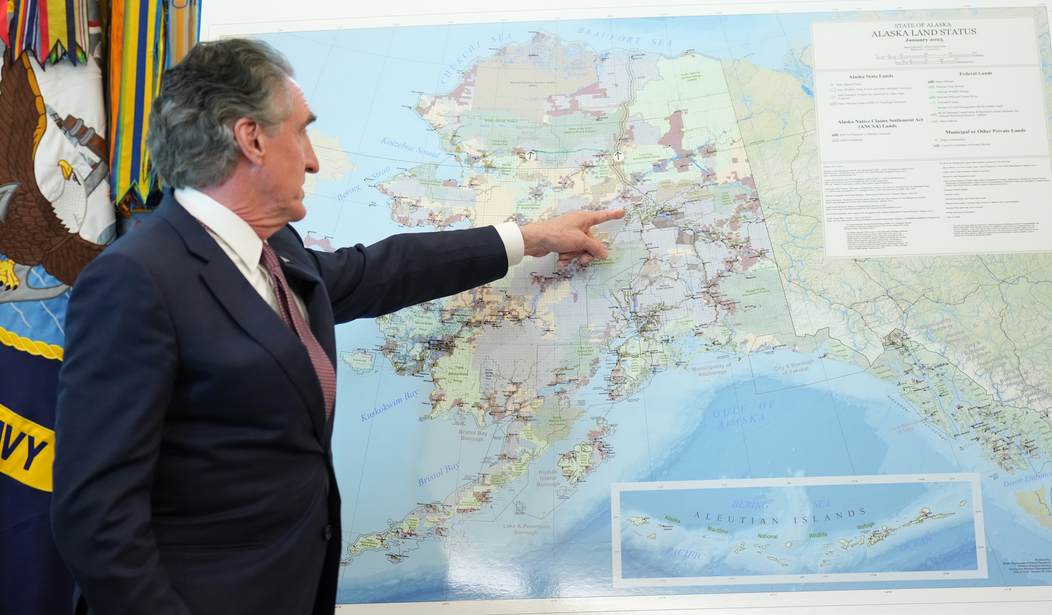

If you've been reading my work for at least six minutes, you will have seen that I'm fond of referring to my state, Alaska, as America's Treasure Chest. We have always had the resources, but for the last half-century or so, Washington has insisted on treating Alaska as a gigantic national park: No mining, no extraction, no way. Since the Trans-Alaskan Pipeline System (TRAPS) was completed in 1977, there's been relatively little energy infrastructure built in the Great Land.
All that has changed since President Trump resumed office. Alaska's potential is being realized, and a big part of that involves natural gas - most notably gas from the North Slope, where the TRAPS begins. There's a lot of gas in the North Slope fields, and willing markets in Asia. That does make sense, and we'll get to why it does in a bit. First, we'll need a new trans-Alaskan pipeline, this one for natural gas, and it presents a mix of challenges and opportunities. Real Clear Investigation's James Varney has some details.
Underneath the glaciers polar bears patrol along Alaska’s North Slope, the decayed bodies of their ancestors who trod there eons ago have left trillions of cubic feet of natural gas, an energy bonanza for the modern world.
That jackpot reservoir has left present-day Alaskans puzzling over how to divide the booty: How much do we need to keep for ourselves, and how much can we export?
The answers lie hundreds or even thousands of miles away, among lawmakers in Juneau, in oil and gas company executive suites in New York and Texas, and in capitals of potential buyers spread across the Asian rim. The solutions are being sought while warfare has erupted against Iran, which makes Alaska’s supply even more attractive, and the pockets of natural gas that state residents currently draw on are dwindling.
OK, the biologist in me is nagging to make one point: Natural gas doesn't come from the bodies of dead animals; it mostly comes from oceanic plants, plankton, and algae. But the jackpot angle is correct; there may be as much as 9 trillion cubic feet of natural gas in the North Slope fields. That's just the resources we already know about. Some estimates run as high as 200 trillion cubic feet. All of it, clean, reliable, high-density.
But how to get it to market? That's where the new proposed pipeline comes in.
“Yet again, Alaskans are wondering why, with a huge amount of North Slope natural gas, we are going to increase our dependence on some of the world’s most unstable regions,” Republican Gov. Mike Dunleavy and former Sen. Mark Begich wrote in the Juneau Empire on March 30. “The answer, in part, is that we have failed to develop our own energy resources.”
Dunleavy’s pitch, which he has been making for more than a year, is for the construction of a natural gas pipeline that would run nearly 800 miles, from the frozen edge of Prudhoe Bay to new processing and shipping facilities on the Kenai Peninsula. At a time when energy demand is growing and energy markets are roiled by instability on several fronts, the pipeline, whose notable backers include President Trump, would seem to come at an ideal moment. Instead, it faces multiple hurdles that illustrate how complex it has become to pull gas from the ground, and how expensive it will be to get it out of such a remote spot and across such a formidable landscape.
“Alaska does need it,” state senator Robert Myers told RealClearInvestigations. “It’s not a done deal yet, but we are definitely seeing some progress.”
We have, after all, done this before.
Read More: Now, a New Look at American Energy and Mineral Wealth
Alaska Mining Built to Last: From Raw Exports to a New 'Made in Alaska' Powerhouse
A new natural gas pipeline would logically run along the existing oil pipeline much of its way. There are some technical complications; oil runs hot in the pipes, so through much of the pipelines' length it runs above ground. A natural gas pipeline could run underground the whole way. The termini of the two pipelines would differ as well. The TRAPS pipeline ends up in Valdez, where tankers take on the black gold to go to refineries in the lower 48. The natural gas pipeline is, according to current plans, intended to end in Nikiski on the Kenai Peninsula, where there is already some infrastructure that can be upgraded to include a gas liquefaction facility. That's tailor-made to cater to Asian customers, especially Japan. Our current energy price shocks, after all, are mostly due to the ongoing mess around the Strait of Hormuz, but Alaska is over a thousand miles closer to Japan than the Strait of Hormuz.
There are some considerable technical challenges, not the least of which is Alaska itself. Much of the Great Land is untamed wilderness. But we already have the right-of-way, as noted. The new pipeline will have to go under the Yukon River, which is a massive, ice-age glacial river, even now, as well as under the Turnagain Arm of Cook Inlet. It won't be quick, and it won't be easy, but it can be done.
We're Americans, after all. If our history has taught us one thing, it's this: If we can imagine it, we can do it.
Here's the catch (there's always a catch). This thing has to be signed, sealed, and underway before January of 2029. We will have a new president on that date, and there is no guarantee that it will be an energy-friendly Republican. We'll be dealing with a new Congress sooner than that, in January of 2027, in fact, but having this locked down by then may be a bit of a stretch.
Alaska's resources are, like the state, vast. The time is now. We have to get this done, for Alaska, for the nation, and for our allies.