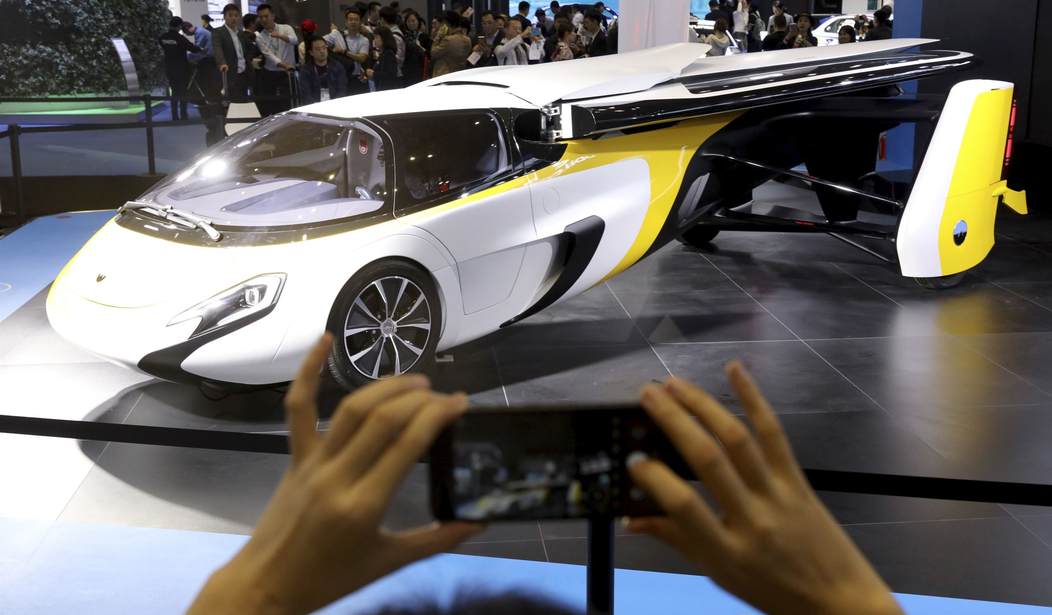

For those of us of a certain age (old), it's hard to invoke the notion of a flying car without having a mental picture of The Jetsons pop into one's mind. But some of the things from George and Jane Jetson's lives have materialized in our real world, even if they are only in the very beginning stages; household robots, for instance. And in the years the original Hanna-Barbera cartoons were still in production, nobody much even imagined anything like the internet or a modern smartphone.
Quite a few companies are messing about with flying cars, but nobody's made a commercially viable one yet; that makes another popular notion, the flying taxi, rather farther out of reach. But some people interested in urban planning are nevertheless floating the idea.
As is so often the case, you may color me skeptical. Even so, the Pacific Research Institute, on Friday, ran an interesting piece on the topic by D. Dowd Muska.
Snicker all you want, but serious people — and deep pockets — are committing considerable resources to making airborne intra-city travel a thing. What the FAA calls Advanced Air Mobility (AAM) — “a collection of new and emerging technologies being applied to the aviation transportation system, particularly in new aircraft types” — could substantially enhance the way urbanites move around. Elected officials, policy wonks and concerned citizens should take notice.
Drones comprise a sizable portion of the AAM phenomenon. Package-delivery from above is already authorized for a number of companies in several cities across the nation. But advancements in fields such as automation and battery storage are pushing safe, affordable, passenger-carrying electric vertical take-off and landing (eVTOL) aircraft closer to viability.
There's a massive difference between a delivery drone and a flying car/taxi, of course: The drone isn't carrying people.
Mr. Muska notes that at least three companies are working on this technology.
In California alone:
- Wisk Aero, headquartered in the Bay Area and backed by Boeing, is developing “the world’s first self-flying, all-electric, four-seat eVTOL air taxi.” The LLC’s “Gen 6 Aircraft” has a cruising speed of 138 miles per hour and its charging time is a mere 15 minutes.
- San Jose’s Archer Aviation boasts that the “unique design expression” of its Midnight vehicle “embodies numerous distinctive features that are harmoniously integrated to form an aircraft that is the first of its kind.” It recently closed a $126 million deal to “acquire control of a one-of-a-kind Los Angeles asset, Hawthorne Airport,” which will “serve as its operational hub for its planned L.A. air taxi network operations, including serving a key role in the LA28 Olympic & Paralympic Games.”
- Joby Aviation, which went public in 2021, is “developing a world-class manufacturing facility in Marina (California)” and has “offices and workshops in Santa Cruz, San Carlos, Washington, D.C., and Munich, Germany.” In November, it announced the inaugural flight of a “turbine electric, autonomous VTOL aircraft,” which “builds on Joby’s fully-electric air taxi platform and integrates a hybrid turbine powertrain along with the Company’s … autonomy stack to deliver greater range and payload capability.”
I can think of several problems with this idea. So can Mr. Muska.
First, as the article points out, this thing will involve government regulation and plenty of it. The FAA will come down on any attempt to implement a commercial flying taxi service like a thousand of brick; if it's allowed at all, the companies trying to offer it will spend wheelbarrows full of money just dealing with the regulatory burden. And, as someone who worked in a heavily regulated industry for 30 years, I can attest that a lot of the cost will lie in validating all the software running these vehicles, validating the engines, and ensuring safety standards for the passengers are met.
Second, Mr. Muska points out something I've been saying for years: If this thing has to be subsidized, it shouldn't happen.
Third, think about the social implications. These things will be expensive to build, maintain, and operate - likely orders of magnitude more so than traditional ground-based conveyances. The fares will likewise be expensive, and there will inevitably be whining about "equity" and how people below a certain income level won't be able to use them, and the whiners will demand subsidies. See above.
Read More: Perils of High Tech: Turns Out You Can't Give a Ticket to a Robot
Woman Delivers While Riding in Self-Driving Robotaxi in San Francisco
Here's my major concern: Infrastructure. These conveyances, should they ever prove safe and practical from an operational standpoint, will have to have places from which to take off and land. For them to be practical, they would have to be able to access most, if not all, of the locations that an automobile can access now. Will that mean building millions of landing/takeoff pads? Will they be compact enough to compete with traditional ground-based vehicles for parking spaces? I can see high-end hotels, perhaps, building rooftop landing pads, but I suspect few businesses will be willing to go this far; the Motel Cheap-Sleep out on the highway won't have such a landing pad.
I feel pretty confident in predicting that we won't see a flying taxi anytime soon.