






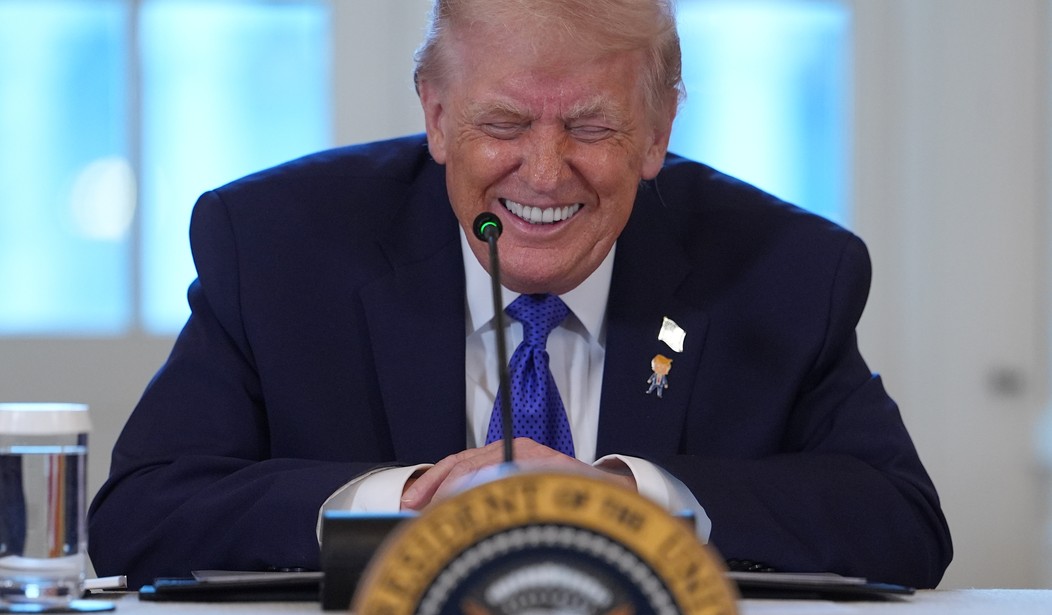
Once in a while, even the notoriously liberal 9th Circuit Court of Appeals gets one right (although we note that the 9th has moderated some since its liberal halcyon days of the '90s.) Now, in a major blow for public-sector unions, the 9th Circuit has ruled that President Trump can go ahead with stripping collective bargaining rights from thousands of government employees. That's good news.
A federal appeals court will allow the Trump administration to end collective bargaining rights for thousands of government employees, in a blow for public-sector unions.
The Ninth Circuit panel's decision allows the administration to proceed with an executive order that allows some federal agencies to cut union ties for national security reasons.
Six unions representing about 800,000 federal civilian employees sued the administration last year, alleging violations of the First Amendment. A lower court previously found that President Donald Trump's order was designed to retaliate against unions. However, the Ninth Circuit panel ended that preliminary injunction.
The panel noted that Trump's executive order, issued in March 2025, was "the largest single effort to date to exclude agencies and subdivisions from collective bargaining on national security grounds."
Here's the thing: In the private sector, unions are fine, as long as any voting done for or against unionization is fair and anonymous — no intimidation to those who vote "no," which we have seen happen too often. But the public sector is different. These are people paid by the taxpayers; they are our employees, not private companies, and it's far too easy for the unions to throw heavy-handed support behind the very politicians who ensure that the unions have a monopoly on government employment. The public-sector unions are far too often at odds with the actual mission their members are tasked with carrying out; just look at the teachers' unions, who have done more harm to American education than any other single group of people.
There's a catch (there's always a catch):
The three judges considered only whether the lower court's injunction should remain in place while the case continues. The panel did not determine if the Trump administration overstepped its legal authority.
"Today's ruling is not a final decision on the legality of this Executive Order," said Everett Kelley, the national president of the American Federation of Government Employees. "The court addressed only whether a preliminary injunction should remain in place while litigation continues. This case is not over. The merits of this case are still very much alive."
Kelley said the unions are considering options and would "continue to build our case and pursue every legal avenue available."
Ongoing, then, but this decision is still a step in the right direction.
In 1937, Democrat President Franklin Roosevelt wrote:
All Government employees should realize that the process of collective bargaining, as usually understood, cannot be transplanted into the public service. It has its distinct and insurmountable limitations when applied to public personnel management.
The very nature and purposes of Government make it impossible for administrative officials to represent fully or to bind the employer in mutual discussions with Government employee organizations.
President Roosevelt was correct then, and President Trump is correct now to continue the effort to clamp down on this practice, which "...cannot be transplanted into the public service."
This case is still ongoing. Stay tuned. If you want to read the entire decision, you can view it here.
⚖️ In American Federation of Government Employees, AFL-CIO v. Trump (rescission of collective bargaining), 9th Circuit Court of Appeals VACATES district court preliminary injunction. https://t.co/0BmMpaljNB
— Susie Moore ⚾️🌻🐶 (@SmoosieQ) February 26, 2026
Editor's Note: President Trump is leading America into the "Golden Age" as Democrats try desperately to stop it.
Help us continue to report on President Trump's successes. Join RedState VIP and use promo code FIGHT to get 60% off your membership.

Join the Conversation
VIP members get the ability to comment on articles.