






Very, very carefully.
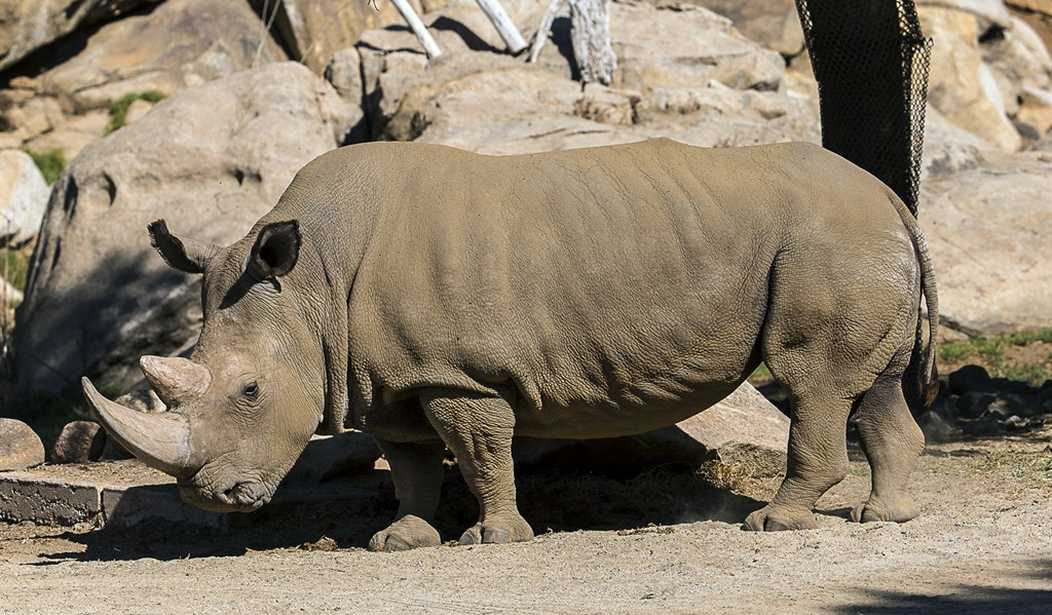
White rhinos (Ceratotherium simum) are big creatures; in fact, they are the largest living rhinos. An adult male can be 13 feet from nose to tail, stand 6 feet at the shoulder, and may weigh in at two to two and a half tons. They have thick skin and an irascible disposition.
They are also critically endangered. There just aren't that many of them around. So, when one has a dangerous parasitic eye infection and is in danger of going blind, medicating it is a challenge. Fortunately for a bull rhino in Zimbabwe, local wildlife workers were up to the challenge.
Corralling a wild rhinoceros into a small chute to give it eyedrops might seem like a crazy plan. But if it’s crazy and it works, then it’s not crazy.
Animal behaviorists partnering with the Palm Beach Zoo & Conservation Society in Florida traveled to Africa in August to help an endangered white rhino with a life-threatening, parasitic eye infection.
Daniel Terblanche, a security manager with Imvelo Safari Lodges, said no one in Zimbabwe would have come up with the plan.
“Believe me, we didn’t think of it; it was a completely ridiculous idea to us,” Terblanche said. “But without trying all of the things that we could to rectify that situation, we would have been in trouble, I think.”
So, what was the plan? Simply something that would not be out of place in my late uncle's livestock auction barn, where we had a very similar setup for confining cattle, even large bulls, to medicate or otherwise deal with them. Keeping big, powerful animals tightly confined in such instances is important; I still have dents in the toe bones of my right foot from a time I stupidly went in a pen with a Black Angus steer, and the steer came around to stand on my foot, leaving me to beat helplessly on his flank until my brother came along, grabbed the steer's tail, and pulled it off my foot.
That probably wouldn't work for a rhino. But the one the Zimbabweans came up with did, and it looks like it's going to be a happy ending.
“Within about a week, we were actually putting the eye drops strategically in his eyes while he held for it,” Lacinak said. “And by the end of two weeks, we had transferred that skill set to not only Daniel, who was in charge of leading their guards, but to the guards.”
The conservation status of southern white rhinos is listed as near threatened, with about 16,000 animals living in the wild. Poaching and habitat loss remain significant sources of danger. So while Thuza and other rhinos continue to face challenges in the wild, at least the animal’s eyes have been protected.
“They’re consistently getting the medications into his eyes every day,” Lacinak said. “And the rhinos are just thriving now and they feel really, really confident that this solved their problem.”
Good news. And, well done.
Read More: Happy Skunky Valentine's Day!
The Curious Case of the Alcatraz Coyote
Rhinos are not only big and charismatic, but they are also an ancient lineage. At one point, various kinds of horned and hornless rhinos were found on pretty much every continent, save Antarctica. The largest land mammal ever was a hornless rhino, native to the Oligocene in what's now Mongolia; a creature called Paraceratherium. These beasts were really big, weighing in as much as 12 tons. Now, in Africa, there are only two, these white rhinos and the Black Rhinoceros (Diceros bicornis).
This rhino gets a happy ending. Let's hope as much for the species.
Editor's Note: President Trump is leading America into the "Golden Age" as Democrats try desperately to stop it.
Help us continue to report on President Trump's successes. Join RedState VIP and use promo code FIGHT to get 60% off your membership.



Join the Conversation
VIP members get the ability to comment on articles.