
The New START treaty, the last major nuclear arms control agreement between the United States and Russia, has expired as of last Thursday. Now that there are no more major deals on nuclear weapons between the USA and Russia, both countries are free to build as many nukes as they want - not that they weren't in any case. These kinds of agreements often aren't worth the paper they were printed on, especially where Russia is concerned.
As a result of this, it seems more Americans are getting agitated over the possibility of a nuclear exchange between the USA and Russia. I find that unlikely, but that's just me; plenty of Americans seem to disagree, according to a new Issues & Insights/TIPP poll.
Americans have lived with the threat of nuclear war for more than seven decades, yet the deadly weapons get little serious attention outside of wonky policy circles. But, as a major U.S.-Russia nuclear weapons agreement expires and nuclear talks with Iran continue, most Americans show real concern about the threat of nuclear war, the latest I&I/TIPP poll shows.
My friend, fellow veteran and colleague streiff covered the demise of that treaty:
Read More: The New START Treaty Violated All 'America First' Principles and It Needs to Die
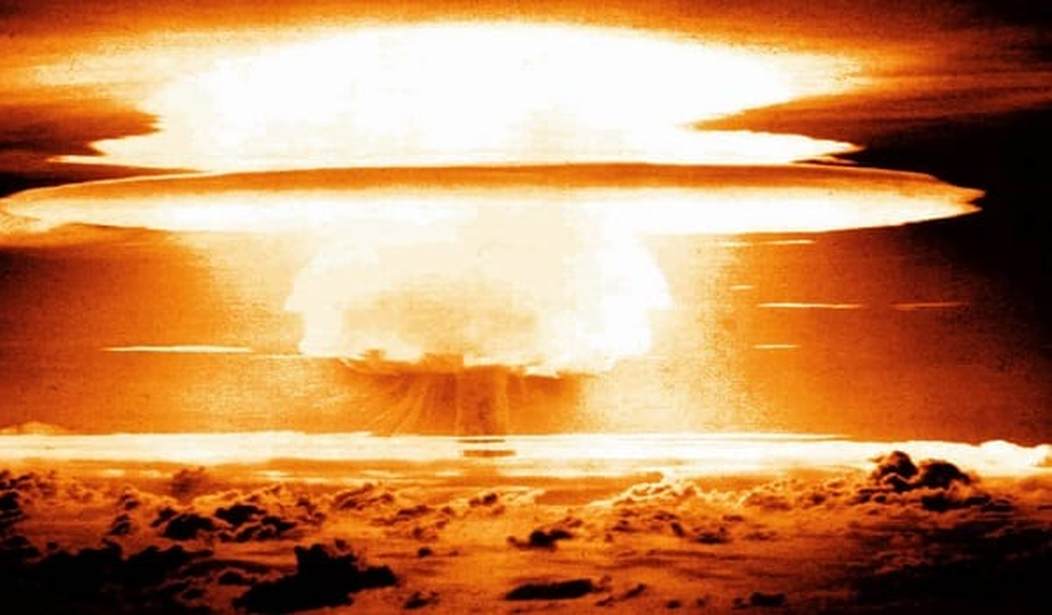
Nobody wants to see Russia and the United States tossing hot rocks at one another, and such an exchange between the USA and Russia, or the USA and China, or the USA against All of the Above, has the potential to be a civilization-ending event. If everyone just starts launching, if the arsenals are empty and 20-30-megaton crowd-pleasers start dropping on major cities and strategic targets, there may be few survivors. Of course, in 10-20 million years, things will be back to whatever passes for normal, most of the signs of the exchange will be gone, and humans will probably be gone, too.
It's a legitimate worry, and the I&I/TIPP poll reflects that.
For the February poll, I&I/TIPP asked four questions related to the nuclear threat. The first asked: “How concerned are you about the risk of nuclear conflict involving the United States, Russia, or China?”
By 2-to-1, or 62% to 31%, Americans said they were either “very concerned” (27%) or “somewhat concerned” (35%) about nuclear conflict, while 20% responded they were “not very concerned” and 11% said they were “not concerned at all.” Another 7% were not sure.
While a majority of all three political identities agree nuclear war’s a threat, there are some differences. Democrats are most worried, with 75% calling themselves concerned, and just 19% not concerned. Some 54% of Republicans expressed concern, while a hefty 42% said they weren’t concerned. Independents broke basically along the overall average: 60% concerned, 32% not concerned.
Of the weapons of mass destruction (WMD) triad, though, nukes may not be the worst.
That triad is known by the Army (or at least, it was in my service years) as Nuclear, Biological, Chemical, or NBC. We used to call them "nukes, gas, and bugs," and of the three, it's bugs, not nukes, that purely scare the kapok out of me. Here's why, and I'm going to tell you.
First, nukes: These are nasty, horrible, and in a full-blown, Katie-bar-the-door exchange, may leave only a few thousand humans alive in a radiation-soaked hellscape. But here's the thing about nukes: Once they go off, once the surface-of-the-sun heat and blast wave is over, the worst has passed. Lingering radiation will still kill many, but it's the explosion that does the worst damage.
Second, gas: There are a lot of different kinds of chemical weapons. Some (CS, or tear gas) are just temporary. Some, most notably nerve agents like VX, can kill by a pinhead-sized drop on bare skin. Some will persist for months, even years in sheltered places like the undersides of fence rails and tree branches; others break down in hours or even minutes. Again, once they are deployed, things pretty much immediately start to recover.
Third, bugs: As a biologist, these are the ones that scare my socks off. Bugs mutate and adapt. They self-perpetuate. They breed, infect, kill, and move on. They increase. They expand. They are deployed, then they self-deploy. There will always be a few resistant survivors, but they will likely be sickly, weak, and in a landscape littered with corpses, with all the comforts and benefits of modern society - gone.
What's really troubling is the number of illegal bio-labs being uncovered around the United States, right now, too often operated by Chinese nationals, forcing us to ask, "To what end?"
Read More: White Coat Waste Uncovers NIH's Dangerous New Biolab Incident
Feds Seize 1000 Samples From Illegal CCP Biolab in Las Vegas Owned by Defendant in Reedley Case
People are right to be concerned about nuclear weapons. The one break we've gotten in this is that the nations that are the primary nuclear powers, including the United States, Russia, and China, aren't altogether insane. They want there to be a nation-state, a home, that is still viable after any conflict.
But a nation like Iran? Not so much. If the mullahs get a nuke, they'd use it.
President Trump and the Trump administration have made rebuilding our military a priority, and that's the only thing that may deter an enemy willing to toss nukes, gas, or bugs at us. That's the needful act; the only way to deter any such attack is the assurance that we can do unto them as they've done unto us, only more so.
It doesn't hurt a bit to have them know that we can jack them up without resorting to weapons of mass destruction. That, too, is a good capability to have.