
The History
World War 2 saw a lot of innovations, a lot of technical breakthroughs. The first jet aircraft flown in combat, the first airborne radar, and the first naval battles fought primarily by aircraft, wherein the opposing ships were never within visible range of one another.
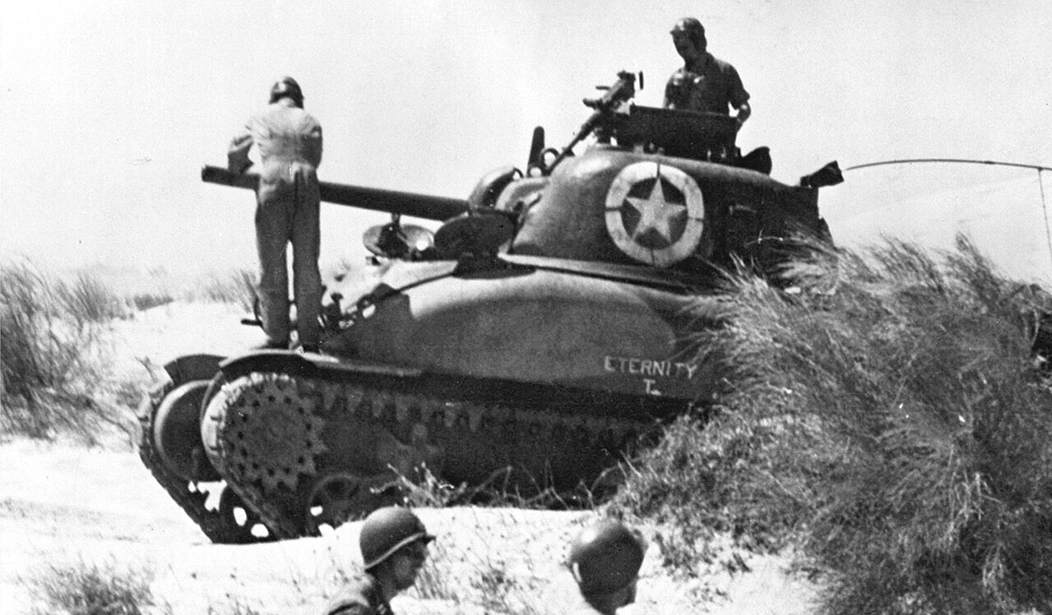
It was also a war that made generous use of armor. The tank, which barely had an impact on the Great War, came into its own in World War 2. The Germans, in particular, built some amazing machines, but in the end, they proved unable to keep up with American industry, and one of the most under-sung and underrated tanks of the war: The American M4 Sherman.
Developed on the same chassis as the older M3 Lee tank, which mounted its big gun in an awkward sponson on the side of the hull, which looked like it was taken off a ship, the M4 was something different. It was made to be mass-produced. The Sherman’s original 75mm gun was… OK. Its armor? OK. Its engine? OK. Put one Sherman up against a Panther or Tiger, and you had a dead Sherman, especially if the contact was at range.
But against five Shermans? Or six? Or 10? There is an apocryphal quote from a German general who faced Shermans in France, who said, “One Tiger or Panther is worth five Shermans. The trouble is the Americans always have six.”
German tanks were technologically advanced, but they were complex and often unreliable. German tank factories were, yes, producing masterpieces, but not so many of them. Meanwhile, American industry was doing the mid-20th-century equivalent of 3-D printing tanks. It was made to be made, and we made a lot of them.
The Design
The Sherman was designed not only to be manufactured but to be maintained. It did have some serious technological advantages over even the late-war German tanks, namely a synchromesh transmission with helical gears that was smoother than the German transmissions and which lasted longer. By late in the war, Germany was running low on, well, everything, including raw materials and the specialized machine tools made to turn out these kinds of transmissions. It wasn’t a matter of know-how; it was a matter of capacity. This enabled the Sherman to travel greater distances under its own power than German tanks. It increased their readiness.
A medium tank that’s moving and shooting is better than a technological masterpiece that’s sitting still with a shelled-out transmission, and that was the first great edge the Sherman had.
Another thing that the American industry gave the Sherman was one of the first gyroscopic gun stabilizers. This wasn’t as capable as modern stabilizers, which allow modern tanks like our Abrams to shoot while moving at high speed and put steel on target. But the Sherman’s stabilizer did allow an American crew to get an aimed shot off at a bad guy within a second or two of the tank coming to a stop. German tanks, lacking this stabilizer, had to wait five or six seconds for the suspension to quit rocking before shooting.
Getting that first shot off counts for a lot. That was the second great edge the Sherman had.
One common criticism of the Sherman was its main armament. The first Shermans carried a 75mm, short-barreled gun that had a low muzzle velocity. This gun couldn’t penetrate the frontal armor of a Panther, a Panzer IV, or a Tiger. In close quarters, if the American crew could get a clear shot at a German’s rear or side, a Sherman with the 75mm gun could knock out the enemy tank.
But in July of 1944, more than a month after D-Day, the first M4A1 tanks arrived in Europe. These new Shermans had a lovely gun, a high-velocity, long-barreled 76mm gun that could punch through German armor. This gave the American crews a gun that was on a par with the guns on a Panzer IV. It wasn’t quite up to taking on a Tiger, but later that year, new armor-piercing ammo with a tungsten penetrator was sent forward, and the Sherman crews found themselves on better footing, even at range. That was the third great edge the Shermans had.
Read More: NATO Boss Warns 'Dreaming' Europe to Wake Up, Says 'Good Luck' Going Without US Military Support
Finally, the Sherman was, as noted, not just designed to be manufactured, but designed to be maintained. An engine change could be done in a couple of hours. The engine and transmission were accessible through bolted-on hatches. The suspension was simple, and the track rollers and suspension arms were separate units, and mounted outside the tank’s armor; if one was hit, it could be removed, replaced, and the tank could be back on the road in record time. A tank that is moving and shooting, again, always beats a tank that is busted and stationary. This was the fourth great edge of the Sherman.
But it was the production that counted.
The Fight
The German armored forces knew they had better tanks. But one captured Sherman was examined and operated by German tank designers, and they were appalled at what they saw. It was a tank that was OK. Its gun was OK, its armor was OK; all of it was just, well, medium. But it was reliable. “You push the button,” one German tank engineer said, “…and it starts.” It ran for long periods without the need to overhaul a persnickety transmission or replace an engine. And the Americans just kept sending them.
The Sherman was also designed to be easily loaded aboard a ship, designed to be able to cross the Army’s standard Bailey bridge, and it was designed to be moved – and the American industry just kept on making them. From 1942 to 1945, almost 50,000 Shermans were built. They weren’t extraordinary, but they just kept coming; a German tank could knock out five Shermans, but ten more would be coming, and the Panther or Tiger was just as liable to blow its transmission when they finally decided to pull back, while the Shermans just kept coming. Quantity has a quality all its own, and that, perhaps, was the Sherman’s greatest edge.
Read More: Europe Now Sending Overwhelming Force of 34 to Defend Greenland
The lessons of the Sherman tank are lessons we would do well to take to heart today. The greatest technological marvels in the world are not much good if they can’t be replaced, if they can’t be built in quantity. That’s the lesson World War 2 taught the world. It’s a shame that we seem to have forgotten so many of the lessons from that war.