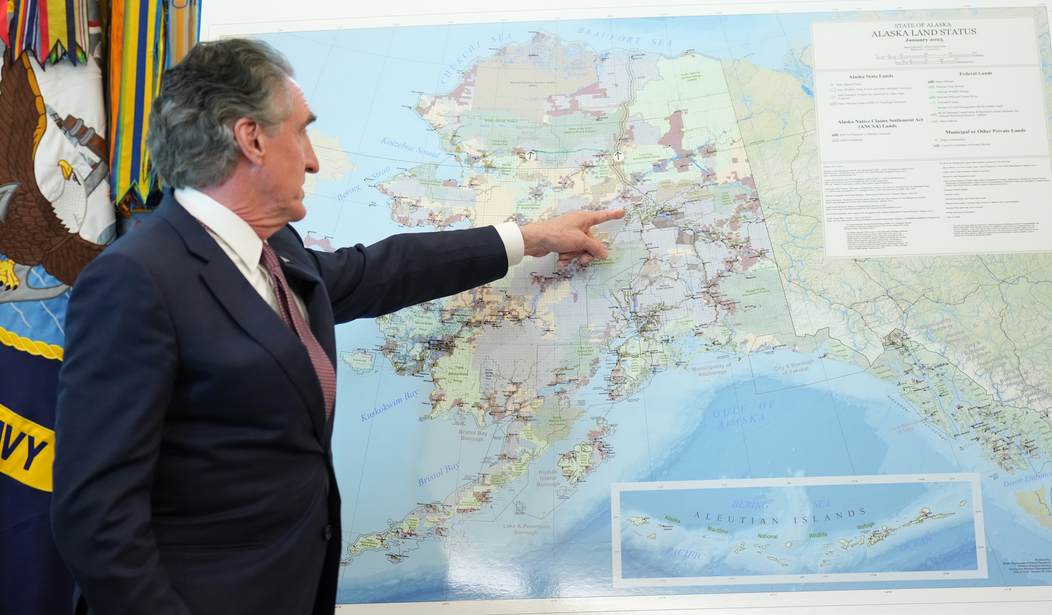

Alaska is, as I have written many times, America's treasure chest. Oil, gas, rare earth minerals, silver, gold - it's a land that would make Yukon Cornelius beside himself with joy. Of course, a lot of these resources aren't where they are easy to get to. The Trump administration is moving to help with that, with things like the Ambler Road project.
But under the ocean? That's a whole different problem. Offshore mining presents difficulties, both technical and environmental, but that doesn't mean it's not worth pursuing.
Just off the Alaskan town of Nome, offshore mining is already taking place. The Alaska Division of Mining, Land, and Water has this to say about it:
Nome, Alaska is located on the Seward Peninsula and is not accessible by road. This means all material must be barged or flown in. There are many mining opportunities offshore off Nome in Norton Sound including two public mining areas, 89 offshore leases tracts, and numerous mining claims. There are currently no available offshore mining leases.
That may be changing. The Trump administration is looking to open up leasing for offshore mining.
The U.S. Department of the Interior’s Bureau of Ocean Energy Management said Tuesday it will soon release a formal “call for information” about possible sales of leases for minerals mining in federal waters off Alaska. The call for information will kick off a 30-day public comment period allowing industry to express interest in such a lease sale.
“Alaska’s offshore holds strategic potential for the minerals that drive American industry, defense and next-generation technologies,” Matt Giacona, BOEM’s acting director, said in a statement. “This Request for Information is a practical first step to gauge interest and identify areas where development could make sense for jobs, investment and national supply chains.”
The push for offshore minerals mining “supports the Trump Administration’s focus on strengthening domestic supply chains and advancing American energy and resource leadership,” the BOEM statement said.
The mining off Nome has historically been gold mining, looking for gold from the same sources as the famous gold sands of that area. But, as we might suspect, there is already environmental opposition - and some opposition from the people who make their livings from Alaska's fisheries. These folks are worried in particular about the halibut and crab fisheries, as these are bottom-dwelling species that may be most affected by any disturbance from mining.
The idea of underwater mining in federal waters drew quick opposition from environmentalists.
“This step toward offshore mining shows that the Trump administration only sees Alaska’s vibrant seafloor as an extraction zone for corporate profit,” Cooper Freeman, Alaska director at the Center for Biological Diversity, said in a statement. “The health and vitality of Alaskan coastal communities are deeply tied to a healthy ocean. Destroying the seafloor by mining puts the entire marine food web in grave danger, from walruses and bearded seals to crab and halibut.” That, in turn, threatens Alaska traditions and economies, he said.
Here's the thing: This isn't a new technology. Offshore mining has been going on long enough off the Alaskan coast that there has even been a reality TV show about it.
Read More: Alaska's Pebble Deposit: From Discovery to New Critical Security Asset
Soaring Prices Fuel Alaska's Mining Renaissance – Gold Hits $4,500/oz
In this case, the environmental concerns are legitimate. Alaska's fisheries are a vital part of the state's economy, and any impact on those fisheries should be looked at. Even so, for crying out loud, we are the United States of America. We can pass gas and chew gum at the same time, and we can have a reasonable amount of offshore mining and yet have our halibut and crab fisheries. Alaska has more coastline than all of the states of the lower 48; that gives us a lot of room. The mineral wealth here is also considerable, including not only gold but tin and platinum and, in deeper waters, cobalt, nickel, rare earth elements, tellurium, lithium, molybdenum, manganese, copper, zinc, iron, and silver.
That's a lot of value, sitting deep under water. Its value is worth exploring; in what Robert Heinlein called the "ungrokkable vastness of ocean," there is room for both mining and fishing.
There's another thing to consider. Extraction technologies, as they are used, as they are developed, refined best practices emerge, and the processes become cleaner and less intrusive. Part of this is because, yes, we really do care about the environment, just not to the point where we will return to a 19th-century lifestyle over it. More so, though, is because efficient practices, processes, and equipment are also cleaner practices, processes, and equipment. T'was ever thus; that's how it has worked in everything from automobile manufacturing to oil drilling, and that's how it will work here, too.
Note as well that Russia and China are almost certainly looking into this same resource, and that Russia controls half of the Arctic Ocean coastline.
This is something the Department of the Interior needs to look into, seriously and soon.