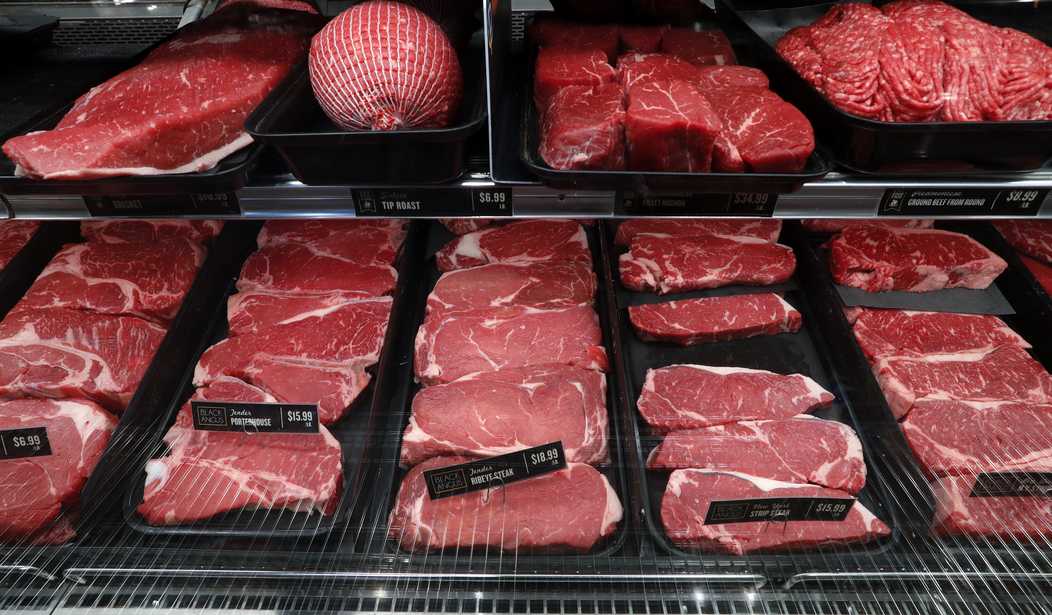

On Wednesday evening, my wife and I enjoyed a rare treat, courtesy of our daughter in eastern Iowa: a couple of nice, thick, Iowa Black Angus t-bone steaks, grilled to perfection and served with a side of buttered potatoes. My Dad raised Black Angus cattle for many years, so I feel an odd loyalty; also, you just can't beat rich, tender Black Angus beef. And Iowa beef is available here in the Great Land, but boy howdy will it set you back some.
Here in the United States and elsewhere, the thinking on diet is changing, as it always has, and always will. And, as with any issue, there are scolds with an agenda to push when it comes to diet; in this case, there is a subset of vegans who can be downright annoying. They overlap with the climate scolds, which makes them even more annoying. But here's the good news: The whole thing, the "ethical vegan" craze, seems to be subsiding. Even in the United Kingdom.
Maybe the UK hasn't yet gone completely daffy.
Perhaps nothing represented Britain’s vegan craze more than the launch of Greggs’ meat-free sausage roll.
Released by the bakery chain in January 2019, the vegan alternative was so popular that it was regarded in some corners of the internet as the UK’s cultural moment of the year.
However, seven years later, it appears the vegan revolution is running out of steam, with some joking on social media that life has just become too depressing to swear off meat.
Signs of veganism’s decline appeared in a recent report by the Good Food Institute Europe, which found that sales of plant-based food in Britain fell by 4.5pc to £898m in the year to January 2025.
Separate data from NIQ show that the share of households buying plant-based meat alternatives at least once a year has waned since 2022, with the organisation highlighting a shift in “flexitarian shoppers back into animal-based proteins”.
I would just like to point out that a "meat-free sausage roll," well, isn't a sausage roll at all.
It's happening here in the United States, too:
Sales of chilled and frozen meat alternatives fell by around 21% in the year to June 2024, compared to two years prior, according to consumer intelligence firm NIQ. The decline isn’t limited to just purchases, either. Google search trends show that interest in terms like “veganism,” “vegan diet,” and “vegan recipes” peaked in late 2019 and early 2020, steadily declining in the years since. It’s no surprise, then, that there has been a 29% drop in the number of people identifying as vegan over the past two years, according to research from consumer insights platform GWI.
If it weren't for the annoying tendencies of scolds, there's an old joke, "How do you know if there's a vegan at your party? He'll tell you," - we would look at these figures and shrug.
Read More: Potato Blind Spots to Milk Myths: What People Don't Know About Food
Udder Madness: Europe Is Now Poisoning Cows for a Methane Myth
People are, after all, free to eat what they like. Most of us do make some effort to partake of a healthy diet, but a healthy diet for humans generally includes meat or other animal proteins like eggs and dairy. It's possible to have a healthy diet with no animal protein, but it isn't easy, and it takes a lot of research and planning.
Now, for the purposes of this discussion, please note that I'm not talking about vegetarians/vegans who eat that way because they simply prefer it, or because of some medical condition that a plant-based diet mitigates; there are some. I'm talking about the scolds, the vegan activists who claim that their diet "results in zero animal deaths." That, of course, is the purest of horse squeeze. Animals are killed in untold millions during plant agriculture. Some are killed accidentally in the course of mechanized farming; some are killed deliberately during pest control. Animals are killed every day.
Every potato, every stick of celery, every cup of rice, and every carrot comes with a blood trail. Rational people know this and don’t worry about it. It’s an inevitable consequence of modern, high-production agriculture. The ethical vegan, when confronted with these facts, collapses. Their reaction, in almost every case, is to do a rhetorical lateral arabesque into a new claim that their vegan diet somehow causes “less death and suffering” than a non-vegan diet, a ridiculous and unsupportable argument. This is why the claims of these people do not describe any statement of ethics or principle, just a silly, easy rule that doesn't really take any effort: "Don't put animal parts in your mouth."
That may well be part of the reason why the movement is collapsing. And collapsing it is; the percentage of the American population calling themselves vegan has dropped from 3 percent in 2018 to 1 percent in 2023.
We might note also that the United States Department of Health and Human Services has retooled the famous "food pyramid" to emphasize animal protein at the top, not the bottom.
Here's the thing: Nobody should care what anyone else eats. But human biology makes it pretty clear that we are omnivores. Our teeth are, as mammals go, undifferentiated; no carnassial teeth, no seizing fangs, no CP3 honing complex. Also, we have no batteries of grinding teeth for dealing with rough vegetation. We lack the short gut of an obligate carnivore or the big fermenting tank of a stomach that obligate herbivores carry around. We can eat almost everything except the coarsest vegetation and get some nutritional value from it; the human digestive system is basically a garbage disposal.
So, eat what you like. And if you're enjoying a meal and one of the declining numbers of ethical vegan scolds decides to bug you about it, just ask them to please pass the pork chops.