








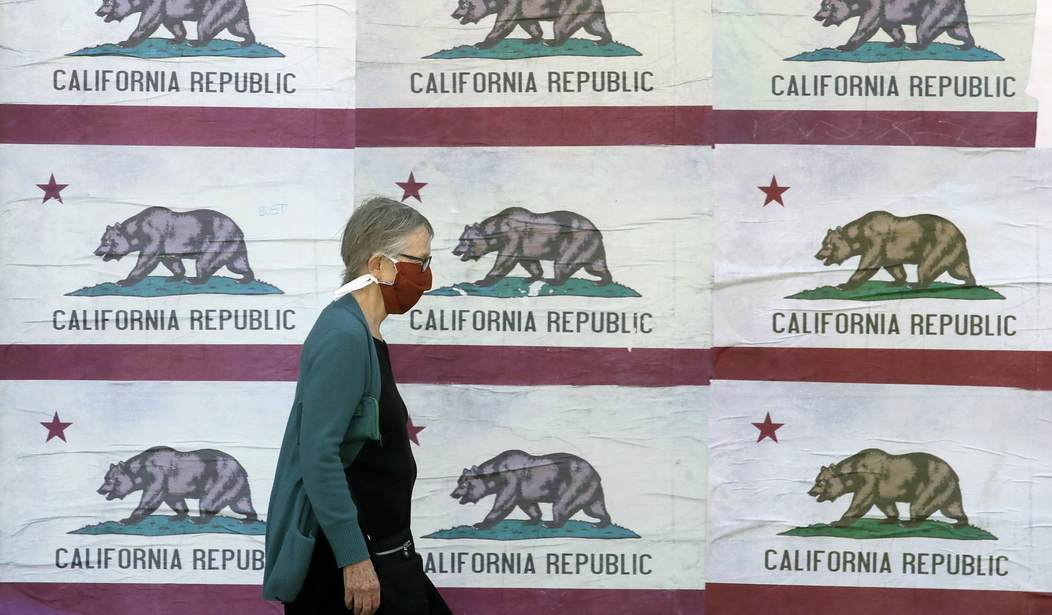
Remember 2020, the halcyon days of mask mandates? I was working in New Jersey when the entire COVID panic started, and one would have thought the very air had turned radioactive. Many people accepted it as a silly necessity, but there are always those who take things to a ridiculous level. We all remember the sights of people driving alone, in their personal cars, wearing masks, or walking alone, outside, on a sunny day, again wearing a mask.
That's OK. I've always thought that stupid people should be conspicuous.
Sanity may be returning, here and there. Now, at Oxford University, former double-mask advocate Professor Trish Greenhalgh has changed her tune on masks:
A leading proponent of face masks as a means of countering the spread of respiratory infections appears to have changed her mind. Professor Trish Greenhalgh, University of Oxford – described as the “high priestess” of the face mask movement, who even appeared on her X feed wearing two face masks during the COVID-19 years – has endorsed a letter to the WHO in which it is claimed, as reported in the Guardian, “There is ‘no rational justification remaining for prioritising or using’ the surgical masks that are ubiquitous in hospitals and clinics globally, given their ‘inadequate protection against airborne pathogens’.”
This is a remarkable volte-face by Professor Greenhalgh whose adherence to the face mask ideology seemed, at times, to defy both logic and the best principles of evidence-based medicine. Once a leading proponent of evidence-based medicine with many entries of her own in the Cochrane Library – the repository of gold standard systematic reviews of clinical evidence including on face masks – she was reported once as saying that “too much weight on evidence-based medicine can be the enemy of good policy”.
It's not the great turnabout it seems. A group of experts recently sent a letter to the World Health Organization advocating, not masks, but actual respirators. (The letter was noted in an article shared in the Bloomberg School of Public Health at Johns Hopkins University's daily newsletter.)
While the above pivot would appear to be good news, sadly it is not all that good. And the bad news is revealed in Global Health Now, the daily newsletter of the Bloomberg School of Public Health at Johns Hopkins University, dated January 12th. The Guardian article, containing a link to the letter, is headlined: ‘Face masks “inadequate” and should be swapped for respirators, WHO is advised’. The letter was addressed to WHO chief Dr Tedros Adhanom Ghebreyesus and the recommendations apply only to clinical staff in hospital environments.
The letter to the WHO chief is titled ‘A Call for the Universal use of Respirators in Healthcare’. In it, the signatories say that as COVID-19 “continues to circulate globally and to mutate” that the WHO must “support equitable access to certified respirators globally”.
Professor Greenhalgh signed on to this latter as an endorser.
Now, note the above mention of the Cochrane Library; that's relevant, and here's why. This is what actual science looks like. This study, titled "Physical interventions to interrupt or reduce the spread of respiratory viruses," provides actual evidence, and the thumbnail is that surgical and medical masks showed no effectiveness, and that N95 masks and respirators didn't produce a benefit to outweigh the discomfort of wearing them.
On masks, the study concluded:
Wearing masks in the community probably makes little or no difference to the outcome of laboratory‐confirmed influenza/SARS‐CoV‐2 compared to not wearing masks (RR 1.01, 95% CI 0.72 to 1.42; 6 trials, 13,919 participants; moderate‐certainty evidence). Harms were rarely measured and poorly reported (very low‐certainty evidence).
For N95 masks and respirators:
The use of a N95/P2 respirators compared to medical/surgical masks probably makes little or no difference for the objective and more precise outcome of laboratory‐confirmed influenza infection (RR 1.10, 95% CI 0.90 to 1.34; 5 trials, 8407 participants; moderate‐certainty evidence). Restricting pooling to healthcare workers made no difference to the overall findings. Harms were poorly measured and reported, but discomfort wearing medical/surgical masks or N95/P2 respirators was mentioned in several studies (very low‐certainty evidence).
Want to know what made a difference? Something medical professionals and any rational person know: Washing hands.
Pooled data showed that hand hygiene may be beneficial with an 11% relative reduction of respiratory illness (RR 0.89, 95% CI 0.83 to 0.94; low‐certainty evidence), but with high heterogeneity. In absolute terms this benefit would result in a reduction from 200 events per 1000 people to 178 per 1000 people (95% CI 166 to 188). Few trials measured and reported harms (very low‐certainty evidence).
That's how you do it. This is the kind of rational analysis that should have been done in 2020, and we might remember, as late as 2023, we were still arguing the whole "mask mandate" horse squeeze.
Read More: GOP Senator JD Vance to Introduce Bill Banning Federal Mask Mandates
It Sure Looks Like Mask Mandate and Vaccine Requirement Plans Are in the Works
These kinds of policy decisions, be they made by academia, by government, or by individuals, should be based on evidence. The Cochrane study here produced evidence. Professor Greenhalgh would do well to give it another look.
Editor's Note: This article was updated post-publication to clarify the source of the letter directed to the World Health Organization.
Editor’s Note: Do you enjoy RedState's conservative reporting that takes on the radical left and woke media? Support our work so that we can continue to bring you the truth.
Join RedState VIP and use promo code FIGHT to receive 60% off your membership.


Join the Conversation
VIP members get the ability to comment on articles.