
The key to prosperity, for any nation, anywhere on the planet, is reliable, affordable energy. That doesn't just include electricity, although that's vital. It also includes gasoline for cars and trucks, diesel fuel for trucks and railroads, and natural gas for heating and cooking. The extraction and refining of petroleum also provide many fringe benefits; many raw materials are derived from petroleum, from plastics to pharmaceutical precursors.
You can't have prosperity without affordable energy, and despite the increasingly strident claims of the climate scolds, their "green" energy schemes just aren't cutting it. It's one thing if they try to foist that stupidity on the developed world; we have decades of traditional infrastructure to rely on. But in places like Africa, still struggling to enter the 20th century, never mind the 21st, the efforts of climate scolds are particularly harmful.
One African billionaire and entrepreneur has run roughshod over the scolds. His name is Aliko Dangote, and he's working to run a pipeline from Walvis Bay in Namibia, through Botswana, to Zimbabwe. Vijay Jayaraj is a Science and Research Associate at the CO2 Coalition, and he has some interesting details to share.
Having already industrialized through the use of fossil fuels and enjoying full bellies, stable power grids, and unprecedented luxury, the so-called elite of the developed world present a “low-carbon” economy as morally superior. African nations are pressured to use “sustainable” energy sources—mostly wind and solar technologies—to effectively prevent the development of the Dark Continent’s rich deposits of coal, oil, and natural gas and engender dependence on foreign governments.
Now, when an African entrepreneur moves decisively to break the chains of this dependency, the climate crusaders are revealed not as guardians of the planet, but as guardians of geopolitical control.
In November 2025, Aliko Dangote, Africa’s richest businessman, signed a $1 billion development agreement with Zimbabwe’s president, Emmerson Mnangagwa, to build a 1,300-mile fuel pipeline stretching from Walvis Bay in Namibia through Botswana to Bulawayo in Zimbabwe. Teams are working on routing, logistics, land procurement, and regulatory details.
The project is Zimbabwe’s government policy, and the pipeline has become the country’s moral imperative. To understand why, we must look at the catastrophe of the status quo.
To say that Zimbabwe is, at the moment, a hot mess is to do a grave disservice to other hot messes all over the world. Coming off the disastrous regime of the thuggish Robert Mugabe, Zimbabwe is trying to recover from decades of mismanagement that drove what was once southern Africa's breadbasket to one of the poorest nations on the planet.
Aliko Dangote knows that the only way Zimbabwe will recover to any semblance of prosperity is with affordable, reliable energy. That's what he's seeking to deliver.
Read More: Green Dreams Delayed - Fossil Fuels Now to Dominate to 2050
Climate Colonialism: Western Climate Scolds Campaign Against Energy for Africa
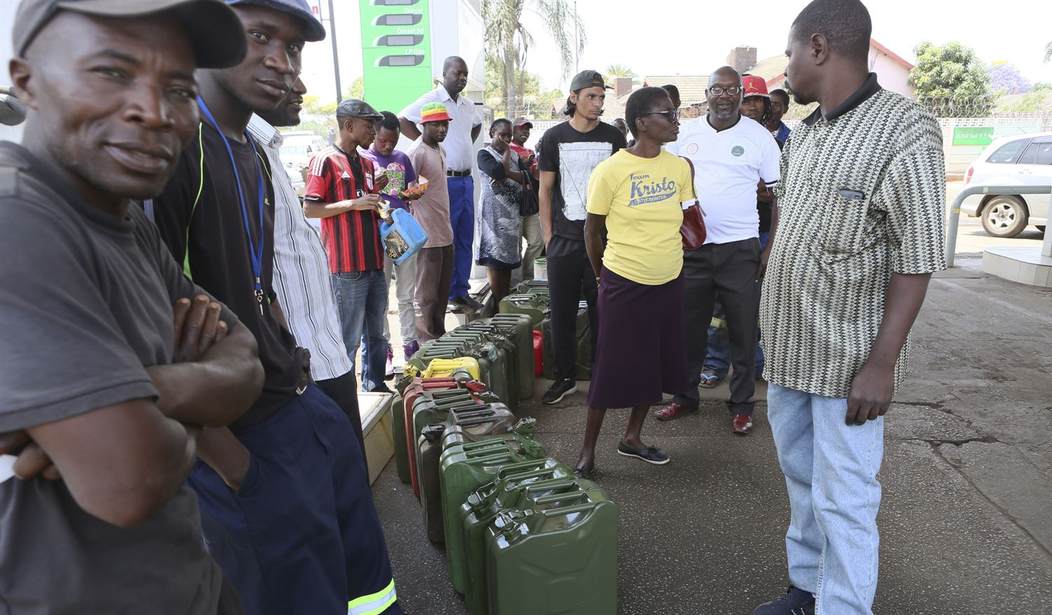
Zimbabwe is, at the moment, struggling under Mugabe's policies. Most of the country only has electricity for six hours a day, which, as you might guess, makes most commercial enterprises difficult, if not impossible.
Although Mugabe was forced from office in 2017, Zimbabwe still faces 18-hour daily power cuts, which cause the country to lose more than 6% of gross domestic product every year, according to World Bank estimates. Removing that economic drag would create space for actual growth.
Here's the onion: The West's climate scolds are already weighing in. Now, hydroelectric generation is more reliable than most "green" schemes, but Zimbabwe needs more than just electricity, although that is vital; again, nature has to be taken into account, and that Kariba Dam that the green energy proponents are suggesting Zimbabwe rely on is drying up.
Green activists want the government to rely on the Kariba Dam, a hydroelectric facility that environmentalists consider “renewable.” But nature is not reliable. An El Niño-induced drought has reduced Kariba to a pitiful 9% capacity. The dam is drying up, and with it, the economic future of a nation.
More promising is the pipeline. Its route—from the Atlantic coast of Namibia, through the stable democracy of Botswana, into Zimbabwe—creates a new strategic energy corridor for Southern Africa. It integrates the 10 economies of the Southern African Development Community in a way that decades of political summits failed to do.
This is what Zimbabwe needs. And Aliko Dangote seems to be the guy to get it done; he has already built one of the world's largest refineries in Lagos, Nigeria. He's not new to the business.
The construction of the pipeline alone will bring great benefit to the region. The construction and maintenance will produce from 50,000 to 100,000 jobs. Dagote is also planning, as part of the overall project, a cement plant, a plant to produce fertilizer, and to enhance the electrical grid. And, best of all, local funding and development reduces African dependence on foreign investment - I'm looking at you, China.
Right now, Zimbabwe's diesel and gasoline are imported. By truck. Zimbabwe is a landlocked country, and there are, at present, no pipelines or even reliable rail transport. Dagote's pipeline will change all that.
Bringing any semblance of prosperity to a place like Zimbabwe, a place that has suffered under years of dishonest, dictatorial rule, won't happen overnight. If Zimbabwe listens to the ululations of Western climate scolds, it won't happen at all. What will make this happen is reliable energy, delivered by pipeline. What will make this happen is for the nations of Africa, some of the poorest nations on the planet, to build out a reliable, modern, high-density energy infrastructure. That's what Aliko Dangote is doing.