
The First Colt Double-Action Sixguns
Most of you don’t need me to tell you, but there are two basic kinds of revolvers: Single-action and double-action. The single-action requires the shooter to manually cock the hammer and then pull the trigger to fire the piece. The double-action presents the shooter with two options: One can fire it in single-action mode, by cocking the hammer (if it has an external hammer; some smaller examples don’t), or one can pull through a long, heavier trigger pull that cocks the hammer and then releases it.
Some small hideout pieces are double-action-only, either striker-fired or with an internal hammer. Those, while still called double-action, are only fired by going through the long pull.
It’s not hard to see the advantages of a double-action revolver. They are marginally to put into action, or so most guntwists claim; personally, I can clear leather with my Ruger Vaquero and get a round off just about as fast as I can with my big Smith & Wesson 25-5, but then I tend to shoot the latter in single-action mode pretty much all the time. But double-action revolvers have more complex innards, and that caused their development to be somewhat behind single-action pieces. While Colt had been producing single-action revolvers since the 1830s-era Paterson Colts, that famous revolver company’s first double-action production gun wasn’t on the market until 1877, four years after the famous Single Action Army.
Colt called it the M1877.
The Design
The gun starts with a name that should be familiar to fans of Colt’s more famous Single Action Army: William Mason, a key designer of that historic sixgun.
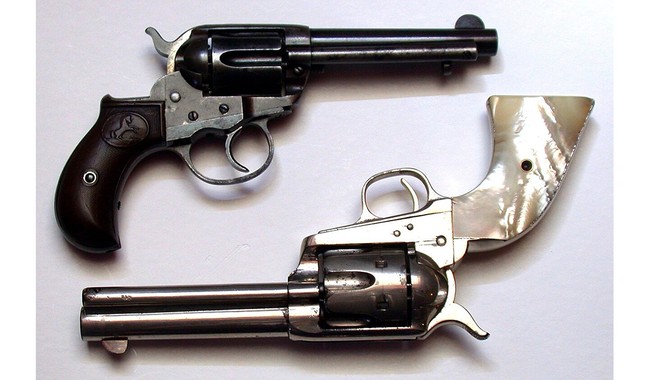
The British firm Webley had been importing its double-action revolvers to the United States since 1873, and Colt was determined to have the first American production double-action revolver. In this, Mason handed them the prize. It was a piece that anyone used to the SAA would find familiar. It loaded the same way, through a loading gate on the right side of the frame; empties were again ejected the same way, out the loading gate, using a spring-loaded ejector rod housed under the barrel. Its grip was different, being what’s called a “bird’s head” grip rather than the standard Colt grip design that dated back to the 1851 Navy model.
The lockwork, though, has some unfortunate problems. For the time, the M1877’s lockwork was intricate and fussy; assembly of the gun required a lot of hand fitting, and they tended to be fussy about ammo. Worse, the delicate lockwork was prone to failure when going through the double-action pull. If the trigger return spring failed, as they were prone to do, the shooter was left with a single-action piece that lacked the robustness and versatility of the Single Action Army. Even when it did work, the double-action pull had a reputation for being heavy and gritty.
One oddity of these guns involved the locking pawl; that’s the doodad that locks the cylinder in battery when a chamber is aligned with the barrel. Normally, in pretty much all standard revolvers, this pawl engages in a cut in the side of the cylinder towards the rear. In the M1877 revolvers, it engaged a cut on the rear face of the cylinder, which again made the design more complicated than it needed to be.
The Guns
The M1877 came in three versions, chambered in .32 Long Colt, .38 Long Colt, and .41 Long Colt. While Colt only ever referred to these as the M1877, a Colt distributor, one Benjamin Kitteridge, gave them new labels in his own sales materials. He dubbed the .32 as the “Rainmaker,” the .38 as the “Lightning,” and the .41 as the “Thunderer.” Colt may have never used these terms, but everyone else sure did.
The revolvers were also available in either nickel-plated or blued finishes, and in a variety of barrel lengths. Some users favored them for concealed carry, as they were smaller, slimmer and lighter than the bigger single-action offerings from Colt, Remington, and Smith & Wesson. But sales weren’t brisk, compared to Colt’s more traditional offerings.Read More: Sunday Gun Day Vol. II Ep. LI - Fun Stuff in Old Gun Shops
A year after the M1877 hit the market, Colt released the M1878, sometimes known as the “Alaskan,” a bigger, huskier double-action that came in the more robust .44 WCF and .45 Colt cartridges. While the M1878 retained the loading gate-rod ejector system of the Single Action Army and the M1877, it was bigger, heavier, and had fewer lockwork troubles. But the M1878 was heavy. Some famous guntwists preferred the M1877, lockwork problems and all; those included John Wesley Hardin, William “Billy the Kid” Bonney, and a notorious British detective named Jerome Caminada.
What Went Wrong?
Ultimately, the M1877 was discontinued in 1909, with a total of 166,849 units produced. While exact numbers of each gun aren’t clear, we know that only a few hundred of the .32 Long Colt versions were made, making these very valuable indeed to collectors. The .38 Long Colt version was the most common, with the .41 Long Colt trailing behind.
We might note that the .32 Long Colt and .38 Long Colt were both pipsqueak rounds, even by the standards of the black-powder world. The U.S. Army would even experiment with the .38 Long Colt in a different revolver, and would end up finding it unsatisfactory, which is to say, it got some people killed. The .41 Long Colt packed more of a punch, but not up to the level of the .44 WCF or the .45 Colt.
In the end, newer developments eclipsed the M1877 and the M1878 by being more reliable, more consistent, and easier to load.
Then, There Was This:
Then, in 1889, Colt kicked over the apple cart with a completely new double-action revolver. William Mason did it again; the M1889, chambered for the .38 and .41 Long Colt cartridges, was like the M1877 in using those rounds, and in being a double-action piece, but that’s where the similarities end. The M1889 was the first American production double-action revolver to use the now-standard swing-out cylinder, with empties being ejected all at once by an ejector built into the cylinder.
Smith & Wesson, Colt’s primary rival, didn’t come out with a double-action piece with a swing-out cylinder until 1896, with the Hand Ejector, Model 1896, also in a pipsqueak round, the .32 S&W Long. But then, in 1908, Smith & Wesson came out with the Hand Ejector 1st Model New Century, or “Triple Lock,” chambered in the powerful .44 S&W Special, and it was off to the races.Colt’s M1889 was the revolver that the U.S. military adopted for a brief time, until maniacal Moro tribesmen showed the Americans the error of their ways, resulting in a pistol out of legend: The Colt/Browning M1911. But the M1889 was still a remarkable piece in its own way: It set the final form of the American double-action revolver that is still in use today.
Read More: Sunday Gun Day Vol. III Ep. V - Guns Nobody Is Making Replicas of, but Should
I’ve mentioned before that I wish one of the replica companies, like Uberti, would undertake an updated version of the Colt M1877. With modern metallurgy, machining, materials, and a little engineering, it seems to me that the mechanical problems that plagued the originals could be fixed. It may require a slightly heavier frame, but a replica M1877 in .357 Magnum and .41 Magnum would be an interesting sixgun to mess around with. And what better reason could there be for owning such a gun?