
Here in the United States, we are fortunate, thanks to the wisdom of our nation's founders, to have several rights and freedoms recognized and guaranteed to us by the Constitution that are rare or unheard of in other parts of the world: Freedom of speech, freedom from unreasonable search and seizure, right to a trial by a jury of our peers, and so on. It was something of a new thing in governance; other countries have paid some lip service to fundamental human rights, but our founders really meant it.
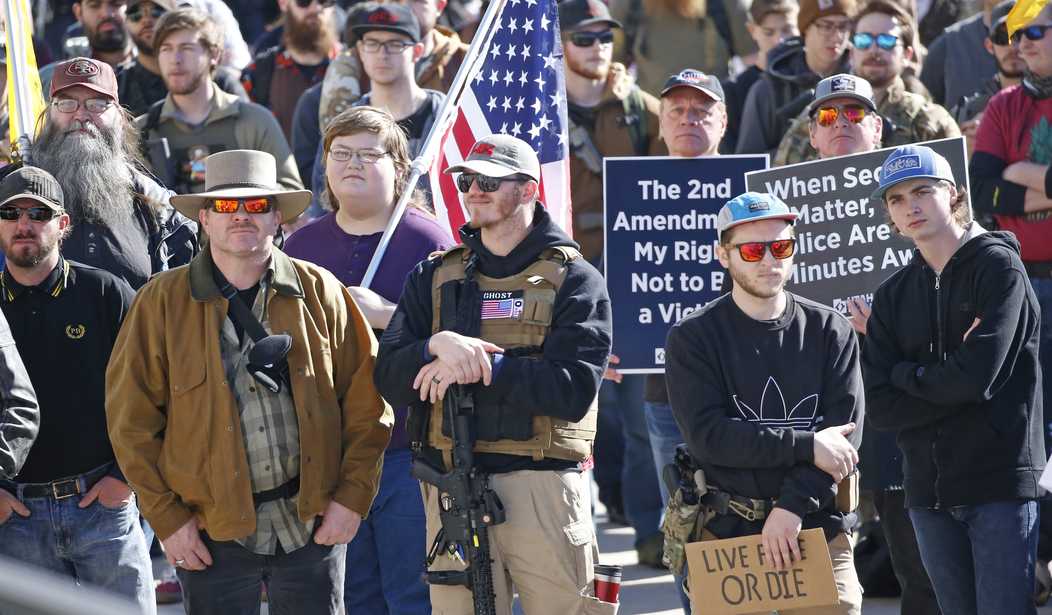
There's one right, though, that Americans are guaranteed by our Constitution that exists nowhere else: The right to keep and bear arms, as enshrined by the Second Amendment. That amendment, the second item in the Bill of Rights, is very simple:
A well regulated Militia, being necessary to the security of a free State, the right of the people to keep and bear Arms, shall not be infringed.
The Second Amendment is the ultimate protection of our liberty, our ultimate safeguard against tyranny, the guarantee that the reins of power will always be held by the people. There's an old, oft-repeated statement about the three boxes available to us to protect our liberty: The soapbox, the ballot box, and the cartridge box.
Totalitarian governments can't abide this freedom. Every time a totalitarian government has seized control, one of its first acts is to disarm the population. Always. Venezuela, much in the news of late, is no exception, and now we see the result: Gangs of armed thugs, non-uniformed goon squads of an illegitimate government, and a citizenry helpless to do anything about them. As I wrote on Monday:
Read More: Venezuela Now Hunting Supporters of Maduro's U.S. Capture
The Maduro regime used armed, civilian paramilitaries, called colectivos, to crack down on protests while Nicolás Maduro was still in power; it's not at all unlikely that these same regime loyalists may be used to round up any suspected American sympathizers.
T'was ever thus. Let's examine some historical examples.
The Soviet Union, 1918: In 1918, the newly minted Council of People's Commissars implemented the Decree on the Surrender of Weapons, which required all citizens - subjects, really - as well as all organizations to hand over all rifles, handguns, and ammunition. When the Soviet Union was officially formed in 1922, the new nation's criminal code criminalized any unauthorized possession of any firearm, and then in 1924, the Central Committee issued a diktat that restricted Soviet citizens to owning only shotguns for hunting, and then only for authorized purposes.
The remaining decades of the Soviet Union were marked by mass arrests, labor camps, and the deaths of millions in the gulags - or by simple starvation.
Germany, 1938: The Nazi government passed the German Weapons Act, or Waffengesetz, which introduced regulations on firearms, permitting requirements for handguns, deregulation of long guns for groups friendly to the regime (as in, Nazi Party goon squads, like the Einsatzgruppen), and restrictions on Jewish ownership of any firearms. The Waffengesetz exempted Nazi Party members. Later in 1938, the Nazi government passed the "Regulations Against Jews' Possession of Weapons," which forbade Jews from not only owning firearms, but also any weapons, including knives.
We know what happened then: 6 million Jews died in death camps and labor camps, along with millions of others.
Cuba, 1959: On January 8th, Fidel Castro entered Havana at the head of a successful Communist revolution. On January 9th his forces began seizing all privately owned firearms, first in Havana, then nationwide. Also on January 9th, he made a speech, which included the rhetorical question, "Armas para que?" Or: "Guns, for what?" By 1960, the population was effectively disarmed. In 1965, another order went out ordering the surrender of all combat weapons. Violators faced judgment by something called a Revolutionary Tribunal, or, in simple terms, a kangaroo court.
Between 1959 and 1993, over 36,000 Cubans died trying to flee the Castro regime, which they had no power to oppose. Cubans were literally trying to build watercraft from old wood pallets and other junk, risking their lives and their families to try to cross 90 miles of open ocean to get to the United States.
Read More: 'Kidnapped' Maduro Launches Indignant Outburst in Court - the Judge Wasn't Having It
And, finally, Venezuela, 1939: It started with that year's Law on Arms and Explosives, which legally disarmed the public, giving the government a monopoly on ownership and use of firearms. In 2012, another new law, under the regime of Hugo Chavez, banned all commercial sale of firearms and ammunition to civilians. In 2013, the government passed, and then-President Nicolás Maduro signed, the Law for the Control of Arms, Munitions, and Disarmament. This law included penalties of up to 20 years in prison for unauthorized ownership, carry, and sale of firearms, and stopped the issuance of new firearms licenses.
Which brings us to today, and Maduro's colectivos are still armed, and still able to aid the remaining vestiges of Maduro's illegal regime in tracking down anyone who may have helped the United States capture the dictator.
The Founders were very clear on why they insisted on making the right to bear arms second only to the right to free speech and the right to the open practice of faith in the Bill of Rights. It is the right that serves as the ultimate protection of all the others. In Federalist No. 6, James Madison noted that an armed populace in their millions could overturn any possible tyrannical government, while the Anti-Federalists, like Patrick Henry, agreed on this much at least; Henry himself insisted on this ultimate protection of liberty.
History is replete with these examples: A population, once disarmed, is helpless. That's why we have to preserve our rights under the Second Amendment: To the last, to the end, through the soapbox to the ballot box (remember the midterms this November) and, if necessary, beyond.
We are a free people only to the extent that we can protect that freedom. Not the government; us. In the end, it's always we citizens who are, who should be, who must be responsible. That's why I'm a Second Amendment absolutist. That's why you should be, too.