
We're Americans. As a people, as a nation, we've pulled off some amazing feats of arms. Our armed forces have done the impossible, things like General Patton's turning an entire army 90 degrees, in 48 hours, while engaged, in winter, to drive north and relieve the encircled troops at Bastogne. Our Navy aviators decided the outcome of the Pacific theater of World War 2 in a few minutes in 1942, when American dive bombers caught four Japanese fleet aircraft carriers by surprise and, stooping like falcons, sent three of them to the bottom in a matter of minutes, and sank the fourth a few hours later.
Most Americans don't much care for war. But when it comes right down to it, we're pretty good at it.
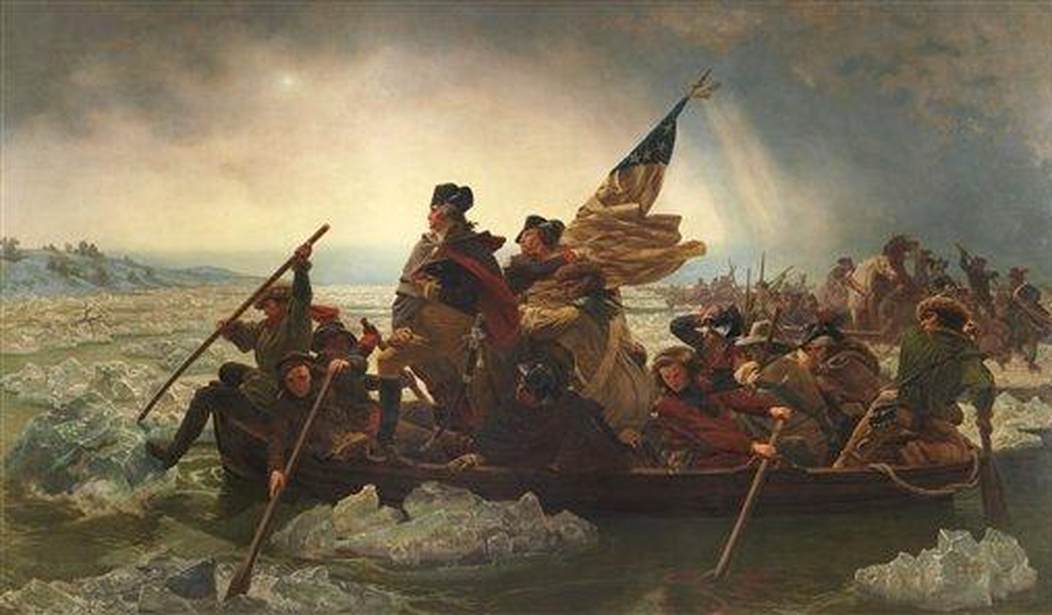
Which brings me to an event 249 years ago today, when George Washington led the Continental Army across the frozen Delaware River, at night, to attack Hessian forces around the town of Trenton, New Jersey. This was a considerable exercise in logistics that still inspires admiration today, as well it should.
Books have been written on this event, but here are the broad strokes.
The whole thing was planned by General Washington and was surrounded by great secrecy, which is pretty amazing, considering they had to assemble enough boats to ferry the army across the river. On December 23rd, however, General Washington briefed his senior commanders on the plan, and his decision to attack Hessian troops around the city of Trenton on December 26th. Of course, the icy Delaware River stood in the way of the Continental Army.
Washington's men assembled a considerable flotilla. Not only small boats, like the one in the famous painting, bearing General Washington, but also large barges and ferries, capable of hauling horses, artillery, and supplies. Soldiers from Maine and Massachusetts, men with experience with watercraft, manned the boats. Locals who knew the river well joined the effort.
On Christmas morning, General Washington issued orders that the Continental Army was going across that river to kick some Hessian butts. He ordered rations cooked for three days, fresh flints to be put in every musket, and he also ordered that even the musicians and officers were to arm themselves, not with the usual swords and pistols, but with muskets. The Continental Army was betting everything. Bear in mind that in 1776, most of these men couldn't even swim; further, when this happened, the North American continent was in the throes of the Little Ice Age.
General Washington crossed with the first wave. He was leading his men, as a good commander should. By daybreak, the crossing was complete.
Read More: Thoughts of the Founders: Cato's Letters
The Battle Road: Lexington and Concord, 250 Years Ago Today
The Continental Army fell on the Hessians like a ton of bricks. General Washington opened the fight by personally leading an attack on a Hessian outpost on Pennington Road. The Hessians, soon realizing this wasn't just a raid with a few troops, began a fighting withdrawal into Trenton. But the Continentals were attacking on three fronts, with General Green attacking from the north, General Sullivan from the northwest, and General Ewing from the south, although General Ewing's forces didn't cross the river, remaining in Pennsylvania.
There were three Hessian regiments in the town, supported by artillery. But the Americans had artillery of their own, and as Hessian forces tried to form ranks, the American guns scattered them. The Hessians were still suffering from an excess of pilseners and schnapps from the day before, and their resistance soon fell apart. It's been proposed that General Washington knew of the Hessian propensity for celebrating Christmas with booze and plenty of it, and that this influenced his planning.
When it was all over, the Hessians had suffered 22 killed, including the commander, Colonel Johann Rall, along with 83 wounded and almost 900 captured. The Americans suffered two killed and five wounded. By noon on the 26th, Washington's forces, with the Hessian prisoners, had crossed safely back across the Delaware into Pennsylvania.
Historian David Hackett Fischer later wrote of this event:
Until Washington crossed the Delaware, the triumph of the old order seemed inevitable. Thereafter, things would never be the same again.
Unlike the battle of Midway, the attack on Trenton wasn't the turning point - but it was a turning point. After Trenton, after that nighttime crossing of an icy river, in the depths of one of the coldest winters in written history, American determination and capability were never again in doubt. General Washington had established himself as a dangerous foe to the British, whom he had previously served in the French and Indian War. The Continental Army had proved itself to be, not a rabble, but a hard, capable, professional army. And in the end, General Washington and the Continental Army, with the British at the end of a cross-oceanic supply chain, won, drove the British out of the 13 colonies, and in time established these United States.
This event and the events that followed, of course, are the ultimate lessons of the crossing of that river and the Battle of Trenton:
We're Americans. If you mess with us, we will cross a frozen river at night to kill you in your sleep. On Christmas.