The early years of the atomic age saw some pretty odd experimentation. Mind you, we didn't have a really good grip on what nuclear power was capable of or what some of the worst side effects of radiation exposure could do, at least, not completely.
But an amazing amount of new technology was made possible by our harnessing of the atom. Nuclear power, in particular, revolutionized submarine warfare; in World War 1 and 2, submarines, including the vaunted German U-Boats, were pretty much light surface vessels that could slip beneath the waves for a short time. The advent of the nuclear-powered sub made possible the first true submarines, able to stay hidden in the depths not for hours, not for days, but for weeks - even months.
Then there was the TV-8 - a proposed design for a new tank. Not just any old tank - a nuclear-powered tank. Yes, really.
In the early years of nuclear development, as atomic bombs and nuclear power made their way into the American military arsenal, companies in the defense industry sometimes got weird with them.
They developed nuclear air-to-air missiles, portable nuclear launch devices, tried to create nuclear death clouds in the atmosphere and nukes small enough for Special Forces soldiers to parachute with. They even considered nuclear-powered bases on the Moon that would be able to repel enemy spacecraft.
For every idea that made the cut, such as nuclear-powered submarines, there were several other more fantastical or outright science-fiction ideas involving nukes that were also proposed.
Yes, those were all real things, and more into the bargain besides; they even considered detonating nuclear weapons on American soil, specifically, in Alaska, and personally, I'm rather glad they didn't.
Read More: Project Chariot: That Time America Almost Nuked Alaska - On Purpose
SADM: That Time the Green Berets Jumped From Airplanes With Atomic Bombs
But the atomic tank, that's a real head-scratcher. Mind you, we aren't talking about the delivery of atomic weapons here; the tank itself was intended to be propelled by a nuclear reactor.
The design had two purposes: The shape was meant to withstand nearby explosive blasts, including nuclear ones, and to help it stay buoyant during amphibious operations. A built-in water jet on the lower section would propel it forward, while its watertight turret would fire 90mm rounds. The tank utilized closed-circuit cameras to give tankers a live feed of their surroundings, according to the “A History of the American Main Battle Tank” by R.P. Hunnicutt.
Then there was the power.
Chrysler put forward a theoretical plan to consider powering the tank with a nuclear reactor.
Granted, I never served in an Armor unit, although I hung around the Infantry for long enough to be exposed to tanks, mostly (at that time) the newer M1, but I also saw a couple of the old M-60 tanks. Which is enough to make me think: "A tank with a nuclear reactor? What if it got hit?"
If you’re thinking, ‘that makes no sense,’ well, the Army soon agreed, but “an onboard reactor on a mechanized battlefield” was the kind of thing you could propose in the early 1950s. The general idea was that a nuke-powered TV-8 would have essentially unlimited range and be freed from the constraints of fuel supply logistics (although ammunition would still need to be delivered).
Of course, that still meant putting a small nuclear reactor inside the tank. Even if the crew could be protected, using the TV-8 in combat meant that any damage to the tank from enemy fire risked exposing nearby troops to dangerous amounts of radiation.
Now, we can see a couple of advantages of this idea. Much like a nuclear submarine or surface ship, a nuclear-powered tank would be free of a lot of the constraints of a traditional tank, namely, fuel. When I was deployed to the Middle East for Operations Desert Storm, I remember driving Tap Line Road in northern Saudi Arabia, which ran from the Persian Gulf up along the border with Kuwait. That road, in January of 1991, was covered with enormous U.S. Army tanker trucks, delivering diesel fuel to the tanks and other vehicles that were lined up, waiting for General Schwarzkopf to point north and yell, "Go!" It takes an enormous amount of fuel to move a tank anywhere, and when you have thousands of tanks and other vehicles - well, that operation was one of the greatest logistical feats in military history.
Imagine an army of nuclear-powered tanks. All we would have to move forward would be beans and bullets. Of course, there's always the chance that if you were in one of those tanks and it got hit, you'd end up glowing in the dark.
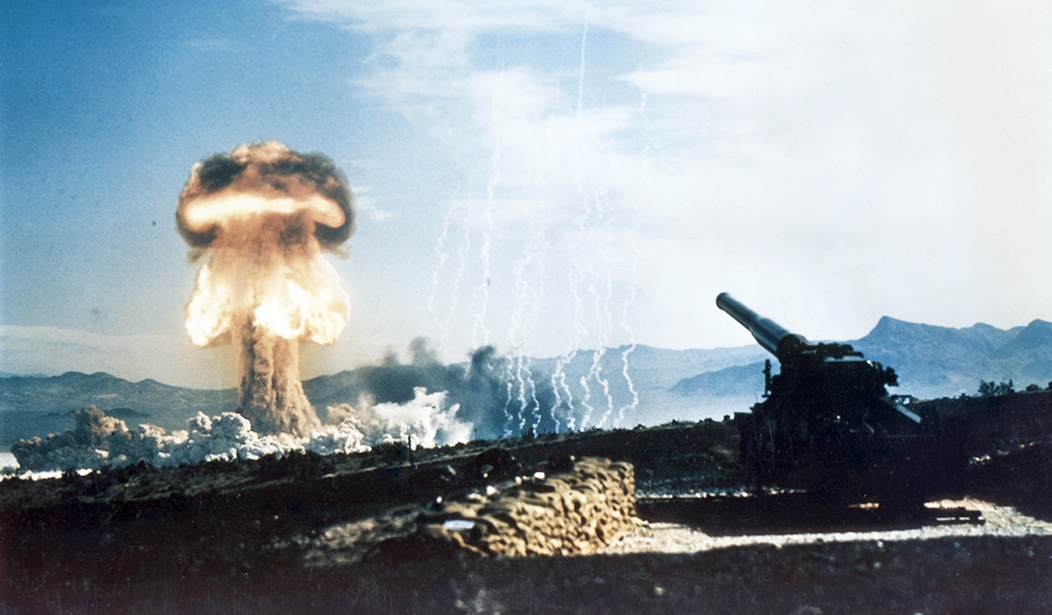
The 1950s gave us a lot of nuclear military oddities. There was "Atomic Annie," the nuclear howitzer, and even weirder, the Davy Crockett nuclear bazooka, meant to be mounted in a jeep and operated by just two soldiers. That last device lent a whole new meaning to "shoot and scoot," so the shooters could avoid getting caught up in the fireball of their own weapon; also, nothing says "nuclear release authority" like two members of the E-4 Mafia in a Jeep.
A nuclear-powered tank, though, that takes the cake. At least, as far as the American military went. After all, it was Britain, not America, who gave us the chicken-powered atomic land mine, so there's that.