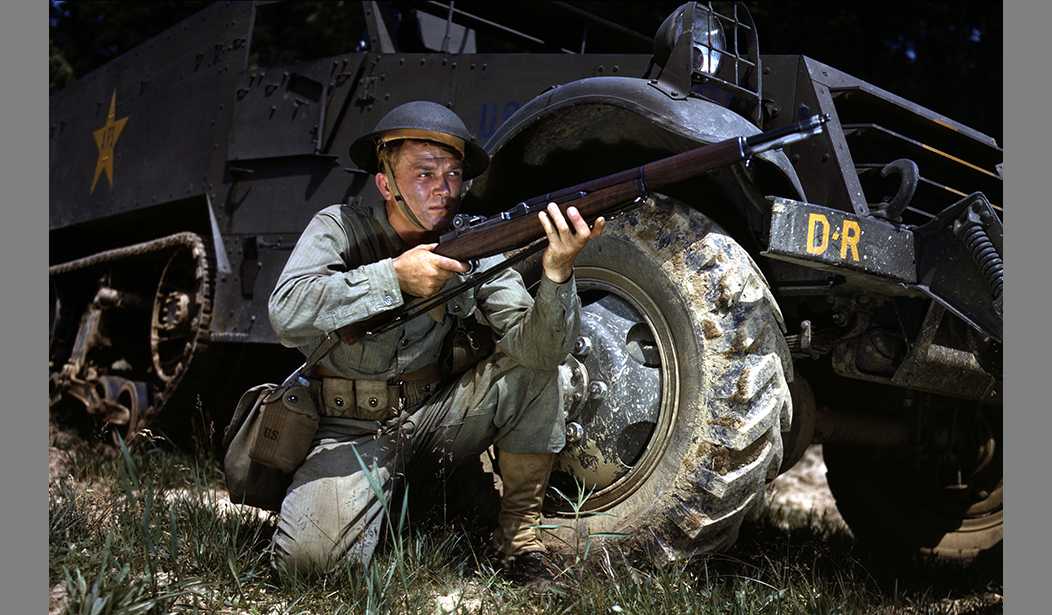

Recently, I wrote that one of the things I'm proudest of in my life is that I was a soldier. Oh, I wasn't a big hero type; no Ranger tab, no big hero medals, no blood-in-my-eye firefights. Like everyone, I went where I was told to go and did what I was told to do, as did my father and grandfather before me. But I wore the uniform. I served, the third generation in my family to do so. When I first joined up, my father told me, "This will change you in ways that people who haven't been through it will never understand." As usual, he was right, but I didn't understand how many of those changes would stay with me long after my service time was over.
Case in point: Several years ago, when I had spent a few pleasant days in between consulting projects, visiting my Mom and Dad, and my oldest daughter and her kids, who lived near my parents. As I was getting packed up to return home, my grandson was watching me, chattering happily at Grandpa. Suddenly, he asked, "Grandpa, why do you roll your shirts and socks? Mama just folds mine."
I looked down at my suitcase. I hadn't even realized I was doing it. But there were my t-shirts and socks, neatly rolled, inspection-ready, as though they were in my wall locker and not a suitcase. "They take up less space that way," I told my grandson, not wanting to take ten minutes trying to figure out how to explain that.
In the years since I hung up Uncle Sam's colors, I've been noticing some ways by which I can spot fellow veterans.
Appearance. Many veterans stick with the military's standards of haircuts and facial hair. They maintain that clean-cut look. It is, after all, a lot easier to maintain a high-and-tight and a cleanly shaved face. But the odd thing about this one is that, if a vet gives that up, he tends to go the other way. Just look at my RedState profile photo: My gray-white hair hangs down past my collar, and my beard - well, it's great for keeping my face warm, when it's 11 below, as it is today. I'm not sure why this is an either-or thing, but it sure seems to be.
Pointing. I don't know the origins of this one, but if someone is giving you directions and points up a road with their hand in a blade, instead of pointing with one finger, that's likely a veteran. This might arise from the fact that, in some countries, it's considered mildly rude to point with one finger. In Japan, for instance, you'll see people pointing in this manner, with a bladed hand.
Situational Awareness. If you see someone scanning the people around them, with the "head on a swivel" practice, that's likely a veteran. Many of us have spent time in dangerous places, and most especially in our more recent conflicts, not all of the people we faced wore uniforms. Being aware of your surroundings at all time isn't an infallible marker of a veteran, but it is a pretty good one.
Read More: Fading Echoes: Pearl Harbor Survivors' Absence Marks New Shift in Remembrance
88-Year-Old Army Vet to Get Life-Changing Sum in Surprise Ceremony to Help Him Retire
Tall Tales. There's an old joke: "What's the difference between a fairy tale and a war story? A fair tale begins 'Once upon a time,' and a war story begins 'No s**t, there I was...'" Veterans are often yarners, with interesting tales of faraway places and funny things that happened on deployments. There is one exception:
Reluctance to Discuss. One of my uncles served in the Marines during World War 2. He landed on Iwo Jima, and there he was wounded by a Japanese bayonet through the shoulder. The family never knew he'd been wounded until he returned home after the war, got married, and had his new wife ask him about that nasty scar on his shoulder - she told my grandparents, who were a bit peeved about not being notified. As long as he lived, my uncle wouldn't talk about the war. However, after his return, he found life on the family farm a tad dull, and so joined the Navy, where he served for 30 years - and he would tell stories about that all day long. See above.
Punctuality. If you're not fifteen minutes early, you're already late. Veterans tend to be on the dot. We learned the importance of that the hard way; for example, woe be the poor first lieutenant serving as convoy commander for the first time who doesn't cross the line of departure (LD) on time.
Cargo Pants/Shorts. We get lonely without all the pockets.
Multi-Tools. We all carry them. Granted, in my case, living in a rural Alaska home, that thing is useful pretty much daily.
Jargon. If you hear two guys talking and trading terms like LZ, LT, BOHICA, FUBAR, track-toad, rotor-head, Ranger candy, or they are spelling words out with the NATO phonetic alphabet, it's a safe bet they are veterans.
Carrying Everything in Their Left Hand. Because you need to keep your right hand free in case you need to salute someone.
Hearing Loss. Spending a good portion of your youth around diesel trucks, aircraft, tank cannon, artillery, and so on is bad for your hearing. I've got a 10 percent disability rating from the VA for hearing loss, so I came out of it luckier than most. My wife is also a veteran, and we spend a fair amount of time cupping our ears and shouting "WHAT?" at each other.
I feel certain that many of your readers are veterans and can add to the list. The comments are all yours! Let's see what you got.