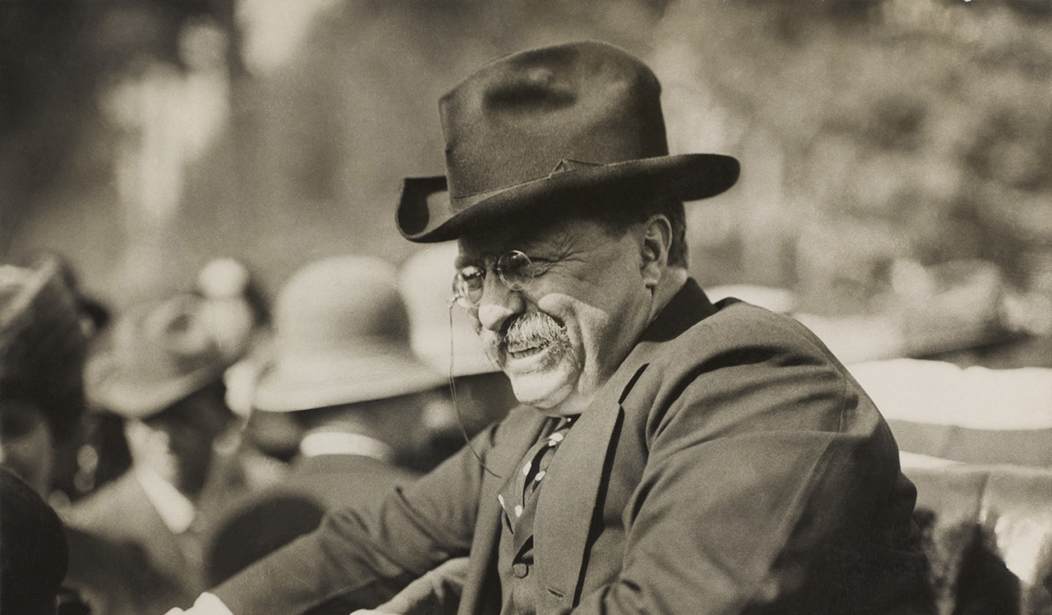

In 1907, President Theodore Roosevelt decided it was time for a peaceful demonstration of American naval might. To that end, he caused to be assembled what would be known as the Great White Fleet, consisting of 16 battleships arranged in two squadrons, accompanied by various support ships. The ships were painted white to symbolize a mission of peace, but the message was clear: Teddy Roosevelt did indeed have a big stick, and he was showing it to the world. Naval port calls had been routine throughout the 19th century, and were broadly used for diplomatic purposes, so in the Great White Fleet's global tour, Teddy was able to, in effect, kill two birds with one stone: Conduct some robust diplomacy while showing off America's naval might.
In the Caribbean, the ships conducted what was known as Big Stick Diplomacy, while in Asia, the fleet's motto was the Open Door Policy, supporting China and promoting open trade and secure shipping lanes. A brief history of the Great White Fleet at American History Central concludes:
The Great White Fleet is important to United States history for the role it played in showcasing U.S. military power to the world, including Japan. Ultimately, the Great White Fleet’s show of force helped reduce tension with Japan. At the same time, the Great White Fleet also showed the willingness of the United States to aid in humanitarian efforts by providing support for victims of the Messina Earthquake.
President Donald Trump, who resembles President Roosevelt in his fondness for a muscular foreign policy, has reinvigorated the Monroe Doctrine, or rather, has re-invented it as what we might call the Trump Doctrine.
Read More: With the New U.S. National Security Strategy, Trump Revives Monroe Doctrine
President Trump and Secretary of War Pete Hegseth have been demonstrating American naval might in the Caribbean, in part by parking a U.S. Navy carrier task group off Venezuela's shores, as a clear message to that country's strongman dictator Nicolás Maduro that he'd better mind his Ps and Qs, and that further, he should do so while getting out of the country and fleeing to some neutral ground where he can presumably still access his Swiss bank accounts.
Is that a show that the Department of War could take on the road?
Read More: Trump's Ultimatum to Maduro: Flee Now or Face American Forces
There is nothing in any of the militaries anywhere on the planet with the striking power of a modern American nuclear aircraft carrier task group. Oh, yes, they have their vulnerabilities; any major weapons platform does. But that doesn't lessen their offensive might. Maybe one or two of these task groups, appropriately painted white, could be sent on a renewed Great White Fleet tour.
The message? America is back. We're promising free passage for all ships conducting commerce. We will protect our allies and prosecute, vigorously, our enemies or anyone who wishes us harm. Don't cross us, or you'll be sorry.
It's a good message. Democrats and the legacy media (but I repeat myself) will slam it as "gunboat diplomacy," and they will, for once, have some semblance of a point. Having the USS Gerald R. Ford dock in foreign ports, where the fleet commodore goes ashore to slap the backs of local and (presumably) national officials, would be another interesting revival of an old naval tradition. But there's a caution, as well; as American History Central points out:
The Great White Fleet (1907–1909) was a fleet of 16 U.S. Navy ships — painted white — that sailed around the world for the purpose of displaying the naval power of the United States to Japan and other nations. The fleet was dispatched by President Theodore Roosevelt in an effort to ease tensions with Japan, which was rumored to be considering war with the U.S. over the treatment of Japanese people living in America. The fleet visited ports of call around the world and effectively demonstrated the naval power of the United States.
Ay, there's the rub.
Part of the purpose of the 1907-1909 Great White Fleet exercise was to ease tensions with Japan, which was a trade partner, but was also a growing geopolitical rival. Roosevelt's robust gunboat diplomacy worked, for a while, but we all remember what happened on December 7th, 1941.
Part of the purpose of a possible 2026-20XX Great White Fleet exercise would almost certainly be to ease tensions with China, which is a trade partner, but is also a growing geopolitical rival. How will that end up? Would this renewal of gunboat diplomacy make China back off, or would we just be kicking that can down the road? The U.S. and China are, after all, the two biggest kids in the West Pacific block, and as the old saying goes, the two biggest kids are going to fight, sooner or later. Given China's demographic problems, time isn't on their side.
I am nonetheless inclined to think this is worth doing. It's an important message to send to the world. "We're here, we're tough, we're smart, we're well-armed, and most of all, America is back."