
I've been waiting for this to happen for a while now – a candidate whose platform is centered squarely on the creeping suburban blight known as data center development. Unfortunately, he's arrived in the form of a Democrat from Michigan looking to replace retiring Democrat Sen. Gary Peters, but his focus on what data centers are doing to American communities is worth considering.
The candidate in question is Abdul El-Sayed, a political newcomer looking to make waves with a platform that emphasizes helping voters "navigate local government negotiations" while also "mobiliz[ing] those discontented with the rising utility prices linked with data centers."
The centerpiece of Abdul's policy agenda is his "Terms of Engagement for Data Centers," which outlines ways that data center developers must operate in order to build in Michigan communities, particularly when it comes to electricity rates, grid reliability, water sources, and jobs.
- No rate hikes
- Data centers must pay for their own energy demand — costs cannot be passed onto ratepayers.
- Community transparency
- Communities must have a meaningful say in project approvals and community benefits packages.
- Energy reliability guarantees
- Energy reliability cannot worsen because of data center projects. Projects must include enforceable commitments from utilities to improve energy reliability, funded by data center revenues.
- Jobs guarantee
- Data centers must create the local jobs they promise, or face penalties.
- Water protection
- Data centers must commit to closed-loop cooling systems to avoid stressing or polluting local water resources.
- Community benefits agreements
- Projects should include binding agreements that deliver real benefits, including local infrastructure investments, improvements to the electrical grid, burying power lines, and upgrading water treatment facilities and piping.
- No clean-energy loopholes
- Utilities cannot use data center projects to weaken or sidestep clean energy laws.
- Enforceability
- All agreements must be enforceable through actionable penalties.
El-Sayed says unchecked data center sprawl has happened because both Democrats and Republicans are beholden to the developers: “The problem is that too often — and this has been my big structural critique of the Democratic Party — Democrats are bought off by the same corporations that are buying off Republicans, and so they conveniently avoid talking about issues that arise in local communities."
Being as Abdul El-Sayed is endorsed by the likes of Bernie Sanders, Rashida Tlaib, and Pramila Jayapal, I'm certainly not going to portray him as some sort of political genius who's about to upend the U.S. as we know it, but his focus on data centers is still intriguing.
From my perch here in Loudoun County, Virginia, the data center issue was always going to end up on a collision course with politics, and that's because I live in an area known as "data center alley." This "alley" runs between my home town of Leesburg and sprawls into the neighboring town of Ashburn. Between the two, there are already over 100 data centers in operation with at least another hundred planned or under construction.
READ MORE: New: America's Nuclear Renaissance, Driven by Data Centers
New: Firm Claims They Can Build Data Centers in Space
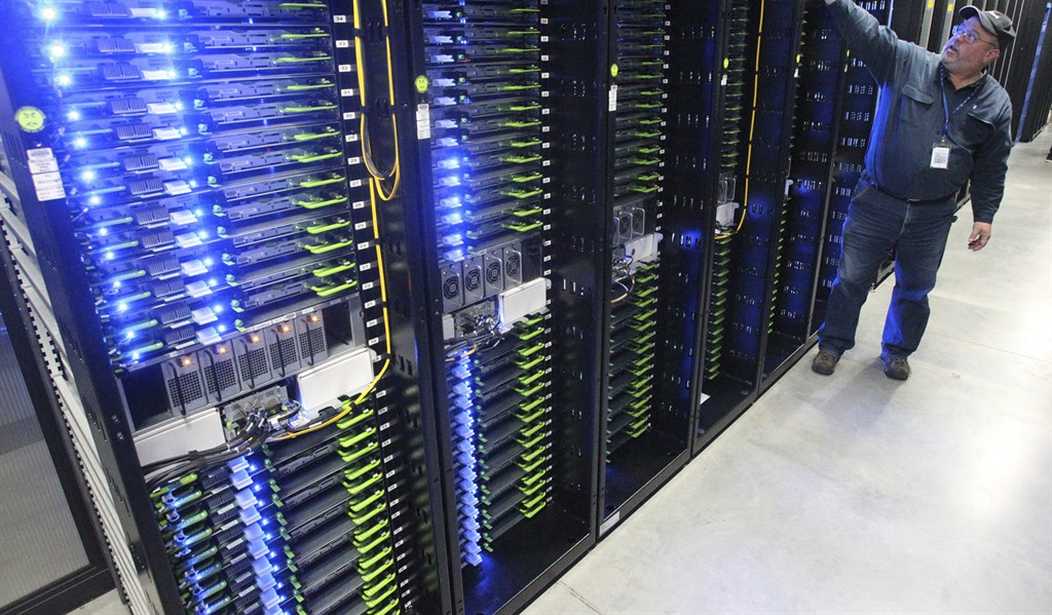
Data centers have been described as the "engine of the internet." From what I understand, the nondescript buildings house rows and rows of energy-gobbling servers. Roughly 40 percent of all internet traffic passes through the Loudoun-based data centers, many of which are "hyper-scale" data centers that power ChatGPT and other AI companies. We apparently have more of them here than anywhere else in the world.
And, boy, do they suck up a lot of power. It's estimated that over 40 percent of Virginia's electric grid goes to power data centers clustered in the northern part of the commonwealth. They use colossal amounts of water, too, to cool the massive servers. Eventually, over 30 percent of the Potomac River basin water could be used for data center cooling purposes.
And, worst of all, they are they ugly and intrusive. They go on for blocks in some parts of the area.
Amazon building a data center right behind homes in Virginia.
— John Pompliano (@JohnPompliano) April 10, 2024
If you’re going to buy a home next to an empty lot, make sure to do thorough due diligence. pic.twitter.com/RXwXIKZWP8
And they're apparently loud, with a constant humming emanating from the buildings as the torrents of water from the Potomac River work to cool the servers. What they don't do is create permanent jobs; very few people actually work in the buildings, so the only jobs created are temporary construction gigs.
They do, however, generate millions of dollars in tax revenue for the county – an estimated $5 million per data center annually – but that's little comfort to homeowners who are watching their house values plummet as more unsightly towers go up to carry electricity into the centers. Those tax earnings certainly haven't driven down the cost of energy, food, and other necessities.
Now, I'm a pragmatist and realize these unsightly behemoths allow me to write my articles at RedState and watch Stranger Things with my teen daughter; I love them for that. I also recognize that a crafty candidate who can successfully thread the needle between necessary tech development and community wants/needs will grab votes from across the political spectrum, and I'd kind of like to see that.
If you're interested in how unchecked data center development is affecting suburban America, Roca News did a short video on Loudoun County.