








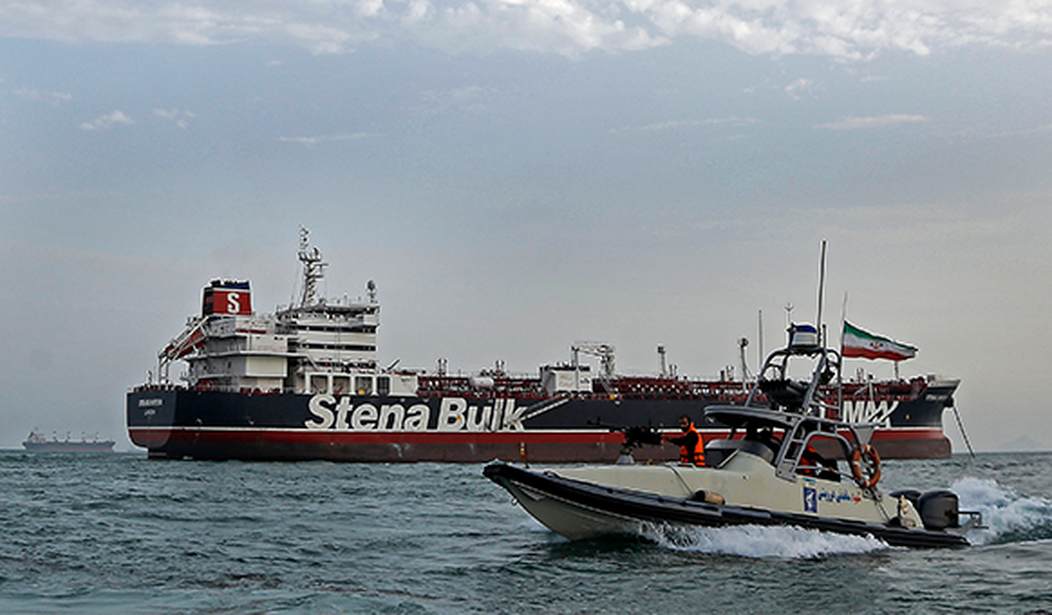
President Trump took this TruthSocial platform on Wednesday to let us in on some rather earth-shattering news in the ongoing war with Iran. According to President Trump, over 200 tankers carrying more than 100 million barrels of crude oil have safely transited the Straits of Hormuz under Iran's nose with U.S. military protection.
Last month, I directed our Great U.S. Military to execute a secret mission to support Oil Tankers and other Commercial Ships through the Strait of Hormuz. Today, I am pleased to announce that this effort has resulted in more than 100 MILLION Barrels of Oil making its way through the Strait, and into the Open Market. More than 200 Commercial Ships have safely traveled through the Strait. This wildly successful effort is because the UNITED STATES of AMERICA CONTROLS the Strait of Hormuz — NOT Iran. Their military is defeated, and their economy is lost. It’s over for Iran! Thank you for your attention to this matter. President DONALD J. TRUMP
More details were provided during an Oval Office interview today; see Trump on Iran: We're Going to Be 'Attacking Them Very Hard,' Reveals US Snuck 22 Tankers Through Strait – RedState.
BREAKING: The U.S. is taking "millions of barrels of oil" out of Iran every night, President Trump announces.
— Fox News (@FoxNews) June 10, 2026
"I'm going to tell you because they just figured it out. So now that they figured it out, I can tell you it was very hard for me. I wanted to say it so badly."
"When… pic.twitter.com/sf3rucqhAj
"When the war is over, it's coming down. It's going to come down like a rock.
And again, we're taking out millions [of barrels of oil], which I'm just announcing today for the first time, but we've been taking out millions of barrels of oil — millions of barrels. Every night we took out [oil].
But now I'm going to tell you because they just figured it out. So now that they've figured it out, I can tell you. It was very hard for me. I wanted to say it so badly, but I didn't want to ruin it.
Millions of barrels of oil have come out. That's why it's at $85–$90 a barrel instead of $250.
But we have the greatest military in the world, the toughest military in the world. Just the best in every way — nobody even close. There's no military that is even close. I rebuilt it during my first term. I'm using it now.
When this conflict is over... [someone] said please go to a 'conflict' right? As opposed to the word 'war.' He didn't like the word 'war,' but it's sort of a conflict, it's a military operation.
When it's over, you will see oil drop to where it was before."
According to President Trump, the U.S. Central Command has been running this infiltration gambit every night for weeks, and Iran, which the left assures us daily controls the Straits of Hormuz, only now figured out what was going on. Looking at the events in retrospect, while many decried Operation Epic Fury as having failed to guarantee freedom of navigation, it seems as though the Trump administration was quietly building the infrastructure for what appears to be a strategic coup.
Operation Project Freedom was announced by President Trump on May 4.
The mission, directed by the President, will support merchant vessels seeking to freely transit through the essential international trade corridor. A quarter of the world’s oil trade at sea and significant volumes of fuel and fertilizer products are transported through the strait.
“Our support for this defensive mission is essential to regional security and the global economy as we also maintain the naval blockade,” said Adm. Brad Cooper, CENTCOM commander.
Those of us hoping to see a phalanx of U.S. destroyers forcing the Strait of Hormuz open under an umbrella of strike aircraft (I'm included in this number) were disappointed. Nothing seemed to happen.
Commercial websites that monitor tanker locations reported very few outbound transits by tankers in the Persian Gulf. The whole incident was written off as Trumpian hyperbole: long on rhetoric and short on results.
Today's announcement paints an entirely different picture. For this, I'm relying on analysis by an authority on maritime operations, Dr. Sal Mercogliano.
When Operation Project Freedom was announced, two U.S.-flagged ships were escorted out of the Persian Gulf before the operation was publicly put on hold. The operation resumed using autonomous vehicles, both UAVs and USVs.
Secrets are hard to keep, and by late May outlets such as the New York Times were reporting that tankers were being escorted out of the Gulf.
American forces in recent weeks have helped coordinate the passage of dozens of commercial vessels through the Strait of Hormuz, according to U.S. officials, even as travel through the waterway remains risky amid stalled negotiations to end the war with Iran.
U.S. Central Command has guided around 70 commercial ships through the strait, traveling into and out of the Persian Gulf, in the last three weeks, one of the officials said, speaking on condition of anonymity to discuss operational matters. The U.S. officials added that most of the vessels had turned off their transponders to avoid detection when going through the narrow waterway.
This prompted the U.S CENTCOM denial, and the framing allowed U.S. CENTCOM to say the U.S. Navy wasn't escorting or assisting commercial vehicles with something of a straight face.
🚫CLAIM: Recent media reporting claims that the U.S. Navy has restarted escorting or assisting commercial vessels during transits through the Strait of Hormuz. FALSE.
— U.S. Central Command (@CENTCOM) May 26, 2026
✅TRUTH: Project Freedom has not resumed, and U.S. forces are not currently escorting commercial vessels through… pic.twitter.com/JD9cY5FUNN
The statement being true as far as it went.
The operation consisted of Very Large Crude Carriers, we'd call them "supertankers," exiting through Hormuz without their Automatic Identification System, the maritime equivalent of an aircraft transponder shut off. Once in the Gulf of Oman, these vessels rendezvoused with other tankers and were emptied via ship-to-ship transfers. The empty tankers then headed back into the Persian Gulf to pick up a new load of oil from the UAE, Saudi Arabia, Bahrain, Qatar, or Iraq. This kept the number of ships in the Persian Gulf stable and provided no hint of Washington running its own "dark fleet" of oil smugglers. Wash, rinse, repeat.
SEE ALSO: Trump Pulls Off a Very Cool Move in the Strait - Right Under the Nose of the Iranian Regime
It also explains the U.S. Navy's aggressiveness in the Gulf of Oman in turning around inbound ships bound for Iran. Yes, it served to support the blockade, but it also prevented an Iran-bound ship from stumbling upon a transfer operation and blowing the whistle when they made port.
The blockade runners were covered by a $40 billion war insurance pool furnished by the Development Finance Corporation. Oddly enough, this was another Trump administration initiative that was derided as a failure.
It looks like President Trump's announcement was made because the whole operation was about to become public. This is from a reporter at Kpler, one of the major private business intelligence firms.
Covert tanker operations have successfully cracked Kuwait’s 2-month export freeze, triggering a significant inventory draw at Mina Al Ahmadi as operators turn to dark transits to bypass regional maritime blockades. More on @Kpler #OOTT #Kuwait
— Amena Bakr (@Amena__Bakr) June 9, 2026
There is a very good chance that the AH-64 that was shot down Tuesday was part of this operation (note that the AH-64 is Army, not Navy, and therefore not covered by CENTCOM's press release); see Trump Reveals US Helicopter Shot Down - and Consequences Are Coming – RedState. The USV, which rescued the crewmen, is almost certainly part of the operation, probably as an escort; see Texas-Built AI Sea Drone Makes History: First Combat Rescue of Downed US Pilots – RedState.
Saudi Arabia and UAE need to move about 12 to 14 million barrels of oil each day. If Trump was correct and we moved 22 tankers through the Strait of Hormuz in one night, that represents about 44 million barrels of crude, or about three days' production.
Help us report the truth about the Trump administration’s decisive actions to keep Americans safe and bring peace to the world. Join RedState VIP and use promo code FIGHT to get 60% off your VIP membership.

Join the Conversation
VIP members get the ability to comment on articles.