






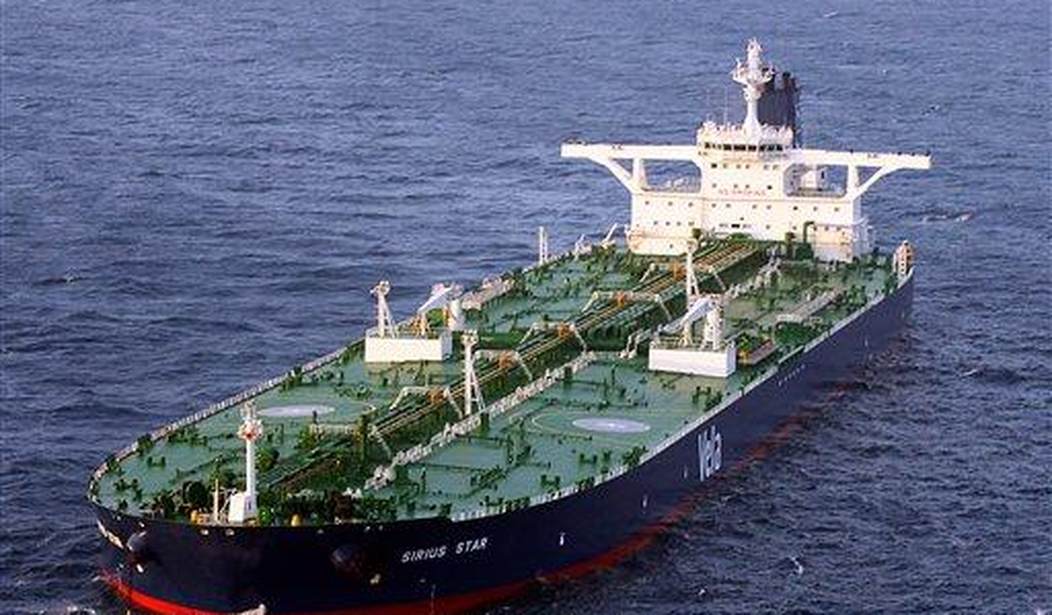
When the U.S. military boarded the oil tanker MT SKIPPER off the coast of Venezuela on Wednesday, it made public what has been known to industry insiders for years. Sanctions placed on oil from Venezuela, Iran, or any other rogue state are effectively useless. Stateless ships take on vast amounts of outlawed oil and then "launder" it by offloading it onto tankers that are not sanctioned. Those tankers then take it into friendly ports, mainly in China, where it is refined.
The House Select Committee on the Chinese Communist Party has produced a thorough summary of MT SKIPPER and its operations. While the report examines one ship, it is important to note that hundreds of such illegal ships are operating at any given time, moving contraband ranging from oil to military equipment and evading national and international sanctions.
Map from @MarineTraffic showing the current traffic of all santioned and shadow tankers around the globe.#sanctions #marinetraffic #kpler #shadowfleet pic.twitter.com/btrfDLWfde
— Nikos Pothitakis (@nikospoth) December 11, 2025
According to TankerTrackers, there are 397 so-called "dark fleet" tankers currently in operation.
Some Dark Fleet stats regarding the Venezuelan oil trade which we'll summarize here for the press as our mailbox resembles a trainwreck right now:
— TankerTrackers.com, Inc. (@TankerTrackers) December 11, 2025
Total: 397 active tankers
Size class breakdown:
- VLCC/ULCC: 143
- Suezmax: 73
- Aframax: 111
- Panamax: 23
- Handies: 47…
Let me translate
- VLCC/ULCC aka "supertankers": Quantity 143
The Very Large Crude Carrier (VLCC) and Ultra-Large Crude Carrier (ULCC) were added as the global oil trade expanded and larger vessels provided better economics for crude shipments. VLCCs are responsible for most crude oil shipments around the globe, including in the North Sea, home of the crude oil price benchmark Brent. A VLCC can carry between 1.9 million and 2.2 million barrels of a WTI type crude oil. With current WTI prices near $92 per barrel, a fully loaded VLCC could carry about $100 million dollars' worth of crude oil.
- Suezmax: Quantity 73
The largest ships that can transit the Suez Canal, these tankers are some 275 metres (900 feet) long and have a capacity of 120,000 to 200,000 dwt. They carry about 800,000 to more than 1,000,000 barrels.
- Aframax: Quantity 111
The maximum size of vessel to use the Average Freight Rate Assessment method for calculating shipping rates, these tankers are around 240 metres (790 feet) long and have capacities of 80,000 to 120,000 dwt. They carry roughly 500,000 to 800,000 barrels.
Panamax: Quantity 23
The maximum size that can transit the Panama Canal, these tankers range in length between 200 and 250 metres (650 and 820 feet) and have capacities of 50,000 to 80,000 dwt. They carry 350,000 to 500,000 barrels.
Handies: Quantity 47
These ships have capacities of less than 50,000 dwt and lengths up to approximately 200 metres (650 feet).
As if to emphasize just how common the "dark fleet" really is, as the U.S. was seizing the MT SKIPPER, seven other VLCC-class tankers were operating in the Caribbean.
There are 8 OFAC sanctioned VLCCs currently off the coast of Venezuela, including Skipper (which was seized yesterday, IMO # 9304667). pic.twitter.com/t2tBLol2kV
— Ed Finley–Richardson (@ed_fin) December 11, 2025
MT SKIPPER has a very opaque ownership.
MarineTraffic lists the beneficial owner and operator as Nigeria-based Thomarose Global Ventures Ltd and it lists the registered owner as Marshall Islands-based Triton Navigation Corp.
In 2022, the US Treasury said that Triton was being used by a sanctioned Russian oil magnate - Viktor Artemov - to facilitate a global "oil smuggling network".
At the time, US officials said Mr Artemov used an expansive network of ships often registered obscurely to transport Iranian oil.
In its statement, the US Treasury said that Triton had "materially assisted, sponsored, or provided financial, material, or technological support for, or goods or services to or in support of, Artemov".
It is owned by a company based in the Marshall Islands and leased to a Nigerian company. It is registered in Panama but sailed under a false Guyana flag. The owner is affiliated, according to U.S. government documents, with a sanctioned Swiss-based Ukrainian oligarch closely tied to smuggling oil to Iran and Hezbollah.
Tanker that US seized off Venezuela is owned by Donetsk-born Ukrainian citizen Viktor Artemov in Switzerland, accused of illicitly shipping fuel for secessionist Donetsk People's Republic Ministry of Defense in Russian-occupied Ukraine. https://t.co/hpXyaPB1nb
— J Michael Waller (@JMichaelWaller) December 12, 2025
RedState has coverage of the takedown of MT SKIPPER, including its history of spoofing its automatic Identification system (AIS) signal to disguise its location from anything but satellites. Here is an image of SKIPPER taking on its load of oil in Venezuela.
SKIPPER (9304667) in hi-res. Nothing escapes @planet pic.twitter.com/6WXLUIczuJ
— TankerTrackers.com, Inc. (@TankerTrackers) December 11, 2025
BACKGROUND:
U.S. Seizes Massive Venezuelan Tanker: Trump Teases More (Updated) – RedState
Venezuelan Tanker's GPS Deception Exposed: Loaded Millions in Sanctioned Venezuelan Oil – RedState
Sen. Schmitt Drops Blistering Clapback to Reporter's Question About Tanker and Drug Boats – RedState
Part of the puzzle the Select Committee fills in is SKIPPER's role in running Venezuelan and Iranian oil to China.
On its final transit through the South China Sea, before returning to Venezuelan waters, SKIPPER engaged in two extended encounters with the PRC-managed tanker LUOIS between August 12 and 14, 2025, lingering at low speeds well outside normal shipping traffic—behavior consistent with a ship-to-ship transfer. In the first meeting, the two vessels stayed together for more than a day in a quiet patch of water off southern China. They separated only briefly before linking up again a few hours later for another day-plus rendezvous in a nearby area. After the second meeting, LUOIS remained in the area for several days, a pattern consistent with receiving cargo and preparing for onward delivery. Taken together, these back-to-back encounters form the operational bridge between Venezuelan and Iranian-linked supply chains and the PRC-based buyers receiving the crude.
The report traces the route of the LUOIS and its wildly varying drafts at each stop, indicating it was engaged full-time in shuttling "dark fleet" oil from a clandestine rendezvous to Chinese refineries.
This case reflects a straightforward reality: China keeps this sanctions-busting trade alive by buying outlawed crude, organizing the shipping, and looking the other way as tankers hide their signals in waters that Beijing monitors when it chooses. PRC firms snap up discounted Russian, Iranian, and Venezuelan oil through opaque ownership structures, Hong Kong fronts, and mainland ship managers that undermine U.S. and allied enforcement. When Treasury targets only the vessel rather than the PRC charterers, handlers, and receivers behind it, the network simply reflags, renames, and continues operating.
The Select Committee asks the Secretary of the Treasury to sanction the Chinese firms that own the ships engaged in evading sanctions.
RedState is your leading source for news and views on administration, politics, culture, and conservatism. If you appreciate our reporting and commentary, please consider becoming a member and supporting our efforts. Use promo code FIGHT to get 60% off your membership.


Join the Conversation
VIP members get the ability to comment on articles.