








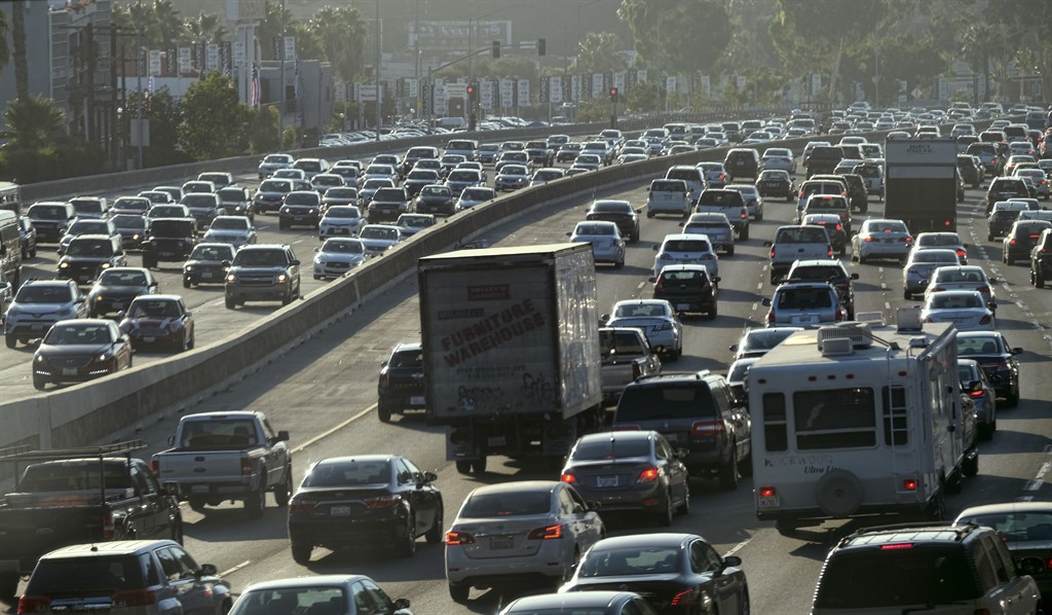
California already has the highest gas prices in the country, some of the highest vehicle fees, and a housing market that forces families to live farther from work every year. Now, the state legislature is one step closer to a new way to charge people simply for driving.
According to Assemblymember Carl DeMaio (R-75), the California State Assembly just approved AB 1421, authored by Assemblymembers Lori Wilson (D-11) and Cecilia Aguiar-Curry (D-4).
CA Democrats just voted to approve a new Mileage Tax, charging every driver in the state per mile that they drive — and that's on top of the sky-high gas taxes! Learn about our fight back to block this insane new tax — WATCH! https://t.co/OgsZZ5pfcY
— Carl DeMaio (@carldemaio) January 30, 2026
Introduced in February 2025, the bill directs state agencies to advance implementation of a mileage-based tax and return to the Legislature with recommendations on how much to charge and how the tax would be collected. While the bill does not impose a mileage tax today, it explicitly moves the state beyond exploration and toward execution.
What California is Actually Doing
What exists today is a road-charge pilot framework that dates back more than a decade, beginning in 2014 when the Legislature passed SB 1077 and directed state agencies to explore mileage-based taxation as fuel tax revenues declined. That directive led to the first statewide pilot in 2016–2017 and has since been extended, refined, and sustained through successive rounds of legislation.
Participants in the pilot pay nothing and receive simulated statements. Drivers can report miles through options that include odometer photos or devices without GPS. Location tracking is not required for everyone.
Supporters cite this as evidence that concerns are overstated. But pilot programs only answer a narrow question. They show whether something can be done, not whether it should be done.
That distinction matters because the state is no longer treating this as a purely academic exercise.
At this point, California is no longer asking whether a road-charge system is possible. It is testing how to administer it, how to enforce it, and how to normalize it.
Assemblymember David Tangipa (R-8) took to social media, warning Californians:
🚨 WARNING: Mileage tax coming to California.
— David Tangipa (@DavidTangipa) January 29, 2026
We already have the highest gas tax in America. Now the state wants to charge you again based on how far you drive on broken roads.
I ran the numbers. If this tax existed last year, my mileage tax would’ve been nearly equal to my… pic.twitter.com/WSAjzIVocE
A Mileage Tax Increases the Cost of Living
A Vehicle Mileage Tax charges people based on distance driven, and in California, distance is not evenly distributed.
The burden rises fastest on people who were priced out of closer housing and must drive farther every day. That is the defining feature of the state’s housing market. Families do not choose long commutes because they prefer them. They accept them because housing policies have pushed affordable housing farther from job centers.
A per-mile charge turns that displacement into a recurring monthly penalty.
Gas taxes at least correlate loosely with fuel consumption and vehicle choice. A mileage tax correlates with geography. It imposes higher costs on people who live farther out, often because they had no other option. That is a direct increase in the cost of living layered on top of already high housing, fuel, and vehicle expenses.
Any system that imposes its heaviest costs on people pushed farther out by housing prices is regressive in practice, no matter how it is dressed up on paper.
RELATED: California Considering Taxing Travel by Tracking Private Vehicle Mileage
Double-Charging Californians
Supporters insist that a mileage tax would replace existing fuel taxes and EV fees. That claim is the linchpin of the entire argument. Without it, a mileage tax is nothing more than a second charge layered on top of what drivers already pay.
California’s own pilot program implicitly acknowledges this risk. The pilot tested gas tax credits precisely because policymakers know that without offsets, a road charge would function as an additional tax.
The real question is not whether replacement is promised, but whether it can be trusted to hold once a new revenue stream exists.
Even if fuel taxes were repealed on day one, the risk does not disappear. It compounds. A mileage tax creates a cleaner, more flexible revenue lever for Sacramento, and history shows how those levers get used.
Temporary taxes do not sunset. Fees increase quietly. Credits erode under budget pressure. What begins as a one-for-one swap rarely stays that way once revenues are flowing and political incentives shift.
Once a mileage-based system exists, the state gains a new billing relationship with drivers. From that point forward, future increases no longer require a gas tax vote or a visible rate hike at the pump. They can be adjusted administratively, buried in budgets, and justified as technical updates.
That is why the replacement argument fails. California’s Legislature has repeatedly shown that new revenue mechanisms expand over time. And a system that depends on permanent legislative restraint to prevent double taxation is not one Californians should accept.
The Local Control Problem
Control is a bigger issue than cost.
California already uses Vehicle Miles Traveled (VMT) as a planning metric. In 2013, the Legislature passed SB 743, which shifted CEQA (California Environmental Quality Act) traffic analysis away from congestion and toward Vehicle Miles Traveled as the primary environmental metric. That reform dealt with environmental review, not taxation, but it reflects a broader institutional direction.
Less driving is better. Shorter trips are preferred. Denser patterns are encouraged. A mileage tax is the revenue version of that same worldview.
Once miles driven are priced, policy gravity shifts. Housing closer to jobs is favored. Parking requirements come under pressure. Development patterns are nudged through financial signals rather than local debate. This happens even if no one calls it land use policy.
In effect, a mileage tax turns housing affordability into a transportation tax and uses price signals to reshape development patterns. Local governments retain some formal authority, but Sacramento sets the incentives.
That is a quiet transfer of decision-making power away from cities and counties toward the state.
Administration and Privacy Issues
Mileage-based systems require tracking, billing, enforcement, and dispute resolution. Even with low-tech reporting options, administration is unavoidable. These systems cost money to operate, and those costs are built into the rates drivers pay.
Privacy protections do not remain static. Even if location tracking is optional today, future legislatures can change requirements with a simple vote. Systems evolve toward more precision and tighter enforcement over time. That is how regulatory systems mature.
The Last Off-Ramp Before This Becomes Law
California does not impose sweeping new systems overnight. It studies them, pilots them, and refines them. Then, when fiscal pressure hits, those systems are presented as the only viable option left.
With the Assembly’s passage of AB 1421, the state has moved past exploration and into implementation planning. Agencies are now tasked with developing recommendations on rates and collection. The debate has shifted from whether a mileage tax is possible to how it would be carried out.
There is no Vehicle Mileage Tax today. But the framework is built, the direction is clear, and the consequences would land on top of already high gas prices, vehicle fees, and housing-driven long commutes.
Editor’s Note: Do you enjoy RedState’s conservative reporting that takes on the radical left and woke media? Support our work so that we can continue to bring you the truth.
Join RedState VIP and use the promo code FIGHT to get 60% off your VIP membership!


Join the Conversation
VIP members get the ability to comment on articles.