



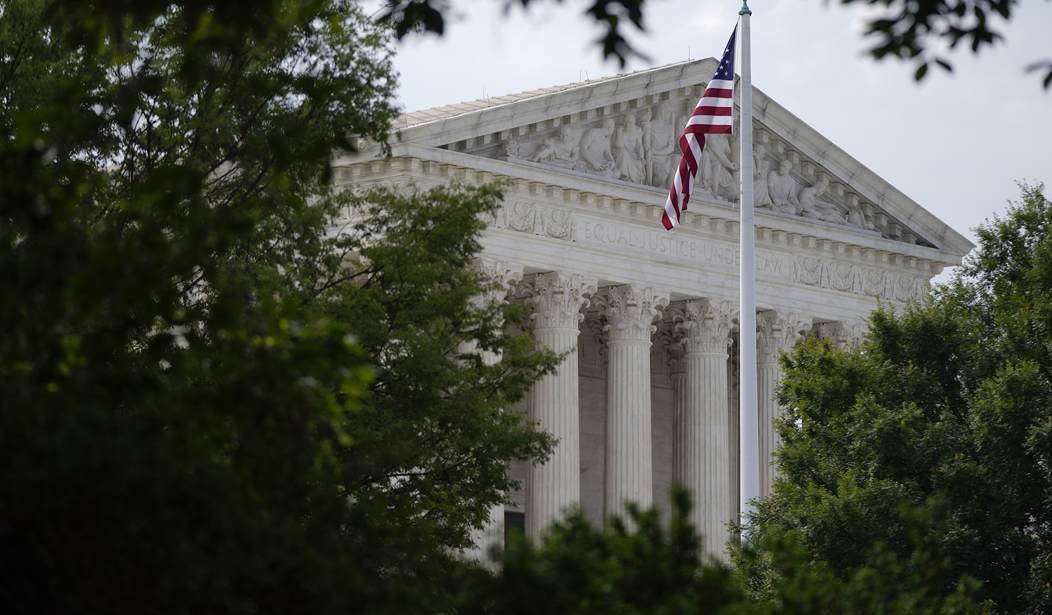
Sometimes, what you call something matters. Other times, the courts aren't particularly interested in your creative labeling.
The Supreme Court made that second point abundantly clear Monday, handing the Trump administration a win in its effort to resume border wall construction in Texas — and delivering a rather pointed lesson about the difference between constitutional claims and statutory ones.
In Mullin v. Friends of the Ruidosa Church, the High Court granted the administration's request to stay an October 2 preliminary injunction issued by a federal district judge in the Western District of Texas. That injunction had halted construction of border barriers and roads in the Big Bend Sector along the U.S.-Mexico border.
At issue is a provision of the Illegal Immigration Reform and Immigrant Responsibility Act of 1996 (IIRIRA), which gives the Homeland Security secretary broad authority to construct border barriers and waive legal requirements that might impede their construction — including environmental and conservation laws.
There's a catch for anyone wishing to challenge those waivers in court, though: Congress specifically limited judicial review to claims alleging violations of the Constitution.
Enter the plaintiffs, including a river guide, an environmental organization, and a group dedicated to preserving a historic Texas church. They challenged the administration's waivers using what's known as the major questions doctrine.
That's a legal principle requiring clear congressional authorization before federal agencies can exercise certain powers of vast economic or political significance. The plaintiffs argued that the administration lacked that authorization. And the district court agreed, concluding that the major questions doctrine is rooted in constitutional separation-of-powers principles and therefore provided a constitutional basis for the challenge.
SCOTUS delivered a big NOPE to that view, however. In an unsigned, five-page opinion, the justices explained that while the major questions doctrine certainly reflects constitutional concerns, it's still a tool courts use to interpret statutes.
And the Court didn't mince words:
There is no such thing as a “constitutional” major-questions claim.
In other words, arguing that an agency exceeded the authority Congress granted it doesn't magically become a constitutional claim simply because the underlying legal principle has constitutional roots.
Call it what you like. It's still a statutory challenge.
Moreover, Congress expressly barred the lower courts from entertaining those challenges to the secretary's waiver decisions. Thus, the Court concluded that the administration was exceedingly likely to prevail on its argument that the district court lacked jurisdiction.
The justices also noted that the injunction was costing the government nearly $500,000 per day in unrecoverable expenses, according to a Customs and Border Protection official, and interfering with Congress's expressly stated preference for expedited border construction.
Justice Ketanji Brown Jackson would have denied the stay, though she offered no written explanation.
Now, there's a caveat here: Monday's order is not a final decision resolving the underlying lawsuit. What today's order means is that the injunction remains suspended while the administration pursues Supreme Court review.
But the ruling carries significance well beyond this particular stretch of border wall.
Congress can limit lower federal courts' authority to hear certain disputes. And when it does, litigants cannot sidestep those limits simply by giving their statutory arguments a constitutional makeover. (A rose by any other name...)
It's also important to bear in mind that the separation of powers works in more than one direction. And sometimes, the most consequential question isn't whether the government acted lawfully, but whether the court had the authority to decide that question in the first place.
Editor's Note: Do you enjoy RedState's conservative reporting that takes on the radical Left and woke media? Support our work so that we can continue to bring you the truth.
Join RedState VIP and use promo code FIGHT to receive 60% off your membership.



Join the Conversation
VIP members get the ability to comment on articles.