








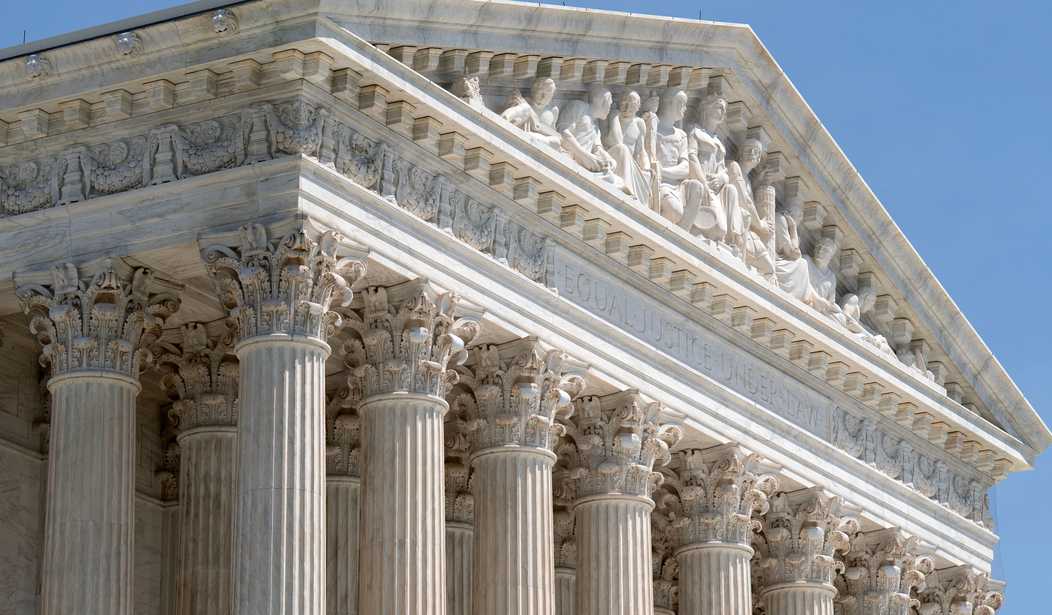
The Supreme Court handed the Trump administration a major win on Monday afternoon, staying a lower-court injunction that had blocked key provisions of President Trump's election-integrity executive order from being implemented against 23 states and D.C. for the 2026 midterms.
The Court acted in Trump v. California, granting the administration's emergency application for a stay after both the Massachusetts district court and the 1st Circuit Court of Appeals had declined to let the challenged provisions take effect.
One key thing to note: With its Monday ruling, the Court did not decide whether Trump's directives ultimately will be found lawful. Instead, it concluded the government is likely to succeed in arguing that the states lacked standing and that their challenge was premature. So, this is a procedural win, but a significant one at that.
President Trump's executive order contained three key provisions:
- The Department of Homeland Security (DHS) is directed, where feasible and lawful, to compile and provide states with citizenship lists for voting-age residents.
- The Department of Justice (DOJ) is directed to prioritize investigation and prosecution of violations of existing federal laws involving ballots provided to ineligible voters.
- The United States Postal Service (USPS) is directed to undertake rulemaking involving new tracking/barcoding and voter-list procedures for mail ballots — and USPS has now completed that process, announcing its final rule Friday. (The final rule requires participating states to provide USPS lists of voters issued mail-in or absentee ballots and uses unique Intelligent Mail barcodes to link and track outgoing and return ballot envelopes.)
READ MORE: A Major New Mail-In Voting Rule Is Ready to Go — but There's One Big Problem
The Massachusetts court (Judge Indira Talwani) permanently enjoined those provisions as to the plaintiff states for the 2026 election. On appeal, the 1st Circuit refused to stay that ruling.
The administration filed an emergency application with the Supreme Court in late July. Monday's decision from the Supreme Court is per curiam (but Justices Sonia Sotomayor, Elena Kagan, and Ketanji Brown Jackson dissented).
In its 10-page decision, the majority essentially finds that the plaintiff states jumped the gun, and repeatedly emphasizes that the EO itself is an internal directive to executive-branch officials and doesn't require the states to do anything. As to the citizenship lists, the Court finds that any claimed injury depends on what DHS ultimately does, whether creation of the lists is feasible, how they're implemented, and whether states actually suffer harm.
As the decision notes: "Article III prohibits federal courts from stacking hypothetical on hypothetical to speculate that harm will eventually materialize." The majority also points out that states can't create standing simply by spending money now in anticipation of a speculative future requirement.
As to the DOJ and mail ballot provisions, the Court says setting federal prosecutorial priorities falls within the President's Article II authority, while rejecting the states' claim that officials presently face prosecution for refusing to use DHS citizenship lists. Likewise, the Court notes that the USPS provision in the executive order directed the agency to undertake rulemaking; it did not itself impose a final rule on the states.
With November approaching, leaving the injunction intact would prevent the administration from pursuing these initiatives for the midterms while the litigation works its way through the courts. SCOTUS therefore found irreparable harm to the executive branch from being prevented even from attempting lawful implementation.
The injunction is stayed through the 1st Circuit proceedings and any timely cert petition; if SCOTUS ultimately grants review, the stay continues through its judgment.
However, as noted above, there's an added wrinkle in that the USPS has now come out with its final rule. That said, the Court's standing analysis focuses on the circumstances at the time the states filed suit, when there was no final USPS rule. The majority therefore says the states' original challenge depended on speculation about whether USPS would ultimately issue a rule, what it would contain, and whether it would injure them.
Now that that contingency has occurred, SCOTUS effectively points the states toward their next move, saying: “If the Postal Service's final rule harms the States, they may challenge that rule.” So today's ruling doesn't necessarily settle the legal fate of the new USPS rule; rather, it removes the injunction against the underlying executive order while leaving the door open to a fresh challenge directed at the now-finalized rule itself.
The dissents are...what one might expect: Sotomayor, joined by Kagan, argues that the threat to states is concrete enough already and flags the government's seemingly conflicting positions: implementation is speculative when discussing the states' injury but urgent when discussing the government's.
Jackson goes considerably further, accusing the administration of trying to “foment chaos ahead of the November elections” and describing the litigation situation as “Kafkaesque.”
Again, this isn't a ruling that Trump's election integrity policies are lawful. It's a ruling that states can't block them based on harms that haven't happened yet. As the Court puts it:
The Court’s disposition of this application does not mean that any measure taken by the Government to implement the Order will necessarily be lawful. On that score, time will tell. But the Order itself does not harm the States, so the District Court lacked jurisdiction to bar the Government from trying to implement it. And for the reasons discussed, that injunction is likely to irreparably harm the Government if it remains in place while the appellate process runs its course.
This isn't the final word on the matter — but it's a significant one as November looms.
Editor's Note: Unelected federal judges are obstructing President Trump's agenda and ignoring the will of the people.
Help us expose out-of-control judges determined to halt President Trump's mandate for change. Join RedState VIP and use promo code FIGHT to receive 60% off your membership.

Join the Conversation
VIP members get the ability to comment on articles.