






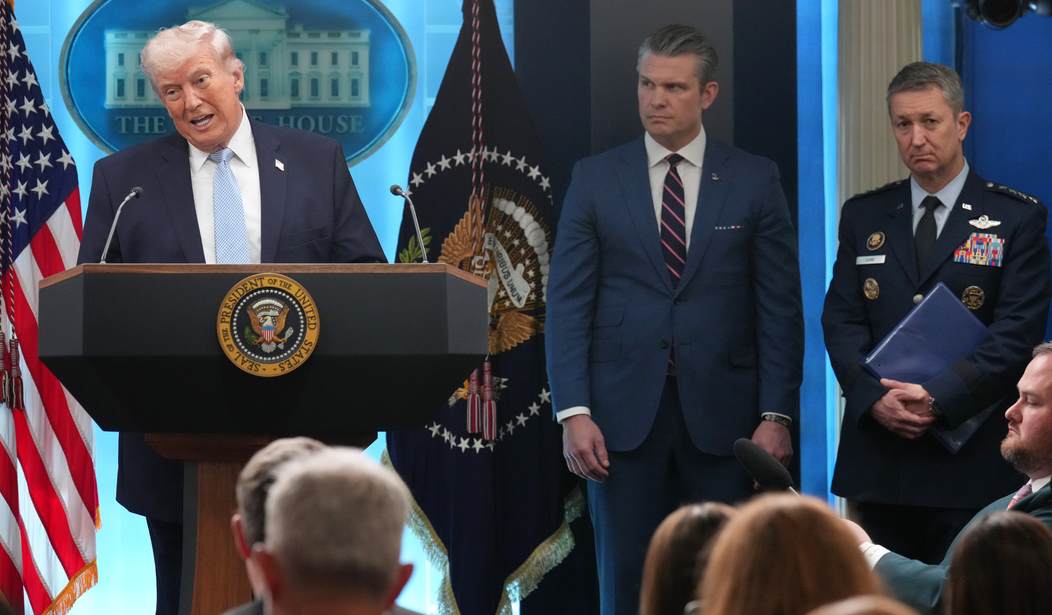
Monday afternoon's press briefing on Operation Epic Fury and the daring rescue mission to retrieve our downed airmen from behind enemy lines was chock full of information. We heard from President Trump, CIA Director John Ratcliffe, Secretary of War Pete Hegseth, and Joint Chiefs of Staff Chair Dan Caine, and each shared some of the critical elements of the mission.
Hegseth and Caine laid out many of the operational details, explaining how teamwork, firepower, and precision helped make the mission a success. Their full remarks are included below, but I'm highlighting some of the key operational details of the mission here.
As Hegseth explained:
"In two extraordinary combat search and rescue operations deep inside enemy territory in Iran, our warriors executed missions of breathtaking skill, courage, and precision.
"Special operators supported by elite air crews and intelligence professionals moved swiftly and decisively into treacherous mountain terrain under the constant threat of Iranian forces closing in.
...
"Now, these are not routine operations. They were high-risk, high-stakes missions conducted in the heart of enemy territory.
"This was not just barely into Iran. This was deep into Iran, involving coordinated strikes to suppress threats, deception tactics to protect our teams, and full synchronization across air, ground, and special operations.
"The Iranians are still asking themselves right now, how did the Americans do this?"
Of the first mission, Hegseth said:
"The first mission, the first of two, was an audacious daylight thunder run right up the middle.
"It was authorized in less than two hours from that pilot going down, when we knew where he was, and it was authorized in the middle of the night because anybody that’s worked for this man knows he’s up in the middle of the night."
Then, onto the second, in which he noted the CIA's assistance:
"The second mission, as soon as we knew where that pilot was — and John was certainly helpful in that also — executed immediately."
And here's something to note:
"I looked up at my screen when the final mission was complete inside our SCIF, our secure facility.
"And we have a running VTC, a running coordination cell, and the top of it read 45 hours and 56 minutes.
"For 45 hours and 56 minutes, we held that call open for coordination.
"From the moment our pilots went down, our mission was unblinking.
"The call never dropped.
"The meeting never stopped.
"The planning never ceased."
Like Ratcliffe, Hegseth praised President Trump's decisive leadership. And then he included a direct message to Tehran:
"The United States military will go anywhere at any time to protect our own and complete the mission.
"We execute with precision.
"We control the skies.
"You see, we flew for seven hours in daylight over Iran to get the first pilot.
"And we flew seven hours in the middle of the night to get the second.
"And Iran did nothing about it."
ALSO SEE: Trump Vows to Hunt Down, Jail Leaker Who Endangered Missing F-15 Pilot by Tipping Off Iran
CIA Chief: Trump Ordered a No-Fail Mission and America’s Aviator Came Home
General Caine then spoke, noting at the outset that there were certain details he could disclose and others he could not.
"On Thursday, 2 April, at 10:10 p.m. Eastern time — 4:40 in the morning local Iran time — the Joint Personnel Recovery Center, which handles the Central Command area of responsibility, declared an isolated personnel recovery event for a U.S. Air Force F-15E Strike Eagle, call sign Dude 44, which was down in hostile Iranian territory.
"The pilot and weapons system officer had both safely ejected and were isolated behind enemy lines.
"Following confirmation of active rescue beacons, and on the direction of the secretary and by order of the president, a rescue operation was launched with the stated purpose of bringing both Americans home safely."
Of the mission to rescue the pilot, Caine said:
"As the secretary said, several hours later, on the morning after positively locating the front-seater, call sign Dude 44 Alpha, and aware of an aggressive ongoing search by the enemy, a U.S. Central Command plan was approved by the secretary and the president.
"Shortly thereafter, a U.S. Air Force combat search and rescue task force comprised of A-10 Warthogs in their Sandy role — and I’ll describe what that is in a minute — HC-130 Combat King IIs, HH-60 Jolly Green II helicopters, and Air Force special warfare airmen, a package comprised of combat rescue officers and pararescuemen operators, audaciously penetrated enemy territory in broad daylight to find, fix, and recover Dude 44 Alpha from behind enemy lines."
He detailed the perils of that mission:
"Over the next hours, the search and rescue task force crossed the beach, entered into Iranian airspace, protected by a fighter strike package, and moved into the objective area, all under fire.
"En route, as some of you have seen on social media, the helicopters took gas off the C-130s and pressed onward and forward up into the objective area.
"While this was ongoing, and out in front of them, the Sandy flight of A-10s and other remotely piloted aircraft, drones, and other tactical aircraft were violently suppressing and engaging the enemy in a close-in gunfight to keep them away from the front-seater and allow the pickup force to get into the objective area.
"During this engagement, one of the Sandy aircraft, the one primarily responsible for communicating with the downed pilot, was hit by enemy fire.
"This pilot continued to fight, continued the mission, and then upon exit flew his aircraft into another country and determined that the airplane was not landable. This was one of our A-10 Sandy aircraft.
"The pilot then made the decision to eject over friendly territory and was quickly and safely recovered and is doing fine.
"After picking up Dude 44 Alpha, the HH-60 Jolly Green flight was engaged by every single person in Iran who had a small arms weapon. And one of the aircraft, the trailing aircraft, took several hits.
"The crew sustained minor injury, and they are going to be fine.
"A note for those of you that do not know what a Sandy does. Named after the flight call sign that did this very mission in Vietnam, flying A-1 Skyraiders and A-7 Corsairs, a Sandy has one mission: get to the survivor, bring the rescue force forward, and put themselves between that survivor on the ground and the enemy.
"They are committed to this. This is what they live for, and this is what they’ve trained for over many, many years.
"The A-10 force and the rescue force did a fantastic job rescuing Dude 44 Alpha.
"He was recovered Friday afternoon."
Then, onto the weapons system officer, or "backseater," a mission that required solid interagency collaboration:
"Meanwhile, the backseater, as the president and secretary have said, had continued to work and survive through the hours of daylight.
"Dude 44 Bravo, the backseater, evaded using every means available.
"The efforts of the United States military, the Central Intelligence Agency, and others were attempting to find and locate with precision Dude 44 Bravo, the backseater.
...
"On Saturday, 4 April, after establishing positive communications with the backseater, we learned, as the president said, that he was injured and actively evading enemy forces.
"And thanks to our interagency partners, we were able to get eyes on his location and positively ID him.
"Throughout this entire time, the enemy force continued to search for 44 Bravo, and the joint force continued to strike them over and over and over again, fighting off marginal weather in Iran and the enemy’s search.
"For a second time on Saturday, at the recommendation of the CENTCOM commander and at the approval of the secretary and the president, we launched a rescue task force to recover Dude 44 Bravo.
"Again, this came to the president and the secretary for approval.
"This time with a much larger force package based on the time that the enemy had to prepare to find 44 Bravo.
"Again, this force was protected by A-10 Warthogs using the Sandy call sign.
"And this force had one single mission: do everything they can to bring an American home.
"This meant having a plan, being prepared to execute that plan, and more importantly being prepared for multiple simultaneous contingencies.
"And because of this force’s professionalism, grit, and determination, they fought off two enemies at the same time: the enemy searching for 44 Bravo and contingencies, which anyone who has done these types of missions knows we run into every single time.
"The force fought off both of those enemies incredibly well.
"During the period of darkness on Saturday and, as the secretary said, into Easter Sunday and into the daylight, the force fought its way in and rescued Dude 44 Bravo.
"They were protected overhead by an air armada, including tactical drones, strike aircraft, and others.
"The force fought through multiple simultaneous contingencies, something no other nation, no other military can do, and safely returned Dude 44 Bravo, the backseater, home, and all other Americans home as well.
"At midnight local Eastern time, Easter Sunday, more than 50 hours after the start of this operation, the Joint Personnel Recovery Center declared Dude 44 Bravo, both the front- and backseater, returned to friendly territory."
Having never served in the military myself, I'm reluctant to presume much about the troops' attitudes and morale, but I have to believe it benefits them to hear words like this from the Joint Chiefs' Chair and SecWar.
First, from Caine:
"A note on the backseater and the front-seater: the single most important contributor to a successful rescue operation is the spirit of attack inside the heart of that downed aviator.
"Their will to survive, their will to evade, their will to recover is everything.
"In this case, the backseater’s absolute commitment to surviving made much of our efforts possible.
...
"The courage demonstrated by both the pilot and the weapons system officer while isolated and evading the enemy cannot be overstated.
"Their grit and warfighting tenacity is a direct result of the absolute trust they have in our rescue forces, their training, and their will to survive and return.
"They always knew that we would be ordered to go get them, and they always knew that we would be coming to get them.
"These two operations reflect our nation’s most sacred obligation to our military service members: we leave no one behind.
...
"It also perfectly captures the first truth of our special operations forces, that people are more important than hardware.
"That is the standard we live by, and the rescue forces that execute these missions operate under a clear motto: these things we do that others may live.
"Their actions were a direct embodiment of that commitment to others, and I could not be more proud of each and every one of them today."
In his remarks, Hegseth also shared the powerful message received from the second airman, confirming that he was alive and the amazing timing and context of it all:
"One downed airman evaded capture for more than a day, scaling rugged ridges while hunted by the enemy.
"When he was finally able to activate his emergency transponder, his first message was simple, and it was powerful.
"He sent a message: 'God is good.'”
"In that moment of isolation and danger, his faith and fighting spirit shone through.
"You see, shot down on a Friday — Good Friday — hidden in a cave, a crevice, all of Saturday, and rescued on Sunday.
"Flown out of Iran as the sun was rising on Easter Sunday.
"A pilot reborn, all home and accounted for, a nation rejoicing.
"God is good."
God is good, indeed.
Editor's Note: For decades, former presidents have been all talk and no action. Now, Donald Trump is eliminating the threat from Iran once and for all.
Help us report the truth about the Trump administration’s decisive actions to keep Americans safe and bring peace to the world. Join RedState VIP and use promo code FIGHT to get 60% off your VIP membership.
Join the Conversation
VIP members get the ability to comment on articles.