








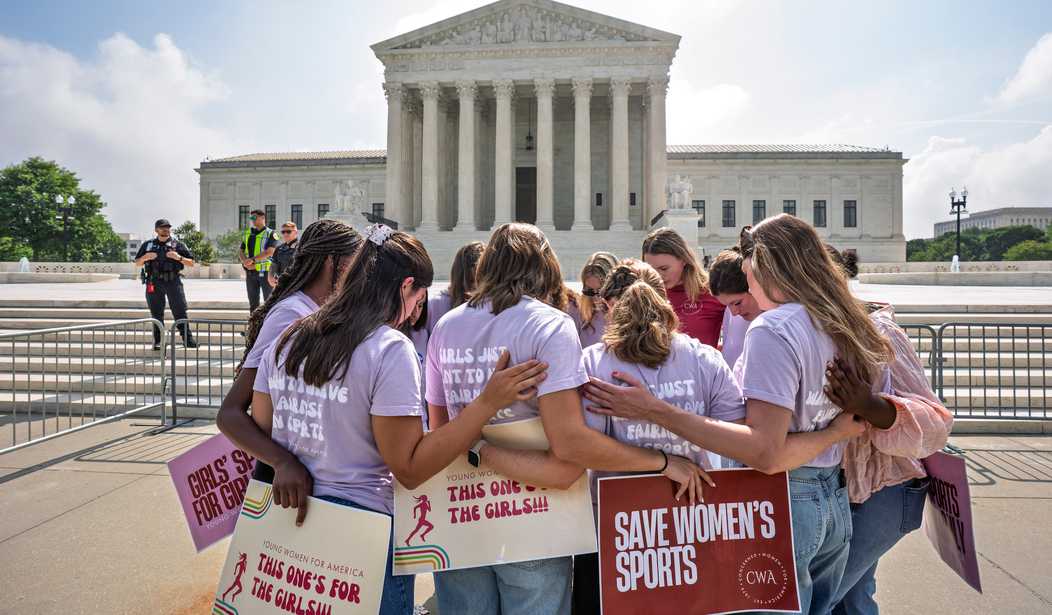
On the final day of the Supreme Court’s term, a day often reserved for the most consequential and high-profile opinions, the Court ruled in West Virginia v. B.P.J. that Title IX and the Constitution’s Equal Protection Clause do not prevent states from restricting girls’ and women’s sports to biological women. After twenty-seven states passed such laws, thus preventing biological males who identify as transgender women from playing on women’s teams, challenges to West Virginia and Idaho’s laws reached the Supreme Court. Paradoxically, the challengers to these laws argued that Title IX — a law that codified women’s rights to equal educational opportunities, including in athletics — required states to let trans-identifying biological males compete against women. Sanity prevailed, and the Court ruled that neither Title IX nor the Constitution prevented states from passing legislation separating sports by sex without an exception for those identifying as transgender.
The majority opinion, written by Justice Brett Kavanaugh and joined by the Court's conservatives, affirmed what biology and decades of athletic reality have long made obvious: Title IX was enacted to ensure that girls or women have access to the same athletic opportunities as boys and men. It does not compel states to force girls to compete against and alongside boys who identify as girls.
The Court’s decision is a just conclusion to years of activist-driven litigation that twisted a landmark civil-rights law — passed to guarantee women equal educational opportunities — into a vehicle for erasing sex-based categories. Challengers, including B.P.J. (a biological male identifying as female), argued that excluding transgender athletes from girls’ teams somehow violated the statute that paved the way for the existence of girls’ teams in the first place. Title IX and its implementing regulations, the Court explained, have always understood “sex” as biological sex — the immutable characteristic at the center of the 1972 statute. The Javits Amendment explicitly authorized separate teams for each sex in light of physical differences, and the 1975 regulations permitted sex-segregated athletics precisely to ensure “equal athletic opportunity.” As Title IX expressly authorized states to create separate sporting categories based on sex, states did not violate Title IX by using sex and sex alone to distinguish between men's and women’s teams.
On the constitutional question, the Court held that the West Virginia and Idaho laws do not violate the Equal Protection Clause of the Fourteenth Amendment. Sex-based classifications are subject to “intermediate scrutiny” under the Equal Protection Clause, meaning the government must show that the classification is substantially related to an important governmental interest. The majority reasoned that safety and competitive fairness are unquestionably important governmental interests, and limiting women’s sports to biological females is substantially related to both due to the well-documented and enduring physical differences between biological males and females in height, weight, strength, speed, and endurance. The plaintiffs focused on a narrow subclass of transgender athletes like the named plaintiff, B.P.J., who had taken puberty blockers and cross-sex hormones, raising the question of whether they had the same advantages as other male athletes. The liberal dissenters, led by Justice Sotomayor, found this argument compelling enough to warrant further factual development in the lower courts rather than outright rejection. In their view, the Equal Protection Clause requires courts to take a hard look at whether a sex-based classification actually serves the state’s interests and if transgender girls who never experienced male puberty pose no competitive fairness or safety concern, then excluding them may be unconstitutional. The majority rejected this approach, holding that intermediate scrutiny does not require states to carve out individual exemptions, that courts are ill-equipped to conduct athlete-by-athlete hormonal assessments, and that legislatures — not judges — are the appropriate institutions to weigh evolving medical and scientific evidence about the effects of puberty blockers and hormone therapy on athletic performance.
ALSO SEE: Supreme Court Delivers Landmark Title IX Win for Women's Sports
A 'BIG WIN' — Trump Hails SCOTUS for Political Spending and Men in Women's Sports Rulings
Justice Thomas’s short but powerful concurrence contained an even simpler rejoinder: Transgender identity is not the type of immutable characteristic protected by the Equal Protection Clause, but rather, a mutable characteristic arising from gender dysphoria. Other judges should heed Justice Thomas’s distinction between sex and gender dysphoria. Earlier this year, for example, the Ninth Circuit required a Korean spa in Washington State to allow biological men who identify as women to enter the women-only spa. This ruling highlights the absurd and unjust consequences that flow from treating identity as equivalent to biological reality.
While the Court’s ruling was a decisive victory for the twenty-seven states that passed legislation protecting women's sports, it is important to understand what the decision did not hold. The majority was careful to note that these cases presented only the question of whether Title IX and the Equal Protection Clause permit states to restrict women’s sports to biological females — not whether Title IX requires them to do so. The question of whether a state violates Title IX by permitting biological males to compete as women was not before the Court, and the majority expressly declined to address that question. In other words, B.P.J. establishes a constitutional and statutory floor, not a ceiling: States may exclude biological males from women's sports, but the Court left open whether a more permissive state policy would itself run afoul of Title IX’s guarantee of equal athletic opportunity for biological females. B.P.J. will likely not be the Court’s final word on the issue: Challenges to state laws that permit biological males on girls’ teams are percolating through the lower courts (including Soule v. Connecticut Association of Schools) and are bound to reach the Supreme Court in due time. When that happens, the Court should make clear that Title IX requires that girls’ sports are just that — not sports for girls and boys who identify as girls. Any contrary result would subject female athletes to the same competitive fairness and safety concerns Justice Kavanaugh identified.
The millions of girls who have trained, competed, and sacrificed to excel at sports should celebrate the Court’s decision. For fifty years, Title IX has filled gyms, fields, and tracks with women who earned their place through talent and hard work. The Court's ruling ensures that those opportunities remain what they have always been: reserved for women. The litigation over the outer boundaries of Title IX is not finished. The question of whether Title IX affirmatively requires states to protect women’s sports from biological male competition remains unanswered. But this week, the Court drew a clear and correct line. Whatever debates lie ahead, no federal court can now order a state to place biological males on girls’ teams, no statute can be read to demand it, and no amount of activist litigation can change it. For female athletes across America, that is no small thing.
Jesse D. Franklin-Murdock is the Miles Visiting Fellow at the Center for American Liberty. He is also a partner at Sweigart Murdock, LLP, in San Francisco, where his litigation practice focuses on First Amendment and defamation law, civil rights, and political law. The Center for American Liberty submitted an amicus brief supporting the state petitioners in B.P.J.
Editor's Note: Do you enjoy RedState's conservative reporting that takes on the radical Left and woke media? Support our work so that we can continue to bring you the truth.
Join RedState VIP and use promo code FIGHT to receive 60% off your membership.

Join the Conversation
VIP members get the ability to comment on articles.