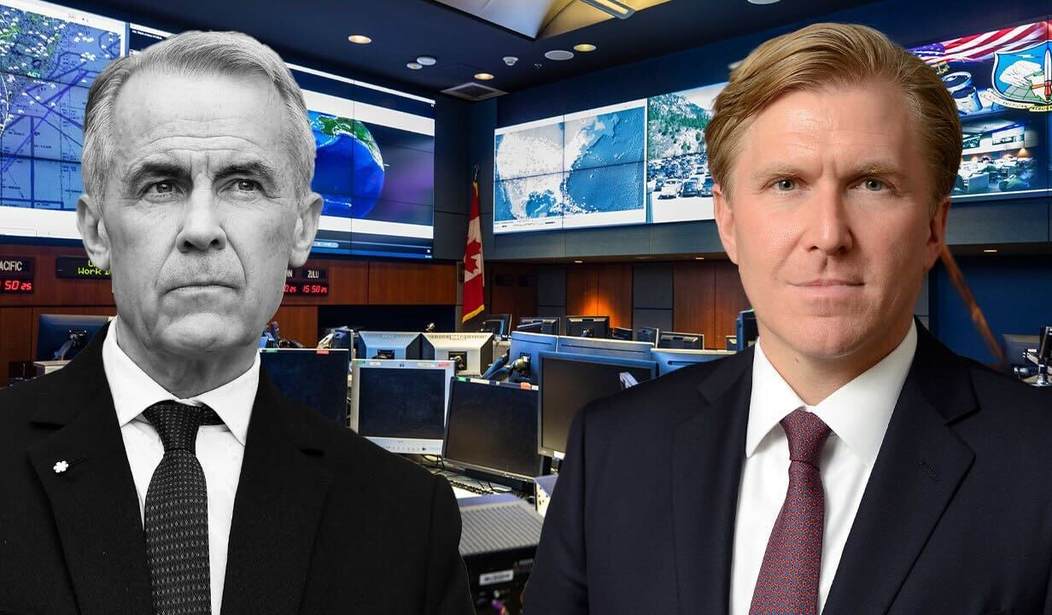
A 1940 fireside meeting between U.S. President Franklin D. Roosevelt and former Canadian Prime Minister Mackenzie King has quietly shaped every major North American defense project for nearly a century. King fought hardest to expand Canadian autonomy from Britain, and now, under Mark Carney’s aggressive push for “strategic autonomy” from the United States, that partnership has been suspended.
Under Secretary of War Policy Elbridge Colby dropped a surprise statement this week announcing that the U.S. is pausing participation in the 86-year-old Permanent Joint Board on Defense with Canada. The decision was handed down after months of consideration and is a clear signal that the Department of War is done indulging Prime Minister Mark Carney’s puffy rhetoric while Canada drags its feet on strengthening continental defense alongside its most crucial ally.
Back in January, at the World Economic Forum in Davos, Carney used his address to deliver a manifesto that openly criticized American “hegemony” while urging other nations to reduce cooperation with the U.S.-led political order. He declared the modern understanding of the geopolitical system was mere fiction and prioritized what he called “strategic autonomy,” a diversification away from U.S. suppliers. “The days of our military sending 70 cents of every dollar to the United States are over,” said Carney.
By suspending participation in the agreement, Washington has effectively dismantled Canada’s crucial forum for joint military planning, intelligence sharing, and continental defense coordination. The suspension will force Prime Minister Carney to prove he can deliver the “strategic autonomy” and reduced U.S. dependence he championed in Davos. The decoupling he demanded, however, will come with costs far steeper than his rhetoric ever suggested. Without an ongoing defense policy forum with the U.S., Canada will also lose its main channel to influence NORAD modernization, Arctic surveillance efforts, and shared military supply chains, leaving Ottawa with larger capability gaps and greater dependence on its limited domestic defense industry.
Colby stated bluntly that “Canada has failed to make credible progress on its defense commitments,” adding that the Department of War made the decision to “reassess how this forum benefits shared North American defense.” Colby emphasized that “a strong Canada that prioritizes hard power over rhetoric benefits us all” and linked directly to Carney’s Davos speech as evidence of the “gaps between rhetoric and reality” that can no longer be ignored.
On Tuesday, Prime Minister Mark Carney downplayed the move during a Quebec news conference, noting the board “has a long heritage” but saying he “wouldn’t overplay the importance of this.” He insisted Canada remains committed to coordination with the U.S. while accelerating diversification of defense ties with other NATO partners.
Carney’s foreign policy and commitment to the U.S. have been erratic at best.
He has repeatedly flip-flopped between rhetoric that appears to back American leadership and statements intended to stoke tension. This mixed messaging has played out across key issues facing the continent. On Arctic security, Carney has voiced support for strengthened NORAD cooperation but sided with Denmark and Greenland in their resistance to proposals for expanded American strategic access and control, which directly complicated Washington’s efforts to bolster missile defense and counter growing Russian and Chinese influence in the region.
When it comes to Iran, he has condemned the regime as a source of terror and supported efforts to block its nuclear ambitions, yet criticized Operation Epic Fury as a “failure of the international order.” Carney has repeatedly ruled out direct Canadian military participation in contingencies for potential Strait of Hormuz carnage caused by Tehran. President Trump withdrew Canada’s invitation to the Gaza Board of Peace after Carney publicly railed against the board’s composition and lack of control the U.N. was given over its functions. Even Justin Trudeau maintained more consistent defense cooperation during the first Trump administration despite disputes over NAFTA and steel tariffs. Under Trudeau, Canada announced a 73% increase over a decade of defense spending to acquiesce to the U.S. continental defense strategy. Trudeau and President Trump even issued a joint statement on the urgency to modernize NORAD.
The Trump administration views North America’s defense as reliant upon a credible forward posture against Chinese and Russian encroachment in the Arctic and beyond. Weak Canadian investment and procurement shifts toward European systems erode power projection and logistics America would rely on in the event of a threat. Beijing notices this friction; it benefits from any wedge that slows NORAD modernization or diverts Canadian resources away from the U.S. orbit. A stronger, U.S.-aligned Canada deters adversaries more effectively than Ottawa’s autonomy play ever could. The day Carney realizes that is the day the North American allies can resume the key bilateral forum, or else the fireside accord that lit North America’s defense for nearly a century could go dark.
Editor’s Note: Thanks to President Trump and his administration’s bold leadership, we are respected on the world stage, and our enemies are being put on notice.
Help us continue to report on the administration’s peace through strength foreign policy and its successes. Join RedState VIP and use promo code FIGHT to receive 60% off your membership.










Join the conversation as a VIP Member