








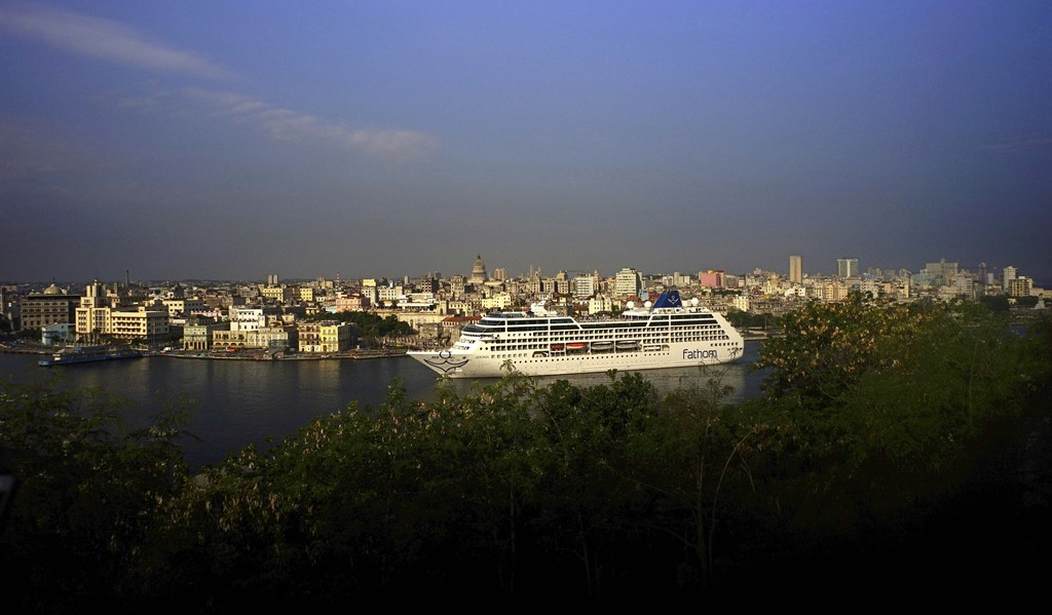
A Supreme Court ruling handed down on Thursday may end up being worth hundreds of millions of dollars for the Havana Docks Corp.
In 1960, after the Cuban Revolution, Fidel Castro’s regime simply took the company’s facilities and made them its own. That’s communism for you, folks. Like democratic socialists Zohran Mamdani and Alexandria Ocasio-Cortez, they may have big smiles, but in the end, they want to take your stuff.
Decades later, the overlords decided to let major cruise lines use the docks, but those cruise lines never paid a dime to the rightful owners.
The SCOTUS ruling could change that:
The Supreme Court on Thursday made it easier for American companies to get financial compensation if they owned property in Cuba that was confiscated by the Communist regime.
In an 8-1 decision, the court revived a series of nine-figure judgments that an American company, Havana Docks Corp., obtained against four international cruise ship operators. Havana Docks says the cruise companies have illegally profited off docks and piers that Fidel Castro seized after the Cuban Revolution.
In an 8-1 vote, the Supreme Court has revived a lawsuit against four major cruise lines over their use of Havana port facilities allegedly seized by Cuba after Castro’s revolution. pic.twitter.com/1dqpIKoY2z
— SCOTUS Wire (@scotus_wire) May 21, 2026
Although the Supreme Court operates on its own schedule, the timing is noteworthy because it comes as the Trump administration has turned up the heat to eleven on the República de Cuba, cutting off their oil supply, issuing punitive sanctions, and even implying that military action could soon be coming.
MORE: The Nimitz Enters the Chat: Carrier Strike Group Arrives in Caribbean As US-Cuba Tensions Increase
'We Have Cuba on Our Mind': Trump Reacts to Raúl Castro Indictment
Quite simply, the dictatorial Castro regime did the Havana Docks Corp. wrong:
The case at the Supreme Court involved facilities at the Port of Havana that Havana Docks began using in 1928. Havana Docks had a long-term property agreement that entitled the company to operate the docks until 2004. But in 1960, Cuba’s new Communist government took control of the docks without compensating the company.
“At that point, the docks were tainted as confiscated property,” Justice Clarence Thomas wrote in the majority opinion.
Decades later, cruise ship operators got permission from the Cuban government to do business there and started using the docks for international cruises. Between 2016 and 2019, four cruise companies—Royal Caribbean Cruises, Norwegian Cruise Line Holdings, Carnival Corp. and MSC Cruises—transported nearly a million cruise passengers through Cuba.
But the court said that the cruise lines’ use of the confiscated docks qualified as “trafficking”:
The Court said the cruise lines’ use of the Havana docks can qualify as “trafficking” under federal law, reopening claims worth hundreds of millions of dollars.
— SCOTUS Wire (@scotus_wire) May 21, 2026
There’s a long and tortured history to the case: The company obtained $110 million judgments against four cruise companies, Royal Caribbean Cruises, Norwegian Cruise Line Holdings, and Carnival Corp., but a federal appeals court tossed them, saying the company’s concession would have expired in 2004. SCOTUS just revived the lawsuits, ruling that the cruise lines could still face liability even though Havana Docks’ concession expired in 2004, and sent the cases back to the lower courts.
Congress passed the law that enabled Havana Docks to sue, the Cuban Liberty and Democratic Solidarity Act (also known as the Helms‑Burton Act), in 1996 after Cuba shot down two unarmed civilian planes, killing four.
Interestingly, the Department of Justice indicted Fidel’s brother Raúl Castro on Wednesday for masterminding those murders.
U.S. companies were prevented from taking advantage of the law for decades because Presidents Clinton, George W. Bush, and Obama ordered a suspension of its provisions for foreign-policy reasons. President Donald Trump let the suspension lapse in his first term in the Oval Office.
The longest-serving jurist on the Court wrote the majority opinion, while Elena Kagan dissented with the “concession would have expired” argument:
Writing for the majority, Justice Clarence Thomas said the company had only to show the cruise lines used confiscated property — the docks themselves — not that they trafficked in Havana Docks’ expired ownership interest. Confiscated property is “tainted,” Thomas wrote, “such that anyone who uses the property can be liable to those who had an interest” in it...
In dissent, Justice Elena Kagan said the docks always belonged to Cuba, not Havana Docks, which she likened to “a renter with a lease” set to expire in 2004. The cruise lines, she wrote, “did not traffic in Havana Docks’ time-limited — and long-ago expired — concession.”
Justice Kagan dissents, arguing the cruise lines did not traffic in property confiscated from Havana Docks because the company only had a temporary right to use the docks, and that right expired years before the cruises began.
— SCOTUS Wire (@scotus_wire) May 21, 2026
Although the ruling isn’t directly against the Cuban government, it’s yet another sign that their tyrannical past (and present) is coming back to haunt them.
Editor’s Note: Thanks to President Trump and his administration’s bold leadership, we are respected on the world stage, and our enemies are being put on notice.
Help us continue to report on the administration’s peace through strength foreign policy and its successes. Join RedState VIP and use promo code FIGHT to receive 60% off your membership.


Join the Conversation
VIP members get the ability to comment on articles.