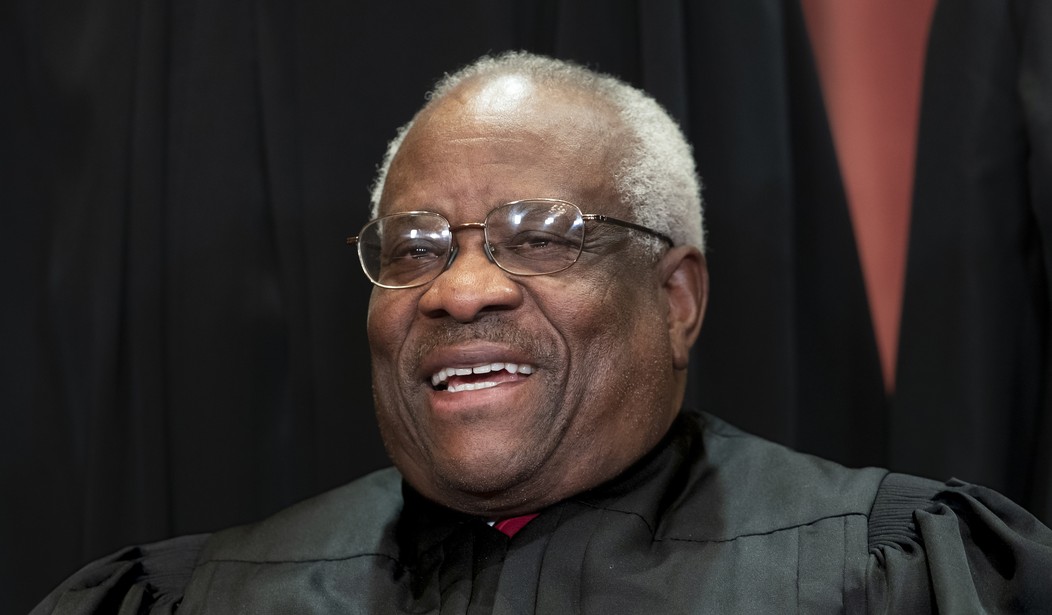

Supreme Court Justice Clarence Thomas gave a speech at the University of Texas at Austin on Wednesday to mark the 250th anniversary of the Declaration of Independence.
It was a powerful tribute to the founding principles of our country and a damning indictment of the dangers of progressivism to those ideals. He called out the "cynicism, rejection, hostility, and animus" towards those ideals.
Thomas started by explaining how, even as a child, at home, at church, and at school (a Catholic school), he was taught that we were all equal and that our rights came from God. Therefore, they could not be denied by man, even as some were trying to deny them those rights. "It was beyond the power of man to alter," he explained. "Others could treat us as unequal," he said, "But they lacked the divine power to make us so." These rights transcended governmental power or authority. "We knew that life, liberty, and property were sacrosanct. Those truths were self-evident to the adults in our lives and were taught to us as indelible, undeniable truths."
Thomas chided those who took those basic ideals of the Declaration and treated them as "esoteric philosophy." "They overcomplicate them, take the spirit out of them," he advised. They are not an abstract theory, but a "way of life" that you can learn from the people all around you.
That is the sense in which he knew the principles of the Declaration of Independence as a child, and that is "the only sense in which those principles can sustain our country," he declared. Despite our failings, it "gave us the freest, the wealthiest, and most powerful nation in the world."
Thomas reminded the audience of the bravery of those men who signed the Declaration, and risked their lives and liberty to take that stand. He read the last line, so people would not forget it, "And for the support of this Declaration, with a firm reliance on the protection of Divine Providence, we mutually pledge to each other our Lives, our Fortunes, and our sacred Honor." "It was a supreme act of courage. Those principles were more important than their fear," Thomas said.
That is the most important part of the Declaration, he asserted.
"What changed the world was not the words, but the commitment and the spirit of the people who were willing to labor, sacrifice, and even give their lives, what Lincoln at Gettysburg called, 'The last full measure of devotion' for the Declaration's principles. It is that devotion to which we owe our rich inheritance."
That devotion has animated Americans ever since, Thomas said: "Think of how that devotion has carried us from Independence Hall to Flanders Field, and the beaches of Normandy." He spoke of the devotion of the Flight 93 passengers who fought back on 9/11 and that of his grandparents, who were determined that he be raised right. It was that willingness to take action that "has been most indispensable."
It was that devotion that we needed today, he warned, if this nation is to endure. Many in Washington spout high-minded words, but do not have the devotion to hold up the ideals. "They recast themselves as institutionalists, pragmatists or thoughtful moderates, all as a way of justifying their failures to themselves, their consciences, and their country," he said.
When Americans look to Washington and wonder why it so often disappoints, it is not because there are too few people who know what is right. It is not because we lack the intellect, or the capacity, or the talent. It is instead because there are too few people who are willing to do what it takes to do the right thing, to sacrifice the popularity, flattery, comfort, and security that are the purchase price for principle. It is because too few of us reflect on, and reflect, the courage and commitment of that final sentence of the Declaration. And so many seem to have forgotten how much others have sacrificed so that this nation can exist and endure.
"None of our rights come from the government," he continued.
"All of the government's authority comes from our consent. And the structure and limited role of government is to assure that it does not exceed the authority to which we have consented or intrude on our natural rights. The Constitution is the means of government. It is the Declaration that announces the ends for government. The Constitution achieves its purpose by protecting our natural rights and our liberties from concentrated power and excessive democracy."
Having laid out the bedrock, he then warned what was threatening it and the dangers of "progressivism" that was opposed to the principles of the Declaration. "It is not possible for the two to co-exist forever," Thomas said.
🚨 JUST IN: Supreme Court Justice Clarence Thomas is being praised nationwide for dropping this TRUTH on leftism and "progressivism"
— Eric Daugherty (@EricLDaugh) April 16, 2026
"Progressivism seeks to replace the basic premises of the Declaration of Independence, and hence our form of government. It holds that our rights… pic.twitter.com/pVRS8AuwwL
"Progressivism seeks to replace the basic premises of the Declaration of Independence, and hence our form of government. It holds that our rights and our dignities come not from God, but from the government. It requires of the people a subservience and weakness incompatible with a Constitution premised on the transcendent origin of our rights."
Thomas pointed out how the progressives, like Woodrow Wilson, wanted to embrace the "enlightened" thoughts of Europe. Yet it was some of those thoughts that departed from the Declaration, and led to an awful century and the deaths of millions. He said Alexis de Tocqueville's "Democracy in America" said largely that we owed our superiority over Europe to the fact that we rejected "central planning and administrative rule, root and branch." Progressivism was regressive, Thomas said.
Thomas quoted Calvin Coolidge from his speech on the 150th anniversary of the Declaration.
If all men are created equal, that is final. If they are endowed with inalienable rights, that is final. If governments derive their just powers from the consent of the governed, that is final. No advance, no progress can be made beyond these propositions. If anyone wishes to deny their truth or their soundness, the only direction in which he can proceed historically is not forward, but backward toward the time when there was no equality, no rights of the individual, no rule of the people.
Thomas then gave the audience a stirring charge, telling them we were now faced with a choice: to stand for the ideals of the Declaration.
"In my view, we must find in ourselves that same level of courage that the signers of the Declaration...so that we can do for our future what they did for theirs...But if you stand, you will find that courage, like cowardice, can be habit-forming. And it will become a part of your life, and a part of who you are. And I may dare say, it is liberating.
Channel the courage of the founders who faced down a king, and with that same reliance on Divine providence, he asked, let us make that same "'pledge to each other: our Lives, our Fortunes, and our sacred Honor.'"
READ MORE: 'Lead by Example': A Much-Needed Flashback to Clarence Thomas' 2016 Hillsdale Commencement Address
Clarence Thomas Unleashed: Calls DC a 'Hideous Place' Where 'People Pride Themselves in Being Awful'
Here's the full speech; it's amazing and well worth the time. The meat starts about 15 minutes in, and the progressivism part is about 41 minutes. It's followed by a brief question and answer session.