






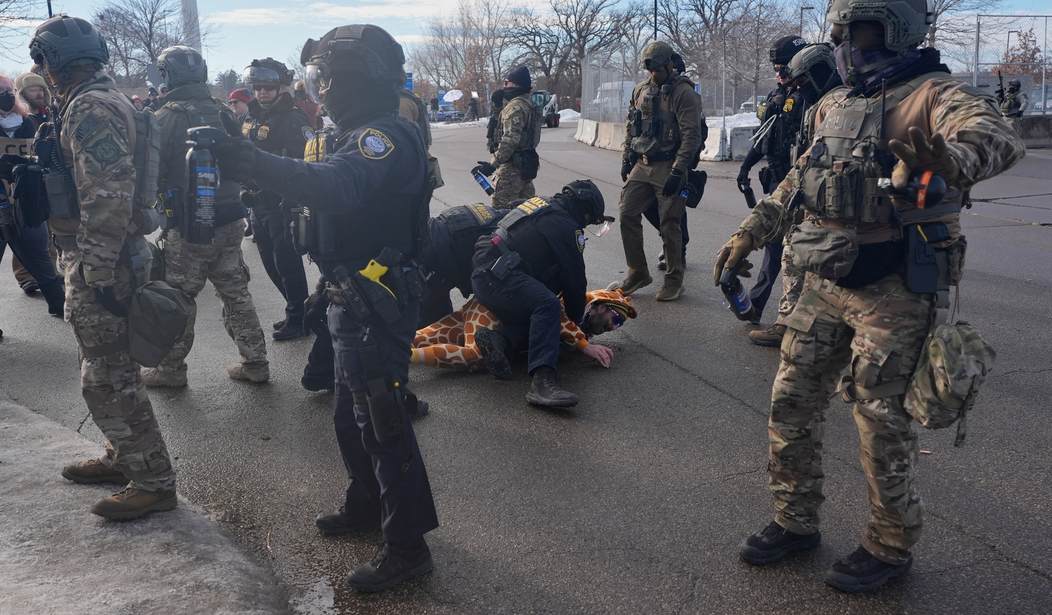
As RedState reported on Monday, Minnesota's left-wing, TDS-riddled attorney general, Keith Ellison, announced that the Gopher State has filed a lawsuit against the Department of Homeland Security (DHS) in a desperate attempt to stop "the unlawful deployment of thousands of armed, masked, and poorly trained federal agents" that he claimed is "hurting Minnesota."
Translation: Federal agents are doing their assigned job — legally — of rounding up the "worst of the worst" as anti-ICE (Immigration and Customs Enforcement) protests continue.
READ MORE: Minnesota Prays for a Judge to Jump in, Takes Trump Admin to Court Over ICE Actions
Not to be outdone, Illinois and the City of Chicago also sued DHS on Monday — on the same grounds.
The lawsuits come on the heels of the shooting death of protester Renee Good after she allegedly tried to run over an ICE agent when she was ordered to get out of her vehicle. Both suits cite the 10th Amendment in opposition to the Trump administration's “Operation Metro Surge.”
While neither a constitutional lawyer nor a legal analyst, I just so happened to run across someone who is: CNN's Senior Legal Analyst, Elie Honig — whose resume includes stints as both a former federal and state prosecutor.
On Tuesday morning, Honig weighed in on the merits of the lawsuits, calling them "political diatribes masquerading as lawsuits" — which is exactly what they are, and then some.
Here's Honig (emphasis mine):
I’ve read both the Minnesota and Illinois lawsuits. They’re really political diatribes masquerading as lawsuits.
I think the most that the states could get out of this, if they get sympathetic judges, is a judge who’s going to ask questions of ICE, who’s gonna hold hearings, who is [going] to demand questions about how they’re training, how they are carrying out their policy.
You also could have judges that issue sort of symbolic orders along the lines of, ICE, you are not to violate the law, but that’s already the case. It’s already not allowed for ICE to violate the law.
So these lawsuits, which appear to be coordinated, they’re potentially powerful political statements, but I don’t give them much of a chance of achieving the legal thing that they’re asking for in the courts.
And there it is.
As is the case with virtually everything that comes from the mouths of the Left — including the Democrat Party and its media lapdogs — I suspect there's a better-than-even chance that these lawsuits are more for the consumption of low-information leftist agitators (read: useful idiots) than as a winnable case against DHS.
🚨 HOLY CRAP. CNN’s legal analysts just eviscerated the Minnesota and Illinois lawsuits against ICE.
— ⁿᵉʷˢ Barron Trump 🇺🇸 (@BarronTNews_) January 13, 2026
Legal experts on CNN aren’t mincing words:
“These suits are really political diatribes masquerading as lawsuits.”
“There is zero precedent for a judge to say a federal… pic.twitter.com/QgkdtVAEpS
When asked about Ellison's claim that the DHS operation is "a federal invasion of the Twin Cities [Minneapolis and St. Paul]," Honig scoffed at the notion:
There is no legalese to that. I mean, it’s a powerful sort of rhetorical term. You heard a lot of things about an invasion and how horrible this is.
Even if every allegation made in both complaints is true, and we don’t know that, it doesn’t necessarily give them a constitutional legal remedy here.
And by the way, to be specific about why there’s a constitutional problem here, if a judge were to say to ICE, you can’t enforce the law in Minnesota or Illinois, it would violate the Supremacy Clause, which says the federal government gets to carry out federal priorities and the states cannot stop them.
Let's revisit the Supremacy Clause (Article VI, Clause 2 of the Constitution). Emphasis, mine:
This Constitution, and the Laws of the United States which shall be made in Pursuance thereof; and all Treaties made, or which shall be made, under the Authority of the United States, shall be the supreme Law of the Land; and the Judges in every State shall be bound thereby, any Thing in the Constitution or Laws of any State to the Contrary notwithstanding.
And, as explained by noted legal scholar, Jonathan Turley:
The Supremacy Clause, prevents states from “interfering with or controlling the operations of the Federal Government.” United States v. Washington (2022). Since McCulloch v. Maryland in 1819, the Supreme Court has consistently struck down state laws that impede federal enforcement.
Moreover, immunity under the Supremacy Clause (Article VI, Clause 2) bars criminally charging officials who are properly carrying out their lawful federal duties. For example, in 1890, the Supreme Court ruled In re Neagle that a U.S. Marshal had immunity when a state tried to charge him with murder after he shot and killed an individual attacking a justice.
Clearly (it appears to this non-lawyer), the Minnesota and Illinois suits are almost certain to be losers on basic supremacy and preemption grounds.
Bottom line: Given that the enforcement of U.S. immigration laws is a federal function, states don't possess the constitutional or legal power to pick and choose which federal statutes they follow, and which ones they don't. Bummer.
Note: The mainstream media isn't interested in the facts; they're only interested in attacking the president. Help us continue to get to the bottom of the massive blue-state fraud epidemic by supporting our truth-seeking journalism today.
Join RedState's VIP and use promo code FIGHT to get 60% off your VIP membership!


Join the Conversation
VIP members get the ability to comment on articles.