








America, we are reaching rock-bottom with the modern Democratic Party.
The bad news is every time we reach rock bottom, we find another rock bottom underneath.
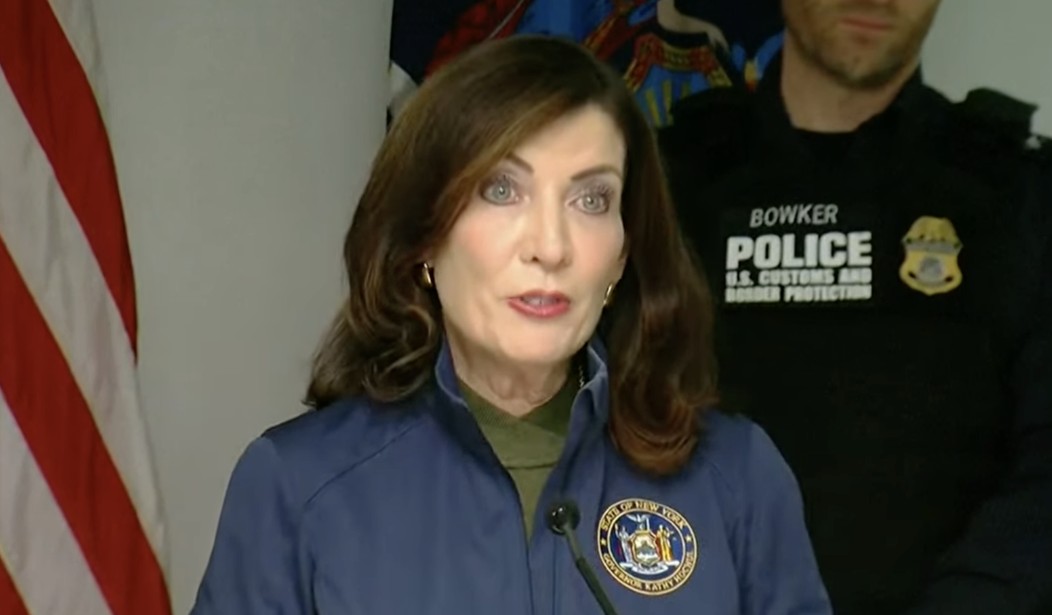
New York Gov. Kathy Hochul just handed a full pardon to a violent criminal alien whose case was headed for the Supreme Court, abruptly killing a major legal showdown that could have handed the federal government sweeping new authority to detain criminal migrants without bond hearings.
The pardon came after the nation's highest court had already agreed to hear the case and just weeks before oral arguments were scheduled.
By pardoning Dominican national Keisy Guerrero Mariano, Hochul eliminated the very conviction underpinning his deportation proceedings and mandatory immigration detention, rendering the Supreme Court case moot before the justices could decide it.
The case isn't over yet, not by a long shot. But Hochul told America just what kind of governor she is: She doesn't care about the safety of the American people. All she cares about is her radical agenda.
Wow. The Supreme Court agreed to hear a case about whether a person who could be deported due to an aggravated felony could be held without bail pending deportation. Three days before the brief was due, Governor @GovKathyHochul *pardoned* the felon to end the case. Case dismissed pic.twitter.com/YN6aeXmBur
— Eric W. (@EWess92) September 11, 2026
Had the Trump administration won, the ruling could have wiped out a favorable Second Circuit precedent requiring bond hearings when detention of certain criminal aliens becomes "unreasonably prolonged." Instead, that precedent remains standing in New York, Connecticut and Vermont.
Here’s how it all went down. The Supreme Court agreed June 15 to hear the dispute in Genalo v. Black, taking up a constitutional question left unresolved by an earlier high-court immigration decision.
Federal law requires immigration authorities to detain certain criminal aliens while their removal cases proceed.
The Second Circuit, however, held that the Constitution eventually requires a bond hearing when that detention becomes unreasonably prolonged. At such a hearing, the government bears the burden of justifying continued detention by clear and convincing evidence.
The government challenged that rule. The Supreme Court agreed to decide both whether the Constitution requires such a hearing and, if it does, whether Washington must satisfy that heightened burden of proof.
Oral arguments were scheduled for Oct. 13. Then Hochul intervened.
On Aug. 28, the Democratic governor granted Mariano a "full and unconditional" pardon for his 2015 second-degree assault conviction.
Mariano, a Dominican national who became a lawful permanent resident in 2011, was arrested in the Bronx in 2012 after an incident involving the theft of a cellphone and an attack with a belt.
He ultimately pleaded guilty in 2015 to second-degree assault, a Class D violent felony, and was sentenced to two years in prison followed by three years of post-release supervision.
ICE arrested him in 2020 and detained him under the federal mandatory-detention statute while immigration proceedings moved forward.
His prolonged detention eventually produced the constitutional fight that reached the Supreme Court.
Under federal immigration law, a qualifying gubernatorial pardon eliminates certain grounds of deportability stemming from the pardoned offense.
Once Mariano's conviction was pardoned, the government and his attorneys agreed that his habeas case had become moot.
The Supreme Court showdown was effectively over before it began.
The stakes were potentially enormous for New York's immigration system. If the Supreme Court had sided with the federal government, the Second Circuit rule could have been erased.
That would mean criminal aliens covered by the mandatory-detention provision could not automatically demand a bond hearing merely because their immigration cases had dragged on for months or even years.
Judges in New York would no longer be able to rely on the Second Circuit's existing rule to require the government, after detention became unreasonably prolonged, to prove by clear and convincing evidence that continued confinement was justified.
A Supreme Court ruling could also have settled the issue nationally rather than leaving different rules operating in different federal circuits.
That ruling will not happen in Mariano's case. Hochul's “heinous” pardon saw to that.
But there’s a plot twist. Solicitor General D. John Sauer did not ask the Supreme Court to wipe away, or "vacate," the Second Circuit decision after Mariano's case became moot.
Instead, the government indicated it wants another case presenting the same constitutional issue, potentially soon enough for the justices to address it this term.
That leaves an unusual result. The Trump administration's Supreme Court challenge is dead. But the Second Circuit precedent it was trying to overturn remains alive.
Kathy Hochul set a man loose to potentially reoffend and harm other Americans because she didn’t want the Supreme Court to enforce the law.
If that doesn’t tell you everything you need to know about the modern Democrat Party, nothing else will.
Editor’s Note: Republicans are fighting for election integrity by requiring proper identification to vote. It's common sense, yet Democrats are spreading lies about the impact of such a measure.
Help us continue to call out these lies by joining RedState VIP and using promo code FIGHT to receive 60% off your membership.


Join the Conversation
VIP members get the ability to comment on articles.