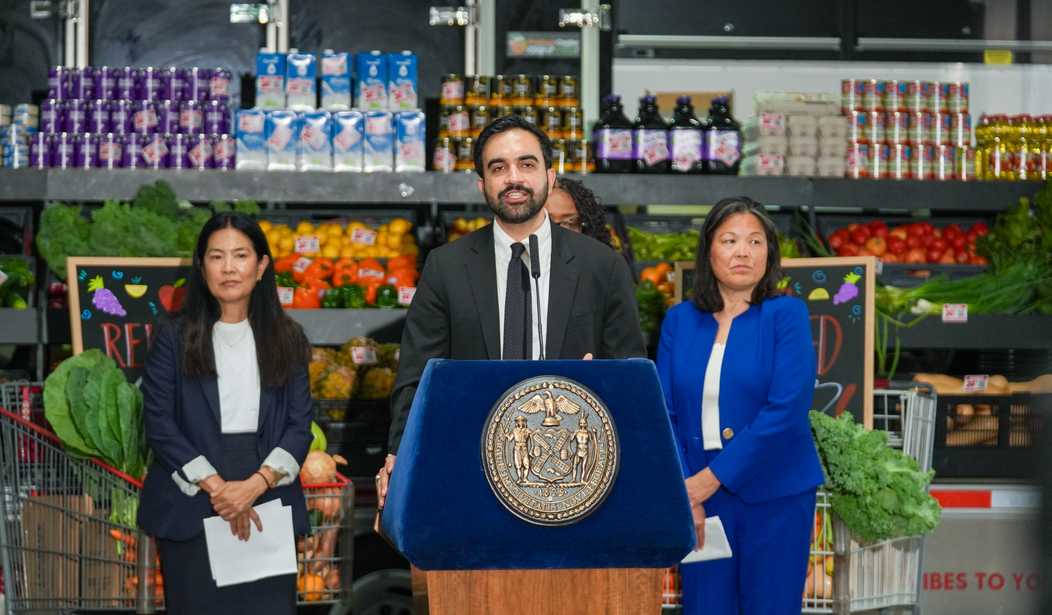

Zohran Mamdani’s socialist supermarkets are already causing real damage — both in terms of economic fallout and the human toll of bad policies.
And now, the mayor has been hit with a fresh federal lawsuit that is one of a growing list of legal actions meant to take down the mayor’s supermarket scheme.
The New York City mayor is facing a fresh federal lawsuit from the National Supermarket Association and two of its members, City Fresh Market in Harlem and C-Town in the Bronx, challenging his plan to open five taxpayer-supported grocery stores across the city.
The suit alleges unfair competition and antitrust violations, arguing that private businesses cannot realistically compete against municipal stores operating with public subsidies and a fundamentally different cost structure.
That case comes on top of two state-court lawsuits filed in August by the Multicultural Business Coalition, which represents roughly 1,000 minority- and immigrant-owned bodegas, delis and supermarkets.
Those suits accuse the city of predatory pricing and other legal violations while challenging the rollout of one of Mamdani’s signature affordability programs.
So what began as a campaign promise to make groceries cheaper has spurred multiple lawsuits from small-business owners who say they will be crushed by it.
And the federal case is not Mamdani's only legal problem.
The Multicultural Business Coalition filed two separate lawsuits in New York state court on August 24. The coalition represents immigrant- and minority-owned bodegas, supermarkets and other businesses through dozens of business organizations across the city.
The first seeks class-action status on behalf of hundreds of business owners and argues, among other claims, that the program would deny predominantly immigrant- and minority-owned grocers equal protection by forcing them to compete with subsidized municipal stores while giving them no comparable access to those benefits.
The complaint argues that the private stores “are unable to offer similarly discounted products” and therefore face unequal treatment from a government that is simultaneously subsidizing their competitors.
The second lawsuit attacks the way City Hall developed the program itself. The coalition contends that the administration moved forward without adequately studying what five heavily subsidized supermarkets selling groceries below prevailing retail prices would do to businesses already operating in those neighborhoods. It seeks to force the city to conduct an economic-impact analysis before proceeding.
That brings the total to three separate major lawsuits facing Mayor Zohran Mamdani.
While Mamdani would rather we not understand the mom and pop grocers who are getting hammered with this supermarket scheme, there is a need to remind the communist mayor about “socialism with a human face.”
Josefina Aguirre’s family opened Little Mexico Meat Market in East Harlem in 1997 after her father came to the United States from Mexico as a teenager. The family survived competition, inflation and the pandemic. Her father died after contracting COVID-19, and Aguirre and her sisters now run the business he spent decades building.
Aguirre says the margin on a $10 steak helps cover the mortgage, rent, utilities and her children’s tuition. A city-supported store selling a comparable product for $7 can absorb losses in a way her family cannot.
“He can afford it because he’s using taxpayer money,” Aguirre said. “We don’t have any help.”
Another East Harlem store owner, Elvis Arias, said that he has spent 25 years running his business and fears the municipal store proposed nearby could force him out.
“I’m scared to get out of the business, because I’m here 25 years,” Arias said.
Here is what kicked this all off. Mamdani’s scheme calls for the city to spend roughly $70 million opening five publicly owned grocery stores, one in each borough. The stores would sell a basket of staple goods at prices around 30 percent below typical retail levels and would benefit from city-backed space and other support intended to hold operating costs down.
Private grocers, meanwhile, still have to pay rent, payroll, utilities, insurance, financing costs, taxes and wholesale prices while somehow competing with a government-sponsored store deliberately pricing essential products below the surrounding market.
That is why National Supermarket Association president Anthony Peña says the issue is not ordinary competition.
“It’s not about us being afraid of competition,” Peña said. “We are against unfair competition.”
The city-run store planned for La Marqueta in East Harlem illustrates the problem. City Fresh Market is located roughly a block away. Mamdani’s planned municipal location would occupy about 9,000 square feet and has been tied to tens of millions of dollars in public investment. The federal plaintiffs say that creates a rigged playing field.
The Bronx presents the same question. A C-Town on Southern Boulevard is joining the lawsuit while the first municipal store is expected to open in Hunts Point nearby.
As my RedState colleague Becca Lower previously reported in her article on the mounting problems surrounding Mamdani’s broader affordability agenda, the mayor has already encountered implementation trouble with another major promise, universal childcare.
Providers warned in late August that delayed city funding threatened scheduled openings, with some operators taking out personal loans or tapping their own savings while waiting for the city to deliver promised money.
The grocery program is producing a different kind of resistance: existing businesses are asking why City Hall is creating new publicly backed competitors instead of helping the stores already serving these neighborhoods lower their own costs.
Frank Garcia, chairman of the Multicultural Business Coalition, has proposed an alternative model in which independent grocers form larger purchasing groups capable of buying directly from manufacturers, eliminating intermediaries and reducing wholesale costs.
His argument is simple: If the objective is cheaper food, use government purchasing power and existing small-business programs to help private stores compete instead of building a parallel municipal network against them.
Mamdani has argued that grocery prices have risen sharply and that the city needs new ways to bring food costs down. He should start by making it easier for there to be market competition, instead of rigging the playing field and imposing excessive costs.
It is easier to solve problems when you propose solutions that we know work — market competition in an environment where prices reflect supply and demand — rather than retry Venezuela-style schemes that fail every time.
There is no mystery about whether Mamdani’s supermarket scheme will fail. It is not a matter of if, but when.
The real question is if we can limit the human cost and the economic damage before it’s too late.