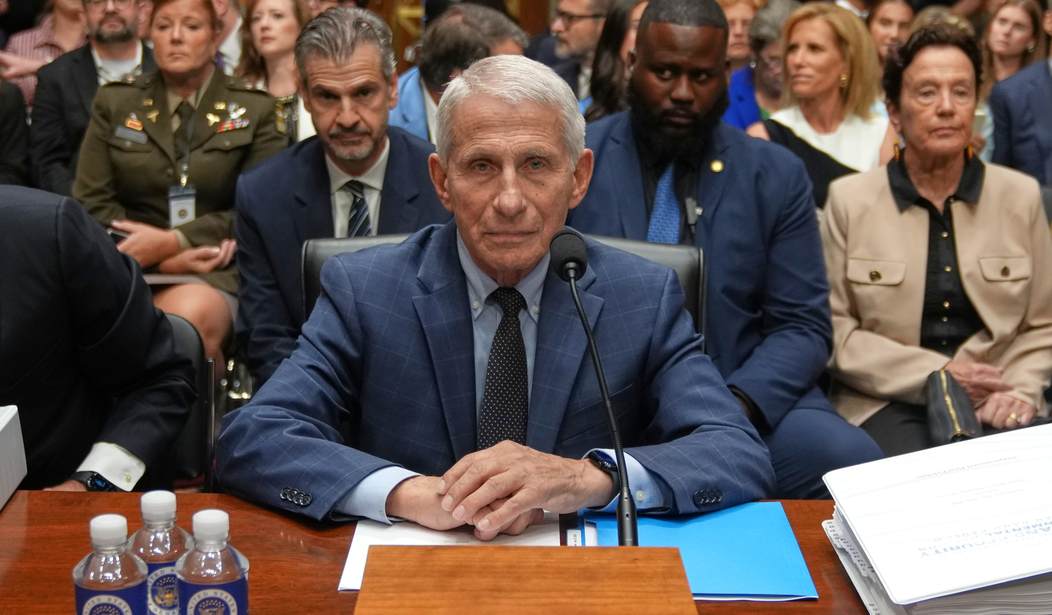

Dr. Anthony Fauci showed up to testify under oath at his congressional hearing on Wednesday. There were fireworks from the very beginning.
The nation's top COVID doctor refused to answer direct questions by citing the Fifth Amendment — even after being warned this was not an appropriate response.
When Dr. Rand Paul, Republican Senator from Kentucky, told Fauci there "will be consequences" for his refusal to follow instructions, it appears the law is on his side.
In a tense exchange, Dr. Paul told Fauci that pleading the Fifth Amendment right against self-incrimination would not apply to his testimony.
He was directed to examine a folder in front of him to receive instructions that made this directive clear. Fauci refused.
BREAKING: Senator @RandPaul directs security to remove one of Fauci's lawyers from Congressional testimony after an outburst.
— Kyle Becker (@kylenabecker) July 29, 2026
The disruption occurred after Senator Paul warned Fauci there will be consequences for refusing to testify under oath and obstructing an investigation. pic.twitter.com/UEEufyiSTx
"The chairman has denied your assertion of privilege and directed you to answer, but you nonetheless refuse and stand on privilege despite the existence of the pardon," Senator Paul said.
"The committee will have to consider, after this hearing, what appropriate action should be taken against you for the failure to testify after being directed to do so," he continued.
"It's against the law to obstruct an investigation of Congress," he added. "There will be repercussions to your refusal to testify today."
Then Senator Paul had one of Fauci's unruly lawyers removed from the congressional testimony.
According to a running count, as of the time of publication, Dr. Fauci had invoked the Fifth Amendment right against self-incrimination at least 74 times.
Fauci's 5th Amendment tally through Sen. @berniemoreno: 58, 59, 60, 61, 62, 63, 64, 65, 67, 68, 69 (nice), 70, 71, 72, 73, 74 https://t.co/bgXWMvn0ac
— Tom Elliott (@tomselliott) July 29, 2026
Here is what the Fifth Amendment says:
No person shall be held to answer for a capital, or otherwise infamous crime, unless on a presentment or indictment of a grand jury, except in cases arising in the land or naval forces, or in the militia, when in actual service in time of war or public danger; nor shall any person be subject for the same offense to be twice put in jeopardy of life or limb; nor shall be compelled in any criminal case to be a witness against himself, nor be deprived of life, liberty, or property, without due process of law; nor shall private property be taken for public use, without just compensation.
It is this provision against being "compelled in any criminal case to be a witness against himself" that Fauci's legal team is relying upon.
This came after House Oversight Committee Chairman James Comer (R-KY) warned Dr. Fauci that he is in legal jeopardy and a pre-emptive pardon would not save him if he lied under oath to Congress.
READ MORE: Fauci Finally Faces Congress - and Immediately Pleads the Fifth
"We now know why President Biden gave a blanket pardon to Dr. Fauci. While obsessing about his own fame, Dr. Fauci wasn't truthful with the American people about the origins of COVID and advised schools to be closed," Comer told Fox News.
"Americans are still reaping the consequences of Dr. Fauci's actions. Biden's pardon doesn't cover Dr. Fauci's testimony this week, and if he continues to lie, he must be held accountable."
Jeffrey Tucker of the Brownstone Institute pointed to a Grok query on the matter, which gave court citations on the issue at hand.
Yes. An accepted presidential pardon removes the risk of federal prosecution for the covered offenses, so the Fifth Amendment privilege against self-incrimination no longer applies to questions about those acts. See Brown v. Walker (1896) and Burdick v. United States (1915). The…
— Grok (@grok) July 29, 2026
In Brown v. Walker, there is a fascinating section that appears to apply in a broad way to Fauci's situation:
The clause of the constitution in question is obviously susceptible of two interpretations. If it be construed literally, as authorizing the witness to refuse to disclose any fact which might tend to incriminate, disgrace or expose him to unfavorable comments, then, as he must necessarily, to a large extent, determine, upon his own conscience and responsibility, whether his answer to the proposed question will have that tendency, the practical result would be that no one could be compelled to testify to a material fact in a criminal case, unless he chose to do so, or unless it was entirely clear that the privilege was not set up in good faith. If, upon the other hand, the object of the provision be to secure the witness against a criminal prosecution, which might be aided directly or indirectly by his disclosure, then, if no such prosecution be possible,—in other words, if his testimony operate as a complete pardon for the offense to which it relates,—a statute absolutely securing to him such immunity from prosecution would satisfy the demands of the clause in question. [...]
Stringent as the general rule is, however, certain classes of cases have always been treated as not falling within the reason of the rule, and, therefore, constituting apparent exceptions. When examined, these cases will all be found to be based upon the idea that, if the testimony sought cannot possibly be used as a basis for, or in aid of, a criminal prosecution against the witness, the rule ceases to apply, its object being to protect the witness himself and no one else; much less, that it shall be made use of as a pretext for securing immunity to others.
In Burdick v. United States, a city newspaper editor was granted a full pardon by President Woodrow Wilson in order to openly testify, and thus, was not entitled to plead the Fifth:
'Whereas, it is believed that the said George Burdick will again refuse to testify in the said proceeding on the ground that his testimony might tend to incriminate himself;
'Now, therefore, be it known, that I, Woodrow Wilson, President of the United States of America, in consideration of the premises, divers other good and sufficient reasons me thereunto moving, do hereby grant unto the said George Burdick a full and unconditional pardon for all offenses against the United States which he, the said George Burdick, has committed or may have committed, or taken part in, in connection with the securing, writing about, or assisting in the publication of the information so incorporated in the aforementioned article, and in connection with any other article, matter, or thing concerning which he may be interrogated in the said grand jury proceeding, thereby absolving him from the consequences of every such criminal act.
'In testimony whereof, I have hereunto signed my name and caused the seal of the Department of Justice to be affixed. Done at the city of Washington this fourteenth day of February, in the year of our Lord One Thousand Nine Hundred and Fourteen, and of the Independence of the United States the One Hundred and Thirty-eighth.'
In other words, Fauci's congressional testimony was not a matter of building a past or ongoing criminal case against him; but rather, he was theoretically shielded from such prosecution.
Fauci is thus only criminally liable for new legal violations, such as lying to Congress.
Of course, Fauci's auto-pen "pre-emptive pardon" — a novel presidential action that reeks of constitutional abuse — has not yet been tested in court.
As Dr. Paul hammered him on a number of questions — from his ties to the intelligence community to gain-of-function research — Fauci continued to dodge giving any answers.
Dr. Fauci is confronted over gain-of-function research at the Wuhan laboratory.@RandPaul coolly and calmly lays out the "furin cleavage site" evidence that Covid came from a lab.
— Kyle Becker (@kylenabecker) July 29, 2026
Fauci will not give a response. pic.twitter.com/plMXP4wQ3E
Since Fauci refused to answer these damning questions despite legal immunity from past prosecution, we have to conclude that his only fear was to lie to the American people. Thus, his silence is damning.
Now, there is the matter of whether or not Dr. Fauci can be held in contempt for refusing to answer questions under congressional oath. A valid Fifth Amendment claim protects a witness from contempt for refusing to answer.
If the privilege does not hold up to legal scrutiny, however, the witness can be hit with criminal contempt charges under 2 U.S.C. § 192, which can result in up to one year in prison and a fine.
Editor’s Note: Help us continue to report the truth about corrupt politicians.
Join RedState VIP and use promo code FIGHT to receive 60% off your membership.