






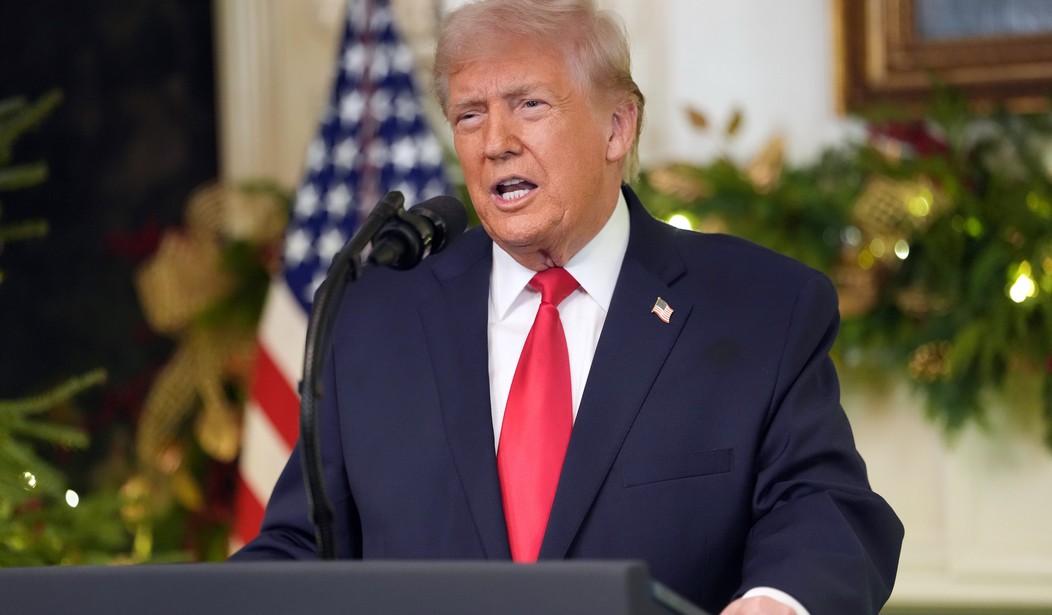
President Trump told Politico this week that the 2026 midterm elections will center on "pricing" as Republicans head into a critical period with control of Congress on the line. It's the right diagnosis. The question is whether Trump can stick to it.
"I think it's going to be about the success of our country. It'll be about pricing," Trump said in an exclusive interview. "Because, you know, they gave us high pricing, and we're bringing it down. Energy's way down. Gasoline is way down."
He's not wrong about the fundamentals. Gas prices have dropped below $3 a gallon for the first time in over four years. The administration has delivered real wins on energy costs. Economic growth hit 4.3% in the third quarter. These are the building blocks of a winning message heading into 2026.
There's just one problem: Trump spent the last two months calling the affordability crisis a "con job," a "hoax," and a "scam" perpetrated by Democrats as voters continued to lose faith in him and his administration over stubbornly high inflation and rising prices.
The Credibility Problem
In November, after Democrats overperformed in off-year elections by focusing on voter concerns about high costs, Trump dismissed the issue entirely.
"Affordability is a lie when used by the Dems. It is a complete CON JOB," he wrote on Truth Social. During a December Cabinet meeting, he went further: "Affordability is a hoax that was started by Democrats who caused the problem of pricing."
The timing couldn't have been worse. Democrats had just won major contests in New York City, Virginia, and New Jersey by running on affordability. Voters were clearly signaling what mattered to them. Trump's response was to tell them their concerns were invented.
Even some of Trump's staunchest congressional allies started sounding the alarm.
"People aren't dumb," Senator Josh Hawley told NBC News. "They know when they go to the grocery store what it costs and what it doesn't."
Representative Tony Gonzales warned that Republicans "would be morons" if they didn't sharpen their economic message before the midterms.
The data backs up the concern. An NPR/PBS News/Marist poll showed Democrats holding a 14-point advantage on the congressional ballot, which is their largest lead since November 2017, right before they won 40 House seats in the 2018 midterms. Trump's approval has fallen from over 50% at the start of his second term to around 42%, with disapproval climbing to nearly 55%.
Voters are responding to a president who campaigned on bringing down costs, costs not going down at all, then that president calling those voters' cost concerns a hoax. Now, he is pivoting back to pricing as his central midterm message. The inconsistency undermines the credibility Republicans need to defend their congressional majorities.
The Susie Wiles Factor
Which brings us to what might be the most important development: White House Chief of Staff Susie Wiles appears to be tightening her grip on Trump's messaging operation.
In a recent podcast appearance, Wiles revealed an aggressive strategy for the 2026 midterms that breaks with traditional playbooks. Instead of limiting Trump's exposure in contested races, she's planning to put him front and center.
"We're actually going to turn that on its head and put him on the ballot," Wiles said. "He's going to campaign like it's 2024 again."
READ MORE: ‘Turnout Machine’ Trump to Go Full-Throttle in 2026 Midterm Blitz
The logic is sound. Trump drove historic turnout among low-propensity voters in 2024. Democrat data scientist David Shor's analysis showed that if all registered voters had turned out in 2024, Trump would have won the popular vote by 5 points instead of 1.6 points. The MAGA base is a turnout machine when activated—the 2022 "red wave" fizzled precisely because Trump wasn't actively campaigning.
Now, Trump himself isn't on the ballot, so there is reason to think he may not have that same effect in 2026. But here's what gives me hope about Wiles' increased visibility: She understands the discipline required to make this strategy work. You can't nationalize the midterms around Trump while Trump simultaneously tells voters their economic concerns are fake. The message has to be consistent, relentless, and credible.
Wiles has been more visible in media recently, which suggests she's taking a tighter hold not just of campaign strategy but of message control. If she can keep Trump and the White House team on the "we're bringing prices down" message—and away from the "it's all a hoax" detours—Republicans have a real shot at holding their majorities.
The Opportunity Republicans Are Squandering
The frustrating part is that Republicans have genuine achievements to run on. Gas prices are down. Inflation has cooled from its 2022 peak. The economy is growing at a robust clip. Border encounters are dramatically lower than during the Biden administration's final year.
Democrats, meanwhile, are dealing with their own message chaos. Progressive activists are pushing the party further left while voters move right on key issues. The contrast writes itself. On one side, you have a Trump administration working to bring costs down. On the other side, you have the Democratic Party kowtowing to its loud, far-left extremist base.
But you can't draw that contrast when you're simultaneously denying that costs are a problem. You can't campaign on "we're fixing Biden's inflation mess" while calling affordability concerns a con job. The message discipline has to be absolute.
This is where Wiles' role becomes critical. Trump needs handlers who will keep him focused on the wins, including lower gas prices, economic growth, border security, and steer him away from the self-destructive tangents about hoaxes and scams.
The signage at Trump's recent Pennsylvania rally said "Lower Prices." That's the message. The question is whether Trump will stick to it or veer off into conspiracy theories about Democratic word games.
The Path Forward
Congressional Republicans had their least productive year since at least 1989, passing only 38 bills. They don't have a strong legislative record to campaign on, and they are fighting more among themselves than against Democrats. What they have is Trump's executive action agenda and the economic improvements that have resulted from it. Between that and the One Big Beautiful Bill, that's the story they need to tell.
The Democrats are vulnerable. They lost in 2024 because voters rejected their economic stewardship. But they've regrouped around affordability messaging, and early results show it's working. Republicans need to meet that challenge head-on with a consistent, credible message about what they're doing to bring costs down.
Trump's acknowledgment that 2026 will be about pricing is exactly right. Energy costs matter. Grocery bills matter. Working families want to know their paychecks will go further. If Republicans can stay disciplined on that message, if Susie Wiles can keep the team focused and prevent Trump from undermining his own narrative, they can hold Congress and continue advancing their policy agenda.
But if Trump reverts to calling voter concerns a hoax, if the message discipline falls apart, if the team can't maintain focus on kitchen table issues, then Democrats will have a clear opening. Voters will choose the party that takes their struggles seriously over the one that dismisses them as imaginary.
The stakes are clear. The path is obvious. Now we'll see if Trump and his team can walk it consistently between now and November 2026. Based on Wiles' recent comments and increased visibility, there's reason for cautious optimism. But optimism isn't the same as confidence—and in politics, execution is everything.
President Donald Trump's agenda can't end here. Republicans need to win in 2026, and we're giving voters the information they need.
Help RedState to continue bringing you the truth. Join RedState’s VIP and use promo code MERRY74 to get 74% off your membership.
Join the Conversation
VIP members get the ability to comment on articles.