








By Jeff Rhodes
The ongoing struggle to protect the right of public employees to disassociate themselves from unions whose values they don’t share has a number of heroes.
There’s Pamela Harris, for example, plaintiff in Harris v. Quinn, which affirmed the right of homecare providers to opt out of union membership and dues in 2014. Or Rebecca Friedrichs, whose lawsuit against the California Teachers Association would have extended the same right to all public employees had it not been interrupted by the death of U.S. Supreme Court Justice Antonin Scalia. And Mark Janus, who finally championed those rights in Janus v. AFSCME.
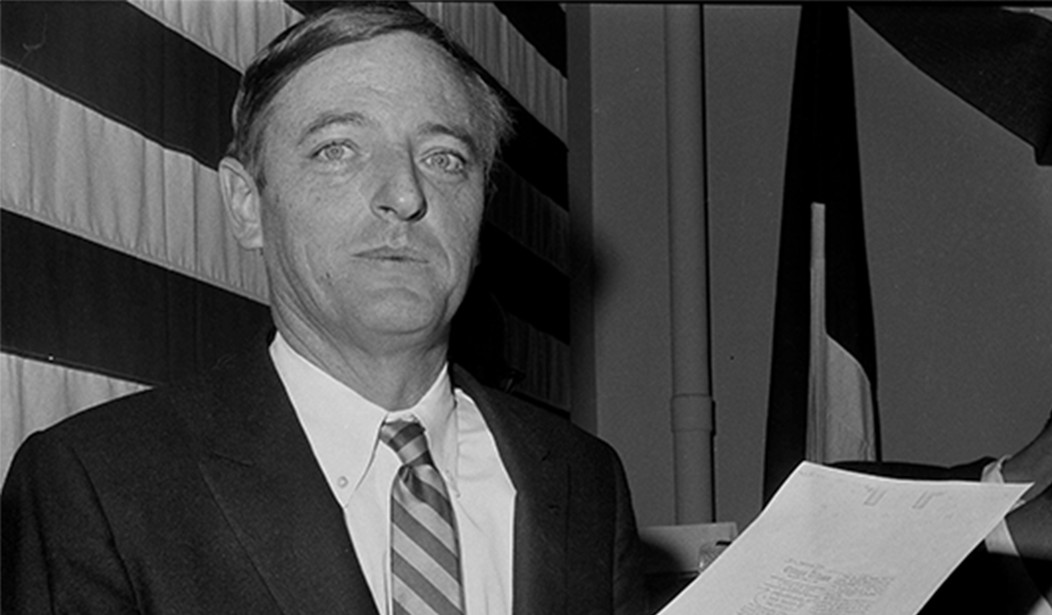
But it’s worth remembering the path to freedom was pioneered years earlier by National Review founder, author, columnist, TV commentator, and liberal provocateur William F. Buckley Jr.
In fact, he waged a seven-year legal battle making the familiar argument that his First Amendment right to free speech was being impeded by laws requiring him to join (and support with his dues) the American Federation of Television and Radio Artists.
Although Buckley v. AFTRA didn’t relate specifically to public employees, as did later precedent-setters like Abood v. Detroit Board of Education (1977), Davenport v. WEA (2007), as well as Harris and Janus, Buckley’s attorneys nonetheless asserted that, since his TV show, “Firing Line,” was created on and broadcast by taxpayer-supported public television, the issue at stake differed fundamentally from similar disputes in the private sector, where “union shop” arrangements are a matter to be decided between labor and management.
RELATED: Get Government out of the Business of Collecting Dues on Behalf of Unions
Malcolm's Memories: The Day Bill Buckley Asked My Help; Small Town Etiquette
In an era when the most conservative voice liberals could find to revile belonged to the maddeningly moderate Richard Nixon, and Ronald Reagan, whose fully articulated conservativism wouldn’t win the White House until 1980, was busy honing his message in the wilderness of California, Buckley was the universally accepted face of the movement, and his platform was an hour-long, stage-bound program relegated by most PBS outlets to weekend afternoons.
In spite of all obstacles, and devoid of any glitz or glamour, “Firing Line” quickly developed a devoted following among Americans captivated by Buckley’s wit and brilliance, and completely unaccustomed to hearing conservative views espoused anywhere else.
In his 1970 lawsuit, Buckley noted that he joined AFTRA when the show was launched in 1966 because union membership and dues were a condition of employment imposed by New York’s WOR-TV, where the show was produced, and its parent company, RKO General, Inc.
Later, he came to resent having to support an organization whose values clashed with his own and sought to opt out — just as hundreds of thousands of public employees have since Janus v. AFSCME affirmed their First Amendment right to do so in 2018.
“The requirement,” the complaint stated, “that plaintiff Buckley be a member of defendant AFTRA, pay dues and obey orders as a condition of his continued employment in the television and radio industries, and the threatened denial of his access to television and radio stations, places an unreasonable restraint upon plaintiff Buckley's right of free speech, deprives him of his property without due process of law and breaches his rights under the 1st, 5th and 9th Amendments of the Constitution.”
Buckley added later, “Many of the people in this country labeled as liberals eloquently object to any compromise of the individual rights of the citizen against the government, particularly in the field of free speech and privacy. I think it is time they join me in demanding that the individual have a right to join or not join, to pay dues or not pay dues, to a private organization surrendering his right to speak.”
His words eerily presaged the dozens of lawsuits still being filed in the wake of Janus by public employees whose attempts to exercise their First Amendment rights were suppressed or ignored by their union.
Buckley’s suit was ultimately denied cert in 1974 by the U.S. Supreme Court and remanded back to the lower courts, which had earlier ruled against him.
The fight dragged on until 1977, finally concluding with a stipulation — or agreement among the parties — that enabled both sides to claim victory.
Under the deal, the union was required to notify all its signatories — the employers of broadcast performers — that performers need not join the union to work in radio or television.
However, performers working under AFTRA contracts could be required to pay union initiation fees and dues, whether or not they are members.
Buckley promptly resigned his membership in AFTRA but continued hosting “Firing Line” until 1999. With 1,504 episodes during its 33-year run, it became the longest-running public affairs program with one host in television history.
Buckley died in 2008, but his logic still resonates on an issue very much still in the news today.
Jeff Rhodes is vice president for news and information at the Freedom Foundation, which specializes in helping public employees opt out of their union.
Editor’s Note: Do you enjoy RedState’s conservative reporting that takes on the radical left and woke media? Support our work so that we can continue to bring you the truth.
Join RedState VIP and use the promo code FIGHT to get 60% off your VIP membership!



Join the Conversation
VIP members get the ability to comment on articles.