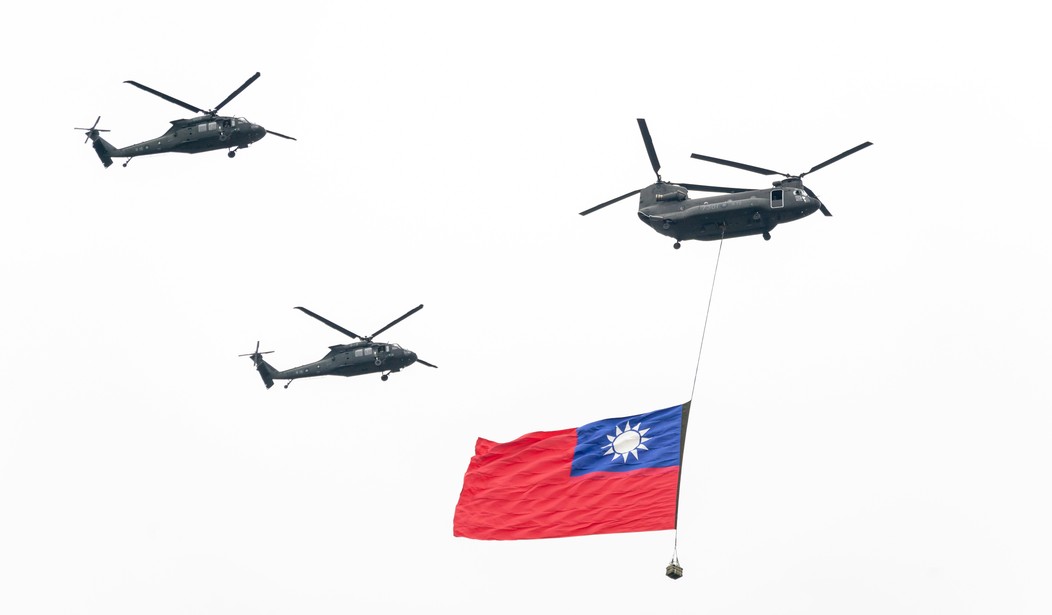

On May 8, Taiwan's legislature passed the supplementary defense budget, capped at NT$780 billion ($24.7 billion) until 2033. This comes after the China-friendly Kuomintang (KMT) and Taiwan People's Party (TPP) used their legislative majority to stall the bill for months — and after U.S. lawmakers pressured Taiwan's opposition to pass the budget.
The bill consists of two parts. NT$300 billion ($9.5 billion) is reserved for the U.S. arms sale that was approved last December, which includes High Mobility Artillery Rocket Systems, howitzers, unmanned aerial vehicles, and Javelin anti-tank missiles — the largest weapons package for the self-governed island to date. NT$480 billion ($15.2 billion) is for a future arms package.
The recently approved budget falls short of Taiwan President Lai Ching-te's NT$1.25 trillion ($39.6 billion) proposal. The T-Dome multi-layered air defense system — capable of detecting and intercepting multiple projectiles, drones, and jets, much like Israel's Iron Dome and the U.S.'s planned Golden Dome — is a central feature of Lai's U.S.-backed package.
While some American elected officials applauded the passage of the budget, a State Department spokesperson said:
While we are encouraged by the passage of this special defense budget after unhelpful stalling, the United States notes that further delays in funding the remaining proposed capabilities are a concession to the Chinese Communist Party.
A senior U.S. official, who spoke on condition of anonymity, expressed a similar view:
Our position on Taiwan's defense budget ... is that it was disappointing in that there was some stuff left on the cutting room floor that we believe still needs to be funded, and we would like to see the rest of the original proposed package funded.
Washington is right to be disappointed in this watered-down budget. While it is more than the "NT$380 billion plus N" version that the KMT had originally proposed, it's still missing many important elements. It's the bare minimum.
Notably absent is funding for Taiwan's domestic drone program, which is needed to transform the Taiwan Strait into an "unmanned hellscape." The war in Ukraine has shown us that drones play a prominent role in modern warfare.
Also missing is funding for military production expansion, "non-red supply chain" development, and U.S.-Taiwan co-development/co-production initiatives. As I've argued in the past, it's essential that Taiwan prioritize co-developing and co-producing more advanced, low-cost autonomous weapons. Doing so would help alleviate the strain on the U.S. defense industrial base.
Taiwan remains highly reliant on American weapons. It is crucial that Taiwan develop its capacity to domestically produce the weapons, especially asymmetric ones, that it needs to fight and win a war against China.
The budget leaves out Chiang Kung, or Strong Bow, anti-ballistic missiles, often referred to as the backbone of the T-Dome system. The omission hinders Taipei’s efforts to develop its air defense capabilities. This is particularly alarming considering that, according to a Bloomberg report, Beijing boosted ballistic and cruise missile production last year at the fastest pace since 2013. The number of Chinese companies that produce critical parts for missiles doubled between 2013 and 2025.
It’s no coincidence that the Trump administration has been working to replenish munitions stockpiles. Experts estimate that in a war with China, the U.S. Air Force would have to strike about 100,000 targets.
On Wednesday, the Pentagon announced that it secured contracts with four defense firms to ramp up production of low-cost cruise missiles over the next three years. In March, the Pentagon struck production deals with Lockheed Martin, BAE Systems, and Honeywell Aerospace. Now, Taiwan must do its part.
The Lai administration is considering how to fund the excluded weapons programs. Regardless of how it's done, whether through a separate supplementary budget or as part of the annual defense budget, funding for Taiwan's domestic arms production and drone manufacturing must be approved. What China fears the most is a robust and independent Taiwanese industrial base, supported by Washington.
KMT Chairwoman Cheng Li-wun is planning to visit the U.S. in early June. It's imperative that U.S. lawmakers raise their concerns with her about the KMT's and TPP's actions that undercut Taiwan's defense sector. Taiwanese opposition parties shouldn't be playing political games at the expense of Taiwan's and the U.S.'s national security.