








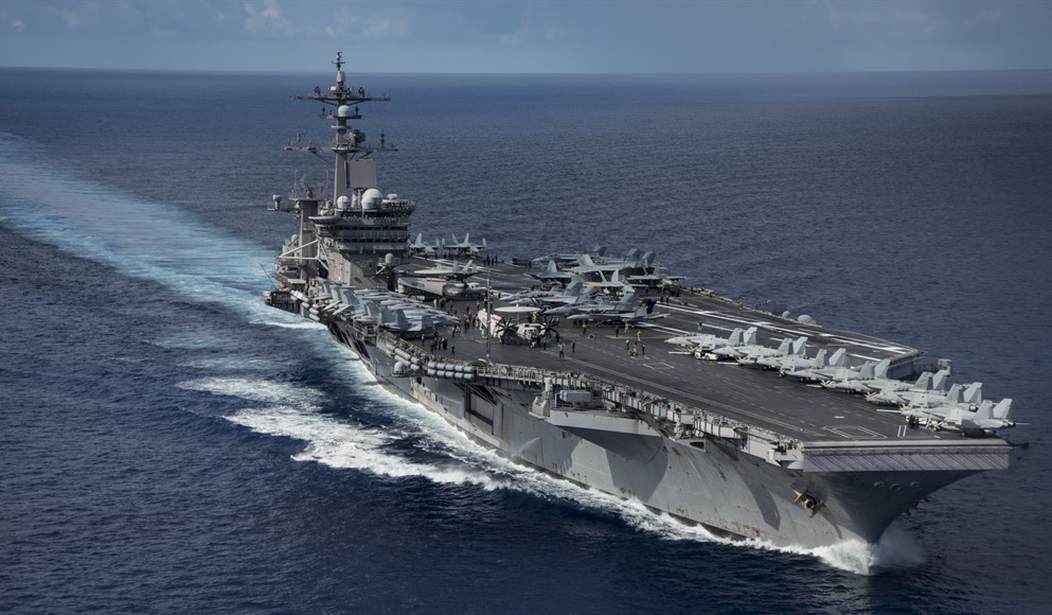
Following the release of the National Security Strategy (NSS), mainstream media outlets, left-wing individuals, and policy “galaxy brains” at think tanks are complaining that an American retreat from the Indo-Pacific is underway.
A Financial Times article alleges, based on anonymous sources, that the Japanese government feels abandoned by Washington amid an escalating row with Beijing. The same Financial Times published a now-debunked piece claiming that the Trump administration had blocked the Taiwanese president’s planned transit through the U.S.
None of these stories and talking points align with reality, though. The Trump administration isn’t turning away from the Indo-Pacific region and doesn’t plan to do so in the foreseeable future. In fact, quite the opposite is happening.
The NSS’s main priority is the Western Hemisphere, in line with the administration’s focus on protecting the homeland. Much of this focus is due to China’s and other adversaries’ expanding influence on America’s doorstep. China, for example, weaponizes migration and drug trafficking to the detriment of the U.S. and the rest of the free world.
At the same time, the Trump administration remains committed to the Western Pacific. The NSS covers a range of topics relating to the region, from China’s economic warfare and coercion to Taiwan, the South China Sea (SCS), the First Island Chain, and defense burden-sharing.
Contrary to attempts to paint the NSS as a dark, isolationist, “far-right” document, there is an emphasis on strengthening Indo-Pacific alliances and partnerships, including with Japan and India — another country Democrat elected officials claim President Trump has left behind.
This isn’t to suggest that the NSS is without shortcomings. It does not mention the Chinese Communist Party (CCP) by name, nor does it outline China’s unrestricted warfare, which is central to the CCP’s military strategy. The NSS could have taken a much stronger position against communist China, given the civilizational threat that the CCP poses.
But the NSS certainly is not the report that left-wing critics are making it out to be, either.
The administration voiced its support for Japan and condemned Beijing’s actions after Chinese J-15 fighter jets directed their radar at Japanese Air Self-Defense Force F-15 fighter jets multiple times. Chinese officials denied any wrongdoing, blaming Tokyo for the incident, and warned Japan’s allies “not to be misled,” typical CCP gaslighting.
— ジョージ・グラス駐日米国大使 (@USAmbJapan) December 10, 2025
On Thursday, Secretary of War Pete Hegseth held a phone call with Japanese Defense Minister Shinjiro Koizumi. Both sides discussed China’s recent military actions and reaffirmed their commitment to bolstering the U.S.-Japan alliance and boosting deterrence in the region. Communication between the two countries remains strong.
今朝、アメリカのヘグセス戦争長官@PeteHegseth と電話会談を行いました。… pic.twitter.com/YyhbCUSsco
— 小泉進次郎 (@shinjirokoiz) December 11, 2025
Beyond the NSS and statements of support, the Trump administration is taking concrete action in the Western Pacific during China’s unprecedented deployment of naval and coast guard vessels throughout East Asian waters.
The U.S. Navy is surging its assets in the Western Pacific, deploying three ships — two aircraft carriers, the USS Abraham Lincoln and the USS George Washington (which has since returned to Yokosuka Naval Base, Japan), capable of carrying F-35C fighter jets and an amphibious assault ship, the USS Tripoli, capable of carrying F-35B jets.
After a joint Chinese-Russian patrol flight through the Miyako Strait, American B-52 bombers accompanied Japanese aircraft in an exercise over the Sea of Japan, aiming to deter China and to improve coordination between Washington and Tokyo.
The U.S. continues to engage with the Philippines — Washington’s oldest treaty ally in the Indo-Pacific — and other regional partners in regular military exercises to counter Chinese coercion in the SCS. During his Asia tour, Secretary Hegseth and his Philippine counterpart, Defense Secretary Gilbert Teodoro Jr., unveiled a joint task force aimed at enhancing military cooperation and readiness.
And it turns out that in November, U.S. forces raided a ship in the Indian Ocean traveling from China to Iran and seized all military-related items, including dual-use components. This is the first at-sea interdiction operation targeting Chinese cargo in years — and hopefully there’s more to come.
Contrary to the narrative that the U.S. is slipping into isolation, betraying allies, and retreating from the Indo-Pacific, the Trump administration is strengthening coalitions and partnerships in the region to address shared security concerns of the 21st century. Peace through strength relies on allied support.
Rather than the doom-and-gloom the Left is fixated on propagating, which benefits Beijing, serious, constructive conversations about how else the U.S., alongside its partners, can strengthen its position in the Indo-Pacific should be the focus.
Washington might consider redeploying the Typhon missile system to Japan and delaying the decommissioning of the USS Nimitz (slated for 2026) to maintain 11 active aircraft carriers for power projection purposes until the USS John F. Kennedy is delivered in 2027. And reviving our shipbuilding capacity — that’s something the administration is working to address.
Editor’s Note: Thanks to President Trump and his administration’s bold leadership, we are respected on the world stage, and our enemies are being put on notice.
Help us continue to report on the administration’s peace through strength foreign policy and its successes. Join RedState and use promo code FIGHT to get 60% off your VIP membership.
Join the Conversation
VIP members get the ability to comment on articles.