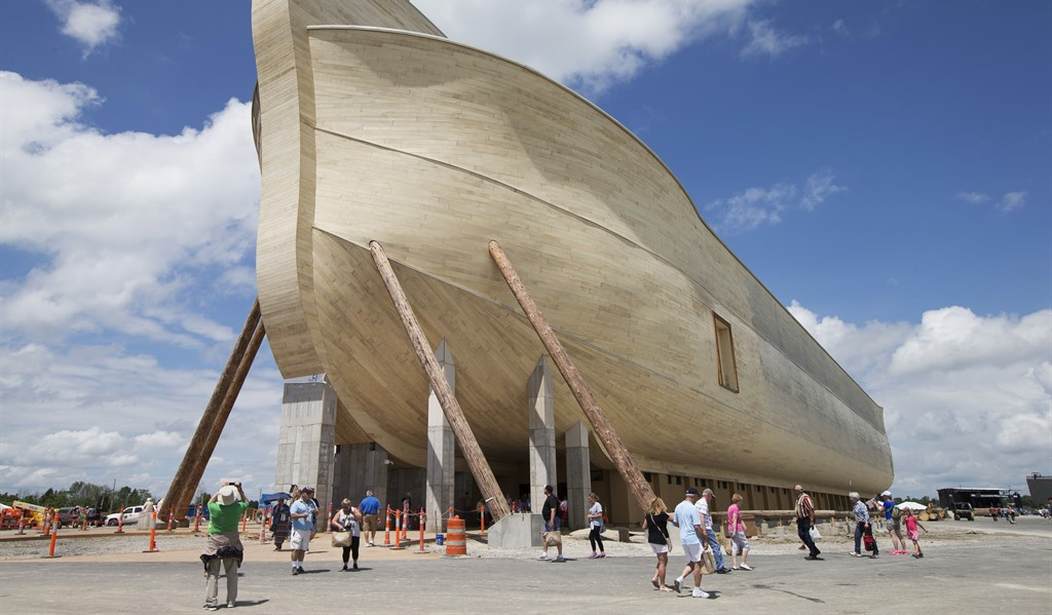

The flood continued forty days on the earth. The waters increased and bore up the ark, and it rose high above the earth. The waters prevailed and increased greatly on the earth, and the ark floated on the face of the waters. And the waters prevailed so mightily on the earth that all the high mountains under the whole heaven were covered. The waters prevailed above the mountains, covering them fifteen cubits deep. And all flesh died that moved on the earth, birds, livestock, beasts, all swarming creatures that swarm on the earth, and all mankind. Everything on the dry land in whose nostrils was the breath of life died. He blotted out every living thing that was on the face of the ground, man and animals and creeping things and birds of the heavens. They were blotted out from the earth. Only Noah was left, and those who were with him in the ark. And the waters prevailed on the earth 150 days.
Genesis 6:17-24 is a harrowing segment of the Bible and one of its most famous. God saw wickedness in man and decided to hit the reset button on Earth, flooding it to wipe out everything and start again with only eight people.
If you've been a Christian all your life, as I have, you've likely been told repeatedly that the flood was a global event. In fact, various translations of the Bible say that very thing.
And to be sure, when archeologists and geologists search for proof that the flood happened, they find it... but not everywhere. While various civilizations report a great flood in their deep history, not everyone's timelines align, and moreover, there are many areas of the world where there is no evidence of a great flood happening at all. In truth, evidence of the great flood is pretty localized.
Atheists love to use this fact as proof that the Bible is all nonsense, or at the very least, that it's wildly inaccurate. The claims it makes are exaggerated and overblown. Moreover, there's clear evidence of other civilizations existing around the same time as the flood that were just fine and experienced no interruption, so the Bible must be a tall tale told by liars.
But is it?
I did some digging, and the story is a lot more nuanced than I think both Christians and atheists understand.
Let's start with the fact that there was a flood in the Near East area, as was described in the Bible. That's confirmed. What's interesting is that the Bible itself does not actually claim it was the whole Earth either, when you dig into the Hebrew translations.
The Hebrew word used to describe the planet as we know it is "Tebel," and you see it appear quite often in Psalms. Interestingly, this word never appears in the flood narrative. The word used during the story is "eretz," which can describe various things such as territories, a country, or even just dirt. It's used in the same way we use the word "land." So, the Bible never makes the claim that the flood was over the whole planet, but that it covered the entirety of the land, which lends to the idea that this was actually a regional event.
"The whole earth" is also a phrase you see that throws people off, but this kind of phrasing is often used by ancient writers to mean the known region, and it also pops up from time to time in the Bible to reinforce this. 1 Chronicles 14:17 notes David's fame "went out into all lands" (kol ha-aratzot) and that the "Lord brought the fear of him upon all nations."
Obviously, the people across the Atlantic didn't know about David, nor did the people in China or whoever inhabited the British Isles. It's describing the known region of the Near East.
Jeremiah 50:23 notes that the Babylonian Empire was the "hammer of the whole earth," but it was a Mesopotamian kingdom whose borders didn't expand beyond that region.
Moreover, to seal the idea that the flood was a regional event, we can look to other passages of the Bible. For instance, the Kenites are mentioned in the book of Genesis during the time of Abraham. These are people who had existed in mountain caves and were skilled metalworkers. Kenites were known as the descendants of Cain. Their name "Qeni" shares a root with Cain's name "Qayin," and the Hebrew people often described descendants using root words. "Kenite" effectively means "Clan of Cain."
And we find this clan in existence both before and after the flood, indicating that the Kenites weren't actually touched by it. Their entire existence would appear to contradict the Bible's claims about the flood if it were global, but it works just fine if we understand it as a regional affair, which, again, the Bible itself seems to indicate when Hebrew wording is considered.
Now, the big question is, does this destroy Biblical narratives?
Not at all.
In fact, I'd say that this only makes the entirety of the Biblical narrative sharper.
For starters, if you pull back and look at the entirety of the Bible, you see it not as a series of disconnected stories but the tale of Jesus Christ. Everything that happens in the Bible is set up for His arrival as a man and the coming of His kingdom afterward. The Old Testament is, in many ways, a series of events that set the stage for Jesus's birth at a specific time, place, and through a specific bloodline.
It appears to me that the flood was necessary because it accomplished a few things. Firstly, it reset the Near Eastern board and allowed God to move some of his pieces into the necessary place, specifically Abram. It allowed him to get rid of a great deal of the Nephilim, which had infested and taken over the area, severely reducing their number and allowing other kingdoms to come about.
These kingdoms would war, trade, and mix in various ways that would eventually lead up to the wars over the land of Israel, which would establish the kingship of David, whose line would go on to birth Christ during a time of Roman occupation. Obviously, there's way more to the story than that, but that would be a very, very long article.
But the point here is that the flood was a maneuver by God to make a certain area a setting for the greatest reclamation story ever told. He didn't need to flood the entire Earth, just this region, because doing so allowed events to play out in a way that He needed them to. This region is arguably the most important in the world, past, present, and future, and so it makes total sense why this region in particular would experience something so catastrophic while other places didn't experience it at all.
A regional flood does not contradict the Bible, nor does it trouble its narrative.