

There is no shortage of myths and fables surrounding spirits, with just about every selection carrying its share of lore. But when it comes to being elevated almost entirely on the wings of artisan preference, Absinthe seems to be carried aloft in a unique fashion. Just the mention of the aperitif alone brings about thoughts and mystery surrounding its mystique.
But just like anything approaching mythical status, facts are often a secondary concern, and this has resulted in the spirit becoming demonized and banned – and this only led to its status becoming elevated. Given this was for a time the preferred tipple of the Parisian painter and poets, it stands to reason that legends and fanciful claims would be attached.
Not unlike what drove the contemporary rise of another aperitif, Jaegermeister, there have been claims that Absinthe carried more properties than just those delivered via the alcohol, driving its popularity and fueling its mythos. So let’s demystify this chartreuse charlatan in a glass.
The Absinthe Drinker (1901), by Viktor Oliva pic.twitter.com/5UJKO2si9y
— The Art Curator (@SeekAfterBeauty) March 14, 2026
Fairy Dreams
Emerging in the late 1800s, Absinthe has a definitive history. French physician Pierre Ordinaire fled the revolution and settled into a commune in the French-speaking state in Switzerland, Neuchâtel. There he crafted his spirit with a collection of herbs, creating a bitter drink with the primary flavor coming from anise and fennel, although he gave its name from another component - wormwood - borrowing from the Latin name Artimisia Absinthium.
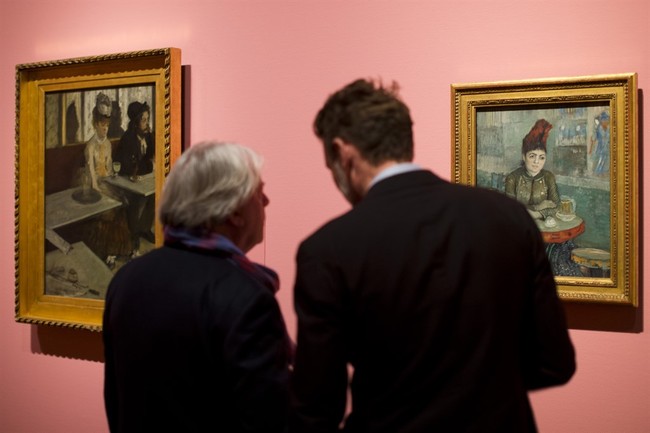
It did not take long for the spirit to find favor and find its way across the border and into France. As the turn of the century was approaching, Absinthe became a revered drink in Paris, especially among the artists in the city. The creative class made claims that Absinthe was delivering mind-altering effects, with the common refrain being that consuming enough would deliver visions of The Green Fairy.
Vincent enjoyed drinking absinthe, a spirit with an intense green colour. He used this specific colour to describe a painting. In a letter to his brother Theo, Vincent explained: 📝‘there’s a view of the Rhône, in which the sky and the water are the colour of absinthe, with a… pic.twitter.com/35VfbQcZav
— Van Gogh Museum (@vangoghmuseum) March 2, 2026
These claims were, of course, apocryphal and mostly the result of some brands of Absinthe sporting the alcohol content of 75-80 percent. Wormwood elements have been used medicinally in wines since the Egyptians circa 1500 BC, as well as in ancient China. The wormwood property touted as delivering mind-bending effects is thujone. The trace amounts in Absinthe are such that you would pass out or succumb to alcohol poisoning before consuming enough to reach those effects.
But the claims delivered contradictory results; the myth led to the drink rocketing in popularity, and it ultimately led to its demise. As other makers got in on the popularity, unregulated and dangerous ingredients were sometimes included, leading ultimately to the demonized drink becoming banned.
Absinthe’s removal from the French marketplace in 1915 led to replacements being attempted, which brought the emergence of popular substitutes, Pernod and Herbsaint.
Return of the Green Pixie
While banned, Absinthe became a known quantity in the States; even during Prohibition, its mystical legend was recognized. Ernest Hemingway became a fan. He wrote as a correspondent for the Toronto Star of “The Great Apertif Scandal,” detailing police activity in shutting down the illegal service of the banned drink under a different name.
Many of his works carry scenes of Absinthe consumption, from “For Whom The Bell Tolls,” “The Garden of Eden,” “The Strange Country,” and “The Sun Also Rises.” He likely enjoyed the unbanned potable when in Spain, and he was able to acquire the drink while in Cuba, and he has a rather infamous quote from a letter he wrote to Guy Hickcock, about a night he had in Key West.
Got tight last night on absinthe and did knife tricks. Great success shooting the knife underhand into the piano. The woodworms are so bad and eat hell out of all the furniture that you can always claim the woodworms did it.
absinthe bar where Dali, Hemingway & Picasso would frequent 🙂↔️ pic.twitter.com/5pT1Uv5ls0
— just elvia (@elviuhhh) November 13, 2025
The primary method of enjoying Absinthe is straight, but with a certain method. Very cold water is included and applied in a specific fashion, referred to as the louche. It is to be added very slowly, one drop at a time, as this will provoke a reaction that turns the fluid milky in appearance.
There are essential oils in the Absinthe that are rather unstable, and the water breaks the molecular bonds, releasing the oils. These arrive at varying stages, so the slow, methodical addition of cold water droplets releases an array of flavors. For this, a slotted Absinthe spoon can be used, with the ice resting atop the small fluted glass.
An addition to this is more modern, which is to first place a sugar cube on the spoon and drip the water so the sugar solution drops into the fluid, but this was not the traditional method. Hemingway wrote of the louche technique in “The Garden of Eden,” mentioning that if the water is added too quickly. He described the method needed to add the drops slowly, but then alluded to the illegality of what you would be drinking: “Everybody would know what it is then.”
There is another method to enjoy Absinthe, using another common drink. In a celebrity cocktail compilation, “So Red the Nose,” Hemingway donated his recipe.
Death In The Afternoon
In a Champagne Glass
1 Jigger Absinthe
Pour Iced Champagne Until It Attains the Proper Opalescent Milkiness
Drink 3 - 5 of these slowly.
As the authors noted on this concoction: “It takes a man with hair on his chest to drink five Absinthe and Champagne cocktails and still handle the English language in the Hemingway fashion.”