
With the collapse of Spirit Airlines came predictable claims that high fuel prices did the ultra-low-cost-carrier in. Of course, to believe that, you'd have to ignore the previous three years of reality, something Democrats were more than happy to do.
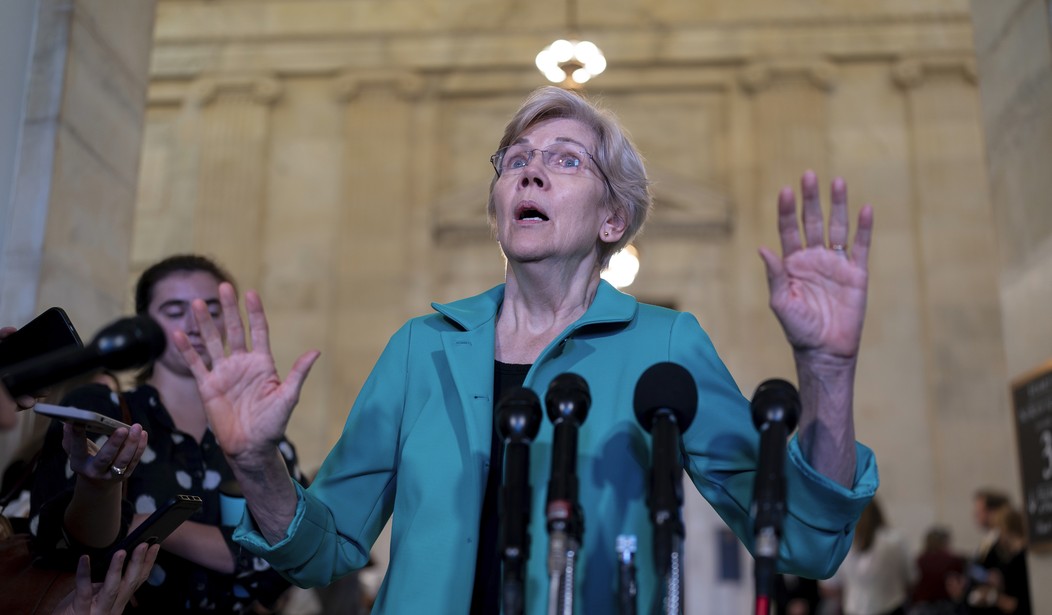
In 2023, the Biden administration sued to stop a merger between Spirit and JetBlue, a low-cost carrier (yes, there's a difference) predominantly servicing the Northeast and Island vacation destinations. The justification? That a merger would decrease competition and lead to higher ticket prices for consumers. In a series of now-infamous posts, Democratic Sen. Elizabeth Warren celebrated the move, calling it a "Biden win for flyers."
I've warned for months that a @JetBlue-@SpiritAirlines merger would have led to fewer flights and higher fares.@JusticeATR and @USDOT were right to stand up for consumers and fight against runaway airline consolidation.
— Elizabeth Warren (@SenWarren) March 6, 2024
This is a Biden win for flyers! https://t.co/lJFGS3ucv3
This anticompetitive airline deal would have increased prices and reduced options for flyers. Even a Reagan-appointed federal judge agreed!
— Elizabeth Warren (@SenWarren) January 16, 2024
A major win by @JusticeATR Kanter & @MassAGO Campbell & further evidence of successful antitrust enforcement by the Biden administration. https://t.co/TArpoZNXS6
This is why you don't let politicians who've never run anything of real value dictate business policy, much less socialists who haven't met an issue they are right about. I'd ask Elizabeth Warren how competitive Spirit Airlines is now, but she's already doubled down, refusing to take any responsibility for the carnage she and the Biden administration helped cause.
Spiking fuel prices from Trump’s war was the nail in the coffin for twice-bankrupted Spirit airline.
— Elizabeth Warren (@SenWarren) May 2, 2026
FWIW, JetBlue merger failed because a judge, appointed by Ronald Reagan, said the deal was illegal.
Republicans are desperate to shift blame from higher costs hitting families.
To be clear, the judge only had a chance to rule because the Biden administration sued to stop the merger, and even then, a waiver still could have been issued to allow the deal to go through. Instead, then-Secretary of Transportation Pete Buttigieg bragged that no such waiver would be issued.
But let's handle these issues as they come. First, did Spirit go under because of fuel prices? The short answer is no. Coincidentally, the long answer is no. Spirit's demise has been sealed for quite some time, no matter how much D.C. politicians who have no idea how airlines operate tell you otherwise. Go ask any pilot about Spirit's situation, and they'll tell you the company has been doomed since its first Fall 2024 bankruptcy. The company wasn't doing just fine until the fuel price spike that started a few weeks prior. On the contrary, its finances have been in abysmal shape for years, compounded by engine issues on their newer A-320/321 NEOs that required significant groundings.
That's why any suggestion of a bailout by the Trump administration was always pointless. Even if Spirit had been temporarily bailed out, you can't fly airplanes without pilots, and the writing was on the wall. No one with options was going to stay, and because of how obvious the coming collapse was, Spirit has been losing pilots hand over fist since mid-2024. As of early 2026, they were having trouble even crewing aircraft while working the crews they did have left to the limit. By 2025, I didn't know a single Spirit pilot who didn't have their applications out with other airlines. It was not a secret what was coming.
Which brings us to the next claim being pushed by Democrats: That merging with Spirit would have just led to JetBlue failing as well.
JetBlue's own founder said in leaked audio that the airline may go bankrupt this year. JetBlue hasn't turned a profit in six years. Now imagine them absorbing Spirit's debt while jet fuel doubles.
— Douglas Farrar (@DouglasLFarrar) May 2, 2026
The merger wouldn't have saved Spirit. It would have taken JetBlue down with it. pic.twitter.com/VnSB34rHb5
Is that true? No one has a crystal ball, and there are no guarantees in any industry, but claims that the merger would have certainly failed and taken JetBlue down with it are mostly based on ignorance of the industry. Unlike most other sectors, scaling down in the airline world can actually cost you more money, leading to financial issues that otherwise might not have existed. Everything revolves around route structures, access to gates, and fleet management. It is generally cheaper to have a larger fleet serving more routes, presuming the demand exists (and despite some slowdowns, airline demand is still near all-time highs), because it allows for easier subsidization of less profitable legs. Furthermore, regardless of what Warren and others say, the airline industry is not a monopoly. It's highly competitive, and an airline that can get a customer from New York to a regional airport in Oklahoma is more competitive than one that can't.
That was the entire point of JetBlue's attempted acquisition of Spirit. It wasn't an act of charity. It was to greatly expand JetBlue's route structure and fleet size, allowing it to better compete with the Big Four (Delta, United, American, and Southwest). It was also going to be a cash deal, meaning the airline would take on no additional debt. Now, JetBlue is stuck, still mostly siloed in the Northeast, unable to expand in the ways it needs to in order to remain competitive long term. Because of that, JetBlue is now more likely to go under than it would have been had the merger with Spirit occurred.
"But why doesn't JetBlue just buy Spirit's gates and planes now?" some will ask. For one, Spirit no longer owns any aircraft. Everything they had left were leases, which will now be bid on globally, and the A-320 family is the most popular airliner in the world outside the United States. Meanwhile, better-financed airlines like United will snap up new gate assignments and continue to hire pilots under their superior union contract. The merger was JetBlue's way of making expansion feasible and competition with the Big Four viable, and the Biden administration blocked it for some cheap seal claps from know-nothings who didn't understand the situation. All while claiming they were doing the exact opposite of what they were actually doing, which was decreasing competition.
In short, by blocking the merger, not only was Spirit's death warrant signed, but JetBlue's may have been as well. It wasn't fuel costs that did this, though they may have expedited the timeline slightly. Every airline is currently dealing with higher fuel costs. It was a dumb, overbearing federal government, run by Democrats at the time, that ensured this outcome.