
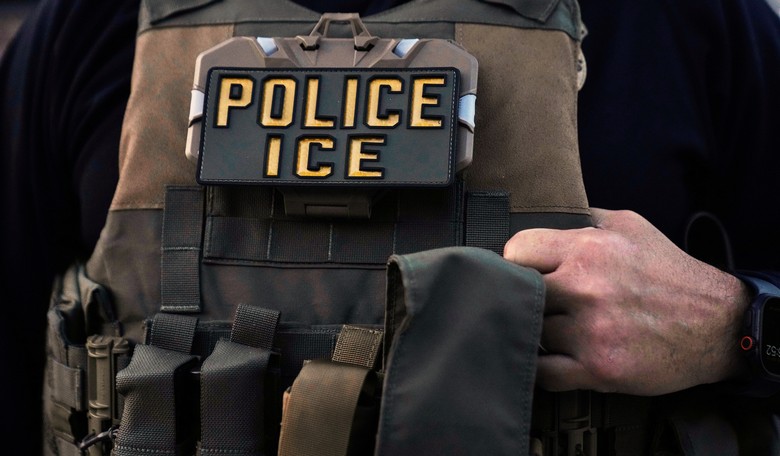
Gregory Morgan is an Immigration and Customs Enforcement (ICE) officer embroiled in a legal case that could have far-reaching implications. He may be facing six years in state prison in Minnesota over the incident, which happened during an ICE sweep in February.
On February 5 Morgan and another officer, who may also face state charges, were pulling out of a hostile neighborhood where they were engaged as part of Operation Metro Surge. The withdrawal was prompted by a protestor who had threatened to kill the officers.
According to Rachel Paulose, a former U.S. Attorney and managing attorney at the Upper Midwest Law Center, Morgan, unfamiliar with the area, was driving on the highway shoulder when a Cadillac automobile swerved into their path twice, braking hard in what would seem to be an attempt to cause a collision, which Morgan narrowly avoided. Morgan shouted at the Cadillac's driver, "Police! Back off!" while displaying his sidearm in a low-ready position.
Hennepin County (Minnesota) prosecutors alleged that Morgan was driving on the shoulder deliberately, and described the incident as a "moment of road rage" on Morgan's part.
Morgan was charged on April 6 with two counts of second-degree assault with a dangerous weapon.
James Percival, the general counsel for the Department of Homeland Security, has weighed in, calling the case "frivolous."
These “prosecutions” by sanctuary states are unconstitutional to the point of being frivolous. States have no authority to regulate federal officers in the performance of their federal duties. And it won’t work—the deportations will continue.
— James Percival (@DHSGenCounsel) November 29, 2026
The question is this: Are federal agents immune from prosecution for state crimes? The immediate answer is no; a federal agent doesn't necessarily have blanket immunity from any possible state crime. But the question in this case is whether Morgan will be tried at the state or federal level.
On the immunity question, federal officers are shielded from state criminal prosecution in some circumstances, but they do not have blanket immunity and never have. In fact, states have a long history of prosecuting federal actors for state crimes, stretching back to at least the early 1800s. Many of these cases arose amid high-tension flashpoints between the federal government and states, including in disputes over slavery, desegregation, and prohibition.
Morgan's attorneys maintain that a state prosecution over an incident in which nobody was injured in any way, will "open the floodgates" for the prosecution of federal agents performing their lawful duty while carrying out a policy that isn't popular with local officials and prosecutors. The defense asserts that Morgan's matter should be tried in a federal, not a state court.
Morgan's defense rests in part on a federal law with roots dating back to the War of 1812, which allows federal officers facing state criminal charges to move their cases into federal court if the alleged conduct is sufficiently connected to their official duties, and they have a plausible federal defense.
Paulose said the law was intended "to insulate federal officers from vindictive prosecutions by local and state officials who simply disagree with federal policy."
It's far more likely, given the political makeup of Hennepin County, that Morgan will get a fair hearing from a federal court. But if the Minnesota prosecutors win out, that could very well, as noted, set a precedent wherein any vindictive city or state prosecutor can seize on any incident to file charges against federal agents.
The case seems to hinge in part on the fact that Morgan and his partner had disengaged from the enforcement action and were returning to their headquarters when the incident in question occurred. But a law enforcement officer's status doesn't change when he leaves the enforcement site, especially when he's still on duty and, as appears to be the case here, the confrontation was provoked by the agent's participation in the event he just withdrew from.
It's a near-certainty that the prosecutors in this case aren't concerned with a fair proceeding so much as they are concerned with intimidating ICE agents carrying out their legal and constitutional duties. That's why this should be escalated to federal court, and out of the purview of the local prosecution.