




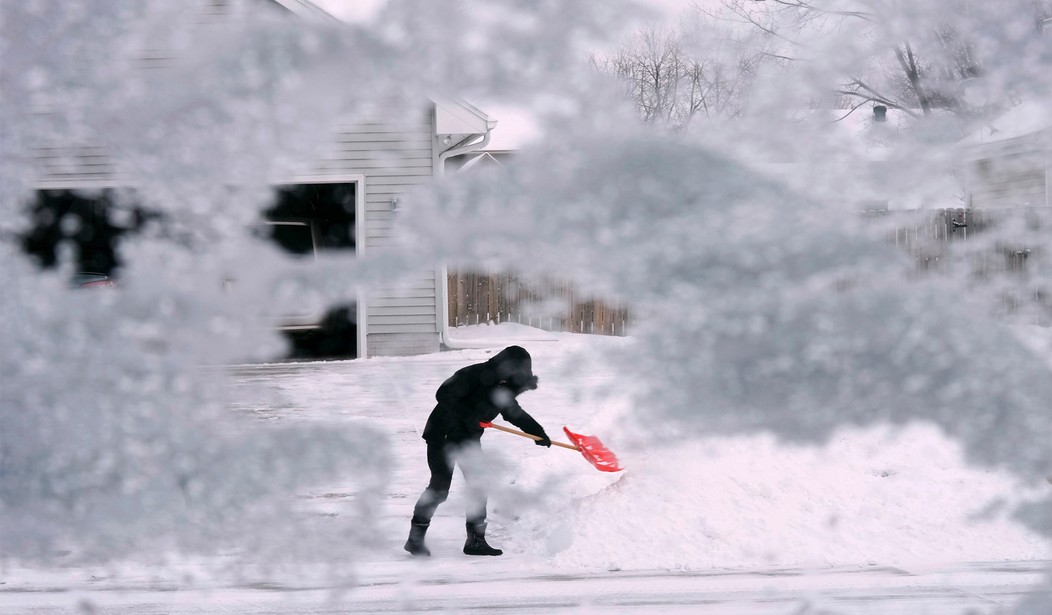

Most people like warm weather better than cold weather. Even here in Alaska, despite how much many of us love our beautiful winters — and if you don't like winter, you shouldn't live in Alaska — even the most hardened sourdoughs breathe a small sigh of relief when spring comes.
That brings us to an interesting observation. When you look at some of the more hysterical proclamations of climate scolds, the pattern you notice is that they are always going on about excessively hot temperatures, especially in Europe, where the people seem incapable of taking advantage of that great late 19th-century technology called "air conditioning." They complain about heat, they imply that the world is about to catch fire because we insist on driving SUVs and having modern things like, you know, electricity.
As I have always said, and written, yes, the climate is changing. It always has and always will. There is no "correct" setting, and it's the peak of human hubris for anyone to assert that there is; the global climate has been slowly warming since the end of the last major glaciation, about 13,000 years ago.
But a look at the data informs one that it's not hot summer weather that is driving most of that change. It's milder winters.
In Europe, there are temperature records going back centuries; granted, temperature readings weren't as precise in 1700 as they are now, but its trends we're looking for, and the trend is clearly towards milder winters.
The Central England Temperature (CET) series, maintained by the UK Met Office, runs from 1659 to the present and is the longest continuous instrumental temperature record available. For each calendar month I calculated the linear trend over two periods – 1659-2025 and 1850-2025 – and expressed the result as degrees Celsius per century. This produces 12 independent rates of change that can be compared directly. Because the same month is compared with itself across centuries, many of the practical difficulties that affect long temperature series (instrument changes, site moves, time-of-observation bias) are held constant.
Full record: 1659-2025
When the monthly rates of change are plotted for the entire 365-year period, a clear pattern appears. March is one of the strongest warming, roughly 0.45-0.5 °C per century. June shows the weakest, around 0.05°C per century – more than eight times slower. Winter months (December-February) and October also warm relatively quickly; late spring and early summer warm far more slowly.
The same applies to North America. North American winters, since the 1970s, have warmed by an average of three degrees (in Freedom Degrees, not commie Celsius) while summers have warmed by about 1.5 to 2 degrees. Not a huge difference — but it's there.
Look, there are effects on ecosystems with every change in climate. Some of those are short-term (on the geological scale) and bad for humans, like the Little Ice Age, marked by crop failures and famine. Some of those are also short-term and good for humans, like the Roman Warm Period, which saw agricultural outputs booming, including things like vineyards in Britain in places that are too cold today.
The upshot? We are having fewer extreme cold events. Admittedly, yes, data shows we are having more heat events in some places; look at Europe last summer, where, again, they don't seem to have assimilated the American ideal of air conditioning. Cold injuries, not heat injuries, are a major cause of injury and death in North America.
Milder winters also have an effect on our primary food crops, by yielding up longer growing seasons. Alaska, in 2025, approved the funding and structure of the state's very first Department of Agriculture, as commercial farming in the Great Land is increasing. Longer growing seasons could open up great swathes of land in Europe and Asia for agriculture, just as did the Roman Warm Period. Growing more crops, not fewer, is good — and will only increase the demand for things like diesel fuel, which despite the outcry of climate scolds, is still how we move those crops to market — with diesel-powered trucks and locomotives.
These are facts.
I'll repeat what I've been saying for years: Yes, the climate changes. Yes, right now we are in an interglacial period, and the global climate is slowly warming. Yes, people do have some effect on that; some are claiming we may have averted the start of another glacial advance, although the jury's still out on that. No, we don't know what the planet's ideal temperature range is, although through most of our planet's history it has been warmer than it is now - sometimes much, much warmer.
But our influence on the global climate does not warrant abandoning much of our comfortable modern lifestyles, which rely on conventional energy sources. It doesn't warrant covering much of the landscape with solar panels and eagle-killing windmills, only to still suffer brownouts because of the intermittent, low-density nature of those sources. And yes, slightly milder winters are good for humans in many ways.
These are facts. And it is on facts that we should base policy. That's all.