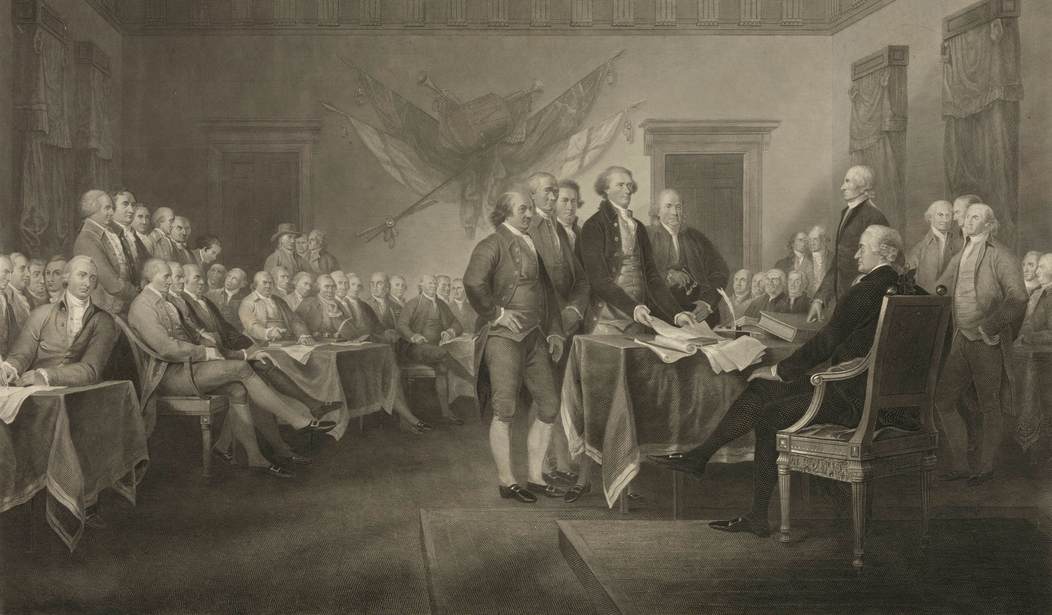

This year, we Americans celebrate our semiquincentennial, the 250th anniversary of the Declaration of Independence, in which we announced our intention to break away from the iron grip of the most powerful empire in human history at that time. The King demanded we return to the fold. The American people told him where to head in, and after a grueling war for independence, the United States of America was born. We have now taken the British Empire’s place as the most powerful nation on the planet, the most powerful nation in human history.
As we near the 4th of July, the date on which the Declaration of Independence was signed in 1776, we’ll be looking at and reading about the events that led up to that day, and what happened afterwards. We’ll be remembering the people involved: American heroes, like George Washington, John Adams, Thomas Jefferson, Benjamin Franklin, Paul Revere, Sam Adams, and more. But I’d like to take a look at some of the lesser-known but no less committed figures who contributed to our fight for freedom.
For this installment, we’ll meet another man born into slavery, and arguably the first person killed in what would be the Revolutionary War – Crispus Attucks.
Read More: Unsung Heroes of the Revolution IV: Sybil Ludington
Unsung Heroes of the Revolution V: William 'Billy' Lee
There’s not a lot of information about Crispus Attucks’ early life. He was probably born around 1723, in or near Framingham, Massachusetts. He was born into bondage; his father was reportedly a slave named Prince Yonger, and his mother was said to be a Native woman named Nancy Attucks. Crispus lived and worked on a farm until he was 27, when he fled the farm and his owner, one Deacon William Brown. His (now former) owner placed an escaped slave notice in the Boston Gazette, describing Attucks as a “mulatto fellow” of about six feet, two inches tall, with short hair and “distinctive knees.”
It’s not clear what was meant by “distinctive knees.”
Advertising and distinctive knees notwithstanding, Crispus Attucks kept his liberty. He went to Boston, where he found work as a sailor and a whaler, professions in which one didn’t get too many questions about one’s background, as long as you pulled your weight, which Crispus seems to have done.
Then came March 5th, 1770. Crispus Attucks was no longer a young man, being aged around 47; it’s unclear if he was still working as a sailor at that point. On that day, though, he was in Boston. A regiment of British troops had moved into Boston. Tensions were high; the population wasn’t happy, and things were on a razor’s edge. Crispus Attucks was part of a crowd that started throwing snowballs and taunting the British troops. In those days, throwing things at armed soldiers often had an unpleasant result, and that’s what happened in what became known as the Boston Massacre. The British troops leveled their muskets and opened fire. Crispus Attucks was the first to fall, pierced by two musket balls in the chest, which caused fatal damage to his liver and lungs. Four others were also killed: Samuel Gray, James Caldwell, Samuel Maverick, and Patrick Carr.
The martyrs to the revolution that would be were carried to a place called Faneuil Hall, where they were placed for viewing. They were then buried together in Granary Burying Ground.
Later, in the 19th century, when arguments over slavery were threatening to tear the country in two (and nearly did), Crispus Attucks’ memory resurfaced. He was rightly seen among proponents of abolition as a key figure in American history, the first to fall for the cause of liberty, and a black man at that. He became, and is, a symbol of patriotism and sacrifice, not just for black people but for all Americans.
In Boston, in his memory, March 5th is now Crispus Attucks Day. A prominent monument to the Boston Massacre is on the Boston Common; I’ve seen it, and it features Crispus Attucks prominently.
Crispus Attucks never wore a uniform or carried a musket. He never wrote or delivered a speech. He did get caught up in an angry mob, upset at the installation of British troops in their city. Was he just in the wrong place at the wrong time? It’s possible, but most people don’t get caught up in angry mobs unless they intend to be, and this crowd was substantial by the standards of the day, from 300 to 400 people. But that’s a small enough crowd to enable someone to get out.
No, it seems certain that Crispus Attucks, like the others, was there because he intended to be – he was there to protest the British troops, there as an early advocate for American independence, and he was arguably the first casualty in the war for our American nation. He serves as a great reminder that not every hero of the Revolution was a soldier, a philosopher, a wealthy businessman, or a politician; the cause of American freedom was also fought for by ordinary folks, sailors, whalers, farmers, and even escaped slaves, many of whom, like Crispus Attucks, gave everything they had to the cause of liberty.