






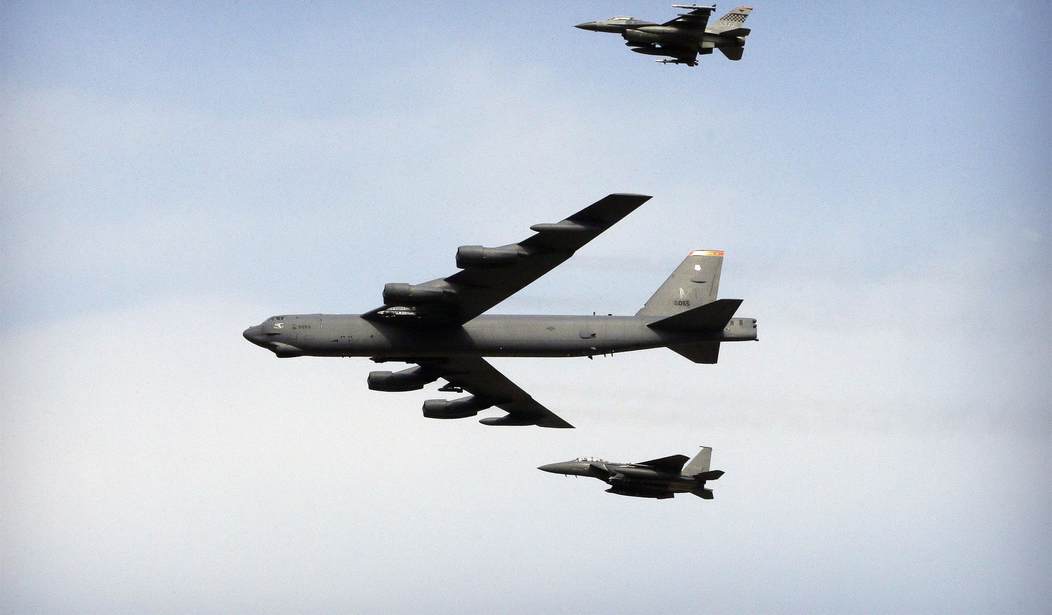
The B-52 Stratofortress is an aircraft out of legend. This wonderful old warbird, known by many service members as the Big, Ugly, Fat Fellow, or BUFF, is the best there is at what it does: Delivering a wide range of heavy explosive payloads on target. When you want to sneak in and take down air defenses in the middle of the night, you call the B-2 people; when you need to deliver a payload and depart the area at Mach 1, the B-1B folks are still around. But when you don't need stealth or speed, but you have a grid square of landscape that you need transformed into something like the surface of the Moon, the BUFF is just the thing for the job. Work is now underway on the latest upgrade of the BUFF, the B-52J, and that will extend the life of the basic design to right around a century in service.
All good things, however, must one day come to an end. Now, the United States Air Force is in the very preliminary stages of determining what will replace the B-52 in its role of solving problems in the American military tradition: with tons of high explosives.
The Air Force is asking for $1 million in its budget request for the 2027 Fiscal Year to conduct a New Heavy Bomber Analysis of Alternatives (AoA). Aviation Week was the first to report on the appearance of this AoA in the service’s budget documents. All branches of the U.S. military routinely use the AoA process to assess available options and further refine requirements for new weapon systems and other capabilities.
The Air Force currently has 76 B-52Hs in service. The last of these aircraft rolled off Boeing’s production line in 1962, though they have received numerous upgrades in the decades since then. These bombers continue to be in high demand as conventional long-range strike platforms, as evidenced by their heavy use in the latest conflict with Iran. They also play a key role in the air leg of America’s nuclear triad.
The BUFF has the advantage of being able to carry huge external payloads in addition to the loads in its cavernous bomb bay, including long-range stand-off weapons; that's a capability we presume will have to be included in any replacement. And while this is all in the very preliminary stages, there may be some clues out already as to which direction this design may go.
The Air Force’s budget documents do not specify any particular design or other requirements for a follow-on heavy bomber. One possibility could be an aircraft with a blended wing body (BWB) planform, something the service has already been exploring for other mission sets. A BWB aircraft could offer a limited degree of low-observability (stealthiness), as well as significant internal payload capacity, including the ability to carry outsized stores. This could also be paired with Air Force plans for a next-generation aerial refueling tanker, which we will come back to in a moment.
Here's what that might look like:
A possible B-52 replacement? pic.twitter.com/uRExaeJFpM
— Ward Clark (@TheGreatLander) May 9, 2026
The USAF is apparently calling this the New Heavy Bomber project:
The U.S. Air Force plans to launch an analysis of alternatives study next year for a New Heavy Bomber aircraft amid continued work on a classified proof-of-concept that is starting this year, budget documents show.
“[A] new heavy bomber analysis of alternatives will begin initial planning activities to develop key performance parameters, key system attributes, and additional performance attributes for a follow-on heavy bomber in the USAF,” the Air Force’s budget justification document shows.
Any new such aircraft will probably be faster and stealthier than the BUFF, but the primary goal should be the same: Delivering ordnance on target. What's less clear as to whether it would be more cost-efficient to design and build a new bomber or just ramp up the upgrades to the B-52J; but, these old airframes can't last forever.
Read More: Rage, Reborn: Legendary B-1B 'Apocalypse II' Gets Back Into Active Service
The BUFF in Iran: What the Deployment of America's Oldest Bomber Means
What's more, the USAF is already, as we noted, working on upgrading to the B-52J, and that's a costly process:
The B-52 is already one of the best that's ever been at solving military problems in the time-honored American way: With the suitable application of high explosives. Any new design should be focused on the role the BUFF now holds: Not invisible or fast, but durable, upgradable, and capable of delivering a wide range of weapons on target. Any new heavy bomber in this role should, one would think, have the advantage of being cheaper and quicker to build than the complex, stealthy B-21, and that's a good thing, too; since at least 1991, American practice has been to first gain utter air dominance over the battlefield, so that birds like the B-52 can deliver their payloads with impunity.
It will be interesting to see what the Air Force comes up with. In the meantime, the BUFF is sure as shootin' still up for the job, and will be for some time.
Editor’s Note: Thanks to President Trump and his administration’s bold leadership, we are respected on the world stage, and our enemies are being put on notice.
Help us continue to report on the administration’s peace through strength foreign policy and its successes. Join RedState VIP and use promo code FIGHT to receive 60% off your membership.



Join the Conversation
VIP members get the ability to comment on articles.