
File this under "Stupid Ideas on Climate Change, Possibly Catastrophic." It's amazing how often that happens, where climate scolds complain bitterly that we aren't worried enough about the Earth's ever-changing climate, where they shout, like more annoying versions of Chicken Little, that the sky is falling, and insist we crawl obediently into 15-minute cities, giving up our automobiles, air conditioning, and even 24-hour electricity, in the name of preventing a climate catastrophe. And then, they go on to propose a solution that may cause an actual catastrophe, by messing about with vast systems we don't understand very well.
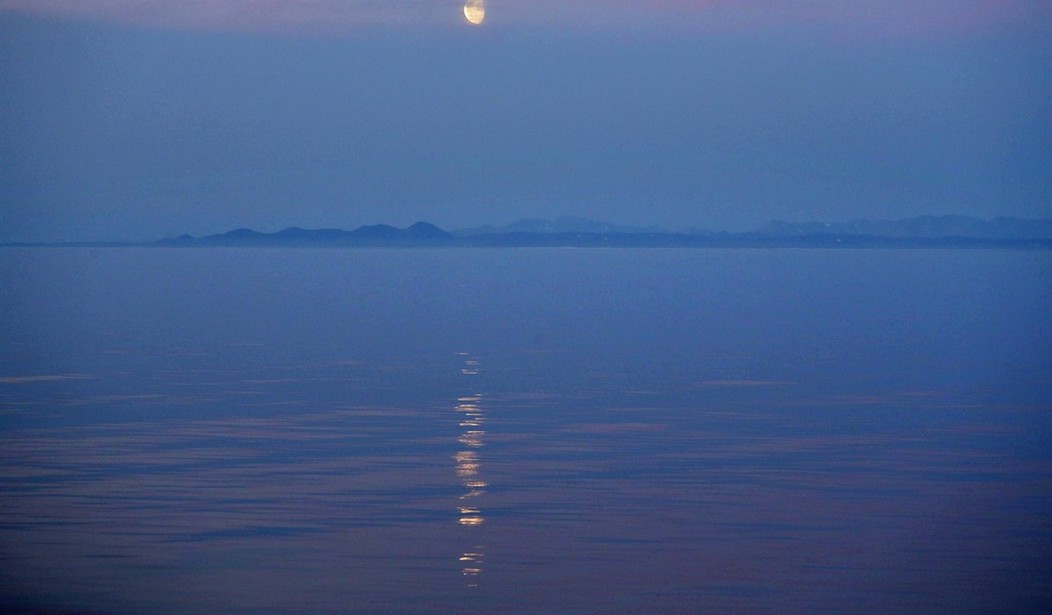
Case in point: Now they are talking about damming the Bering Strait, that body of water that connects the Pacific and Arctic Oceans. Yes, really, a big, big dam across the 51-mile span (if they build this at the narrowest point) of the Bering Strait.
Watts Up With That's Anthony Watts has some details.
There are papers that push boundaries, and then there are papers that quietly step over the line into something closer to speculative engineering fiction dressed up as policy relevance. The recent preprint titled “A Constructed Closure of the Bering Strait can Prevent an AMOC Tipping” falls squarely into the latter category. Published in March, this one has been getting a lot of press lately.
Let’s be clear about what is being proposed here: the physical closure of the Bering Strait—an ~80 km-wide ocean gateway between Alaska and Russia—using a series of dams, in order to manipulate large-scale ocean circulation and “stabilize” the Atlantic Meridional Overturning Circulation (AMOC).
This doesn't just push boundaries; it's even well past what Watts calls speculative engineering fiction. This is lunacy, pure and simple. And where's the fun part: This solution in desperate search of a problem proposes to address an Atlantic phenomenon: The Atlantic Meridional Overturning Circulation, or AMOC. The AMOC is a sort of oceanic conveyor belt that takes cold water south and sends warm water north, which is why northern Scotland has a milder climate than Alaska, despite being at a roughly similar latitude.
There's just one problem: Nobody seems to know exactly what this scheme would accomplish, but much of what we can suspect is bad. Very bad.
The authors rely on an Earth system model of intermediate complexity (CLIMBER-X), running at a coarse 5° × 5° resolution—a level at which the Bering Strait itself isn’t even explicitly resolved, but instead treated as a “baroclinic tracer exchange” between basins.
That alone should give pause.
In other words, the very mechanism they propose to physically shut down is not even directly simulated in a realistic way. The “throughflow” is parameterized, not dynamically resolved. Yet from this abstraction comes a conclusion about constructing one of the largest geoengineering projects in human history.
The authors do acknowledge discrepancies:
“The Throughflow’s strength in this model is not realistic…”
But then proceed as though the qualitative behavior justifies real-world intervention. That’s a leap, and not a small one.
In other words, they haven't the slightest idea what this might do.
Read More: Climate Change, the Alps, and an Inconvenient Tree
Wrong Again: Atlantic Current Isn't on Brink of Collapse, Science Shows
Now, this has happened, naturally, but it when this happened, most recently in the Pleistocene, it was accompanied by an overall drop in sea levels due to the Earth being in the throes of the last major glaciation. You could walk from Russia to Alaska, then, and you could also walk from Wales to France. So any evidence we have from this last time that the Bering Strait was closed is useless to predict what blocking it now might do. A planet where much of North America, Europe, and Asia were covered with mile-thick ice sheets is not a good comparison to our mildly warming earth now in the middle of a warm interglacial period.
None of this makes any sense.
Mr. Watts goes on to talk about some of the possibly catastrophic consequences of this, including such things as:
- Blocking Pacific currents into the Arctic Ocean, which could have unknown effects on sea ice formation.
- Alterations to existing Pacific currents by blocking currents that now enter the Arctic Ocean, again with unpredictable effects.
- Alterations to weather patterns. As anyone who has read about the El Niño/La Niña systems knows, oceans and their warm and cold currents can have a big effect on weather, even hundreds of miles inland.
- Ocean life. This is a migration corridor for whales, pinnipeds, and who knows how many species of fish.
And, as Mr. Watts also points out, the climate scolds are fond of warning us that our relatively small (on the global scale) activities could cause catastrophic climate changes, then they do on to fever-dream solutions that almost certainly would cause catastrophic changes to systems that we do not understand anywhere near enough to be screwing around with.
As we saw in some recent, amazing photos from the recent Artemis lunar fly-by, Earth looks kind of small from even lunar orbit. On the cosmic scale, it is pretty small, a little blue, green, and white dot in the vastness of space, that is the birthplace and resting place of every single human being ever born. But on the human scale, Earth is really big, its systems and cycles vast and complex beyond our imagining. And yet, for the imagining of possible climate catastrophes from the climate scolds, we are asked to consider geoengineering that may very well have an actual catastrophic effect.
Here's the good news, at least in this case: This can't be done. No nation, nor even a group of nations, can dam a 51-mile-wide strait that runs as deep as 300 feet. It can't be done. The cost would be prohibitive, and the materials and resources required, likewise, prohibitive.
So why do the scolds keep floating lunatic ideas like this? To keep the panic going. To keep the cause alive. To push for more and more control over what we do. And to keep the donations flowing.