






There are few contemporary experiments as instructive for the friend of liberty as the one currently unfolding in Argentina. Beneath the soil of Patagonia, in the province of Neuquén, lies a 30,000 km geological basin known as Vaca Muerta — “the Dead Cow.” According to the U.S. Energy Information Administration, it holds the world’s second-largest reserves of shale gas and the fourth-largest of shale oil. Discovered in the early 2010s, this deposit should have turned Argentina into a major energy power. Instead, it remained largely untapped for more than a decade. The reason was neither technical nor geological. It was institutional.
The Cost of an Expropriation
In 2012, the government of Cristina Fernández de Kirchner — the very same person from whom the Argentine judiciary has just seized 550 million dollars for fraud — nationalized YPF by expropriating its Spanish co-shareholder Repsol. The operation was presented as an act of “energy sovereignty.” It turned out, as always in such cases, to be an act of plunder — with ruinous consequences: capital flight, investor mistrust, deterioration of the legal framework, and paralysis of the sector for more than a decade. Argentina offered the paradigmatic illustration of a country rich in resources and poor in institutions. What distinguishes prosperous nations from stagnant ones is not the endowment in raw materials but the quality of the institutional framework.
The Contract as a Weapon Against Arbitrariness
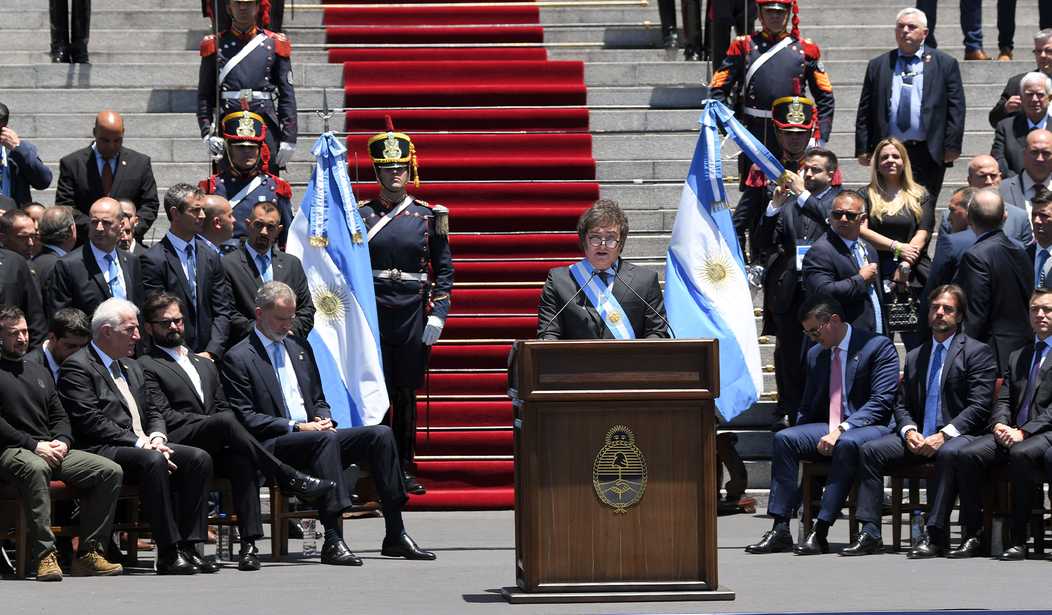
This is exactly the lesson that Javier Milei, the libertarian economist who came to power in December 2023, has made his own. His energy policy rests on a conviction that will resonate with any American free-market thinker: wealth does not flow from state ownership, but from the unleashing of productive forces and the spontaneous coordination of the market. From the moment he took office, the Argentine president deregulated the sector, freed crude oil prices, simplified administrative authorizations, and reopened the country to the American majors — Halliburton, Chevron, and ExxonMobil.
SEE ALSO: Trump and Milei Take Aim at the Left - and Celebrate a Week of Wins
The major institutional innovation bears a name: RIGI (Régimen de Incentivo para Grandes Inversiones), adopted in 2024. This scheme guarantees any project above $200 million, customs and foreign-exchange stability for 30 years. For a country still marked by the memory of past expropriations, it amounts to a genuine founding act. Sovereignty through control gives way to sovereignty through contract. Administrative arbitrariness gives way to legal predictability. This is the very essence of the rule of law applied to productive investment — something the Trump administration has consistently championed on its own soil through deregulation and its “energy dominance” agenda.
Capital Votes With Its Feet
The capital is flowing in. On May 15, YPF — the very company that had been the instrument of the 2012 nationalization — announced its application to the RIGI for a giant project named LLL Oil: $25 billion to be invested over 15 years to drill 1,152 wells in Vaca Muerta. According to its chairman and chief executive, Horacio Marín, this is “the most important oil-export programme in Argentine history” and the largest application ever filed under the RIGI. The objective is ambitious: to reach a production plateau of 240,000 barrels per day from 2032, entirely earmarked for export through the new Vaca Muerta Oil Sur pipeline, generating some $6 billion in annual revenues — that is, over the life of the project, more than $100 billion in cumulative exports and close to 6,000 direct jobs.
In parallel, Halliburton — an American company — is deploying, for the first time outside the United States, its ZEUS system: the first fully electric fracturing unit, steered in real time by the OCTIV digital platform. Technology always follows capital, and capital always follows contractual freedom.
The macroeconomic consequences are already visible. Long a net importer of oil despite its resources, Argentina has become a net exporter. For a country strangled for 50 years by foreign-exchange shortages and chronic inflation, this structural inflow of oil dollars is the very condition for a return to monetary stability and an exit from the inflationary cycle inherited from Peronism.
Europe’s Energy Suicide
This Argentine success should give the European Union (EU) reason for serious reflection. For while Buenos Aires is rediscovering prosperity through economic freedom, the EU persists in moving in precisely the opposite direction. The European Commission has now taken to organizing scarcity methodically. Climate planning has replaced Soviet planning in the minds of Brussels bureaucrats, without correcting any of its fundamental flaws.
The contrast with the United States could not be sharper. The Trump administration has embraced energy abundance as a strategic and economic imperative — lifting restrictions on drilling, fast-tracking LNG export terminals, and withdrawing from the Paris Climate Agreement. The results speak for themselves: the United States continues to set records in hydrocarbon production, strengthening both its economy and its geopolitical leverage. The United Arab Emirates left OPEC for the same reason. Meanwhile, the EU forges ahead with mandates, carbon taxes, and phase-out deadlines that are making European industry uncompetitive and European households poorer.
The real world cares little for Brussels Institutions. China opens a new coal-fired power plant every month. India, Indonesia, and the whole of Africa are raising their coal consumption. Guyana and Suriname are becoming the new oil eldorados, while the EU discourages exploration in its own neighbor, the French Guyana territories. Fossil fuels still account for 87 percent of the world’s primary energy; wind and solar barely 3 percent. Despite some 30 successive COP conferences, global CO₂ emissions have risen by 66 percent since the first climate summit. The policy has failed by any empirical measure.
The Argentine experience confirms what every free-market economist has known since Frederic Bastiat: wealth is not created by decree, it is released by law. An economy is not improved by being constrained; it is enriched by being opened. And a civilization is not saved by being made to feel guilty about its energy use; it is served by being given back the affordable, reliable energy that activists and bureaucrats have sought to deny it.
Vaca Muerta is coming back to life. One can only hope the European Union finds the same path — before it too earns the nickname of “the Dead Cow.”
Samuel Furfari is a Professor of Energy Geopolitics and a retired official of the European Commission.
Editor’s Note: The 2026 Midterms will determine the fate of President Trump’s America First agenda. Republicans must maintain control of both chambers of Congress.
Help RedState continue to report on the Democrats’ radicalism and inform voters as our nation faces a crossroads. Join RedState VIP and use promo code FIGHT to receive 60% off your membership.


Join the Conversation
VIP members get the ability to comment on articles.