
Having lived and worked in Japan, I'm pretty familiar with that country's great passenger rail systems. This includes not only the big, charismatic "bullet trains," the shinkansen, but also all the various other trains and subways in the Land of the Rising Sun - the regional trains, the commuter trains, the rapid expresses that run from hub to hub. Japan's rail system is efficient, almost always on time, and the cars are clean and (because the Japanese people insist on it) quiet.
Some years after my first long-term stint in Japan, I had occasion to ride on San Francisco's BART system. I never did it again. From the superficial appearance of the stations and trains, there are a lot of commonalities between the Bay Area system and the Japanese rail lines, but these were only superficial. The BART, at least the day I rode it from Redwood City to downtown Frisco, was dirty, full of shady characters - at one point, I placed myself physically between a young mother with her daughter, and three youths with resting thug faces who were eyeing them suspiciously. Worse, the car stank of stale urine.
California's impeccably coiffed Governor, Gavin Newsom, has been trying to take the BART model to the statewide scale. But the California high-speed rail project is a mess; billions have been spent, and not one train has moved from anywhere to anywhere. The Pacific Research Institute has some damning figures.
The California High-Speed Rail Authority’s latest draft business plan, which it releases every year, now calculates that it will cost $126 billion to connect San Francisco with Los Angeles-Anaheim. It’s not that far off the previous year’s estimate — give or take a billion or so. But it is a jolting reminder that it was supposed to cost $33 billion when voters approved the train in 2008.
It was also supposed to be carrying 65.5 million to 96.5 million intercity riders a year by 2030. Yet now 2040 is the date for “full service to start.” Skeptics don’t believe we’ll ever see the train run with paying customers aboard.
“In my judgment, the Draft 2026 Business Plan describes a project that has reached a dead end,” says Louis S. Thompson, a 15-year member of the California High Speed Rail Peer Review Group that was established by legislation.
A dead end, indeed, and they have been called out on it, time and again. The Las Vegas Review-Journal, for instance, writes in an editorial:
Has there ever been a greater fraud perpetrated on the taxpayers than California’s high-speed rail travesty? Where are the folks at “American Greed” when you need them? And the news just keeps getting worse.
On Sunday, “60 Minutes” shined the spotlight on what has become the most embarrassing and costly government infrastructure boondoggle in U.S. history: the effort to link San Francisco and Los Angeles by bullet train. The project was born out of lies — low-balled costs, inflated ridership numbers — in an effort to attract popular support but now can’t outrun the deceptions.
It's time that this project was abandoned.
Read More: Newsom’s $450 Million 911 Debacle Reminds Why We Oppose Federal Welfare
CBS Exposes Newsom's $135 Billion Train Debacle: No Tracks Laid, Billions Wasted, and Going Nowhere
Look, this whole thing began in - yes, it's hard to believe - 1996, when the California High-Speed Rail Authority was established by the Assembly. In 2008, it was put to the voters, who approved Proposition 1A, which authorized the sale of $9.95 billion in bonds to start up what was intended to be a high-speed rail line from Los Angeles to San Francisco. The whole thing, in 2008, was expected to cost about $33 billion and to be running in 2020.
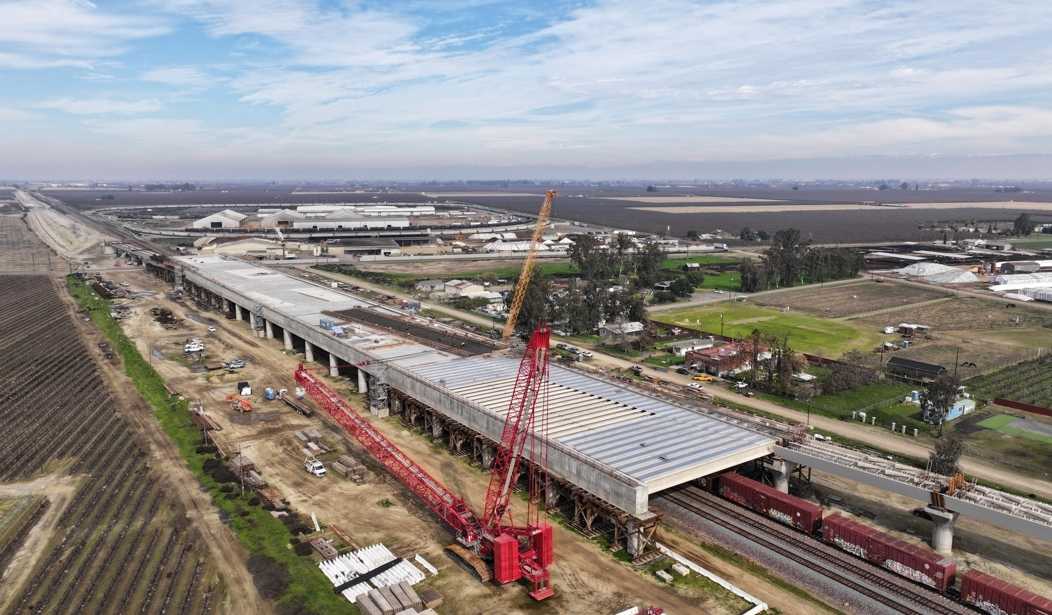
That didn't happen. There was a groundbreaking in 2015 in Fresno, but to date, no trains are running, no rail has been laid. 30 years, and no track has been laid. The supposed "Initial Operating Segment" of this boondoggle, running from Merced to Bakersfield, is staggering along without much happening. No trains will be running, according to current estimates, until 2032 - and I'll bet the spare tire on my pickup that it won't happen, not in 2032, not in 2033, not in 2040.
Why is this still dragging on? Inertia? Well-connected people making bank on contracts that will never be fulfilled? The environmental lobby, strong in California, which utterly hates the notion of people actually driving from Los Angeles to San Francisco - or from Merced to Bakersfield, for that matter? For that matter, what good is there in having a high-speed passenger rail line between Merced and Bakersfield?
It's a fool's errand to look at Japan's rail network and think we can make it work here. Japan is a country with slightly less land area than California, and a population of 123 million people, compared to California's 40 million. Even in California, the numbers just don't work, and for the rest of the United States? In New England and some of the urbanized areas of the Eastern Seaboard, commuter trains make some sense. From Merced to Bakersfield? Not so much.
It's past time to abandon this whole thing. Cut the taxpayers' and bondholders' losses. The longer this bad idea drags on, the more money gets poured into it, and the longer things go on without one rail laid, without one passenger moving from anywhere to anywhere. This thing has become the boondoggle of boondoggles, and it's time to let it die.