
The climate scolds haven't had a good couple of years. People in general are getting hip to the scam. It's not that the climate doesn't change; it always has and always will. It's not that human activities don't have some effect; everything does, and human efforts are pretty puny compared with the vast systems and cycles that shape the global climate. No, it's more because the main run of folks in the developed world are 1) figuring out that a fraction of a degree warmer or cooler isn't worth giving up our comfortable modern lifestyles over, 2) the dire predictions of the climate scolds never seem to materialize, and 3) a quick look at geological history indicates that, through most of the planet's life so far, it's been warmer than it is now - sometimes a lot warmer - and that it's the height of human hubris to assume we know what the planet's "correct" temperature range is.
So now, to keep that activist excitement level up, some of the scolds are turning to a new environmental cause: plastic pollution. Now, here, there are some legitimate concerns, but as usual, the scolds are focusing their efforts on all the wrong places.
In November 2025, the UN Environment Program teamed up with the Ellen MacArthur Foundation to roll out the 2030 Plastics Agenda for Business. Billed as an “evidence-based” and “practical” global framework, it is really designed to morph voluntary corporate sustainability promises into binding international policies.
The agenda seeks to eliminate plastic waste and pollution by rallying governments, businesses, and “stakeholders” to “catalyze market transformations,” enforce standardized packaging designs, force national laws into a single “circular economy” mold, and reshape entire markets collectively.
It calls for “root cause” solutions: eliminating unnecessary plastics, innovating toward reuse models and alternative materials, and recirculating what we still need.
The real pitch? Obeisance to UN plastic directives will deliver “profound benefits” to the economy, nature, people, and societies — backed by a “shared vision” already endorsed by more than 1,200 organizations worldwide.
It's tempting at this juncture to ask, "Who cares what the UN thinks?" But pay note to the nations that mostly pay any attention to UN cajoling: The nations of Europe and, to a lesser extent (and largely depending on which party has control), the United States. Want another good reason for the United States to drop out of the United Nations, by the way? Here we are.
There's just one catch. These nations of the developed world aren't the ones that are the major offenders when it comes to plastic pollution. Not by a long shot.
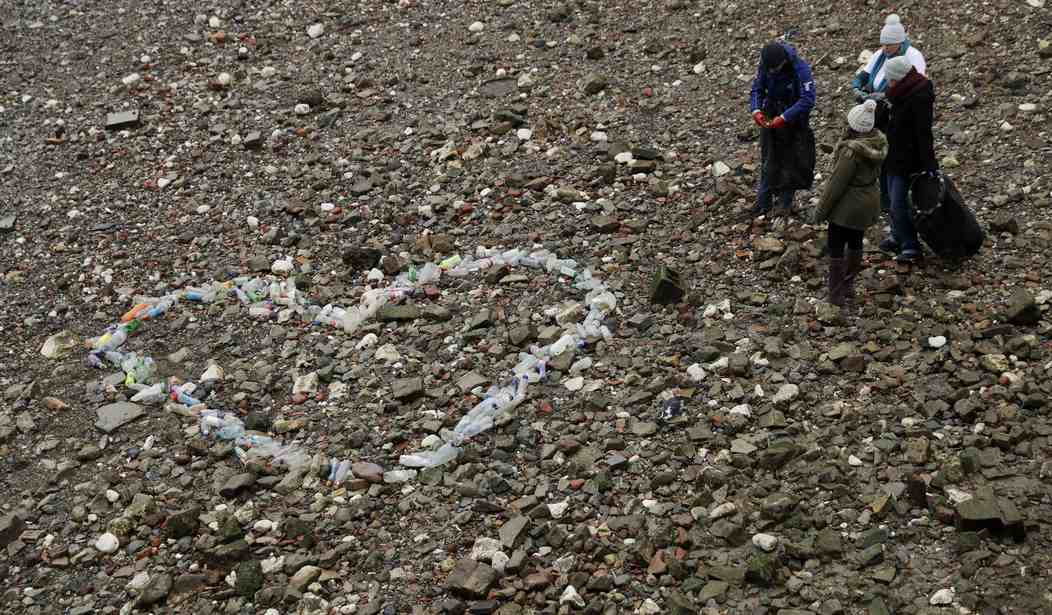
Yes, plastic pollution is real. But roughly 80 percent of plastic wastes reaching the oceans comes from Asia — especially mismanaged waste from countries such as China, India, Malaysia, Indonesia, and the Philippines. Massive population centers dump packaging and other plastics into waterways because of widespread poverty, weak governance, poor waste management infrastructure, and lack of funds for modern programs and technologies.
If the UN genuinely wants to curb plastics pollution, it should strong-arm China (and others) into real action.
But good luck with that. China rarely embraces binding commitments in earnest, since it is the world’s biggest emitter.
In plainer language, China doesn't give an ounce of stale rat urine about plastic pollution, and they will ignore anything the UN has to say about it. China will always do what's best for China, not necessarily what's best for the rest of the world.
Read More: Why Are Climate Scolds Against Nuclear Power?
Geo-Geniuses Now 'Fixing' Atlantic With Chemicals. What Could Go Wrong?
It's not just China. Here are the top 10 producers of plastic waste:
1 🇨🇳 China 2,683,631 2 🇵🇭 Philippines 1,695,260 3 🇮🇳 India 966,447 4 🇧🇷 Brazil 639,665 5 🇮🇩 Indonesia 599,020 6 🇳🇬 Nigeria 496,841 7 🇻🇳 Viet Nam 484,457 8 🇹🇷 Turkey 354,441 9 🇹🇭 Thailand 338,685 10 🇲🇾 Malaysia 332,756
China and the Philippines are the real world-beaters, but it doesn't stop there. Russia, with less than half the population of the United States, produces considerably more plastic waste than the United States; 21,000 tonnes (metric) compared to the USA's 17,000 tonnes. Does anyone think Tsar Vladimir I is overly concerned here?
Ah, but there's a difference between this concern and climate scoldery.
Plastics and plastic packaging drive the world economy, employ millions globally in numerous industries, and are essential to human nutrition, health, well-being and affordability.
Actual progress to reduce the downside of the use of plastics — specifically litter — will require helping poorer countries achieve the level of development, infrastructure, incomes, and environmental responsibility that wealthy countries currently enjoy.
That means UN bureaucrats and eco-activists will have to stop opposing economic development, which will by necessity include wider use of fossil fuels and nuclear power. They will have to stop dictating to poor countries what level of “ecologically feasible development” they will be permitted to pursue.
I'm going to predict that the United Nations will do nothing of the sort. That would mean promoting capitalist development of those nations, as free-market capitalism is, far and away, the most successful system of lifting developing nations out of poverty and into a new, prosperous future. The UN is fundamentally anti-capitalist, and has been for some time. And, while the UN can dictate to those poor countries, the poor countries will almost certainly continue to ignore the UN's whining, as will China.
So what will the UN do? Focus on the developed world, the prosperous nations of North America and Europe, which have the luxury of being able to worry about things like plastic in the world's oceans. They will bloviate about how the USA and Europe have to step up, when it's not the USA and Europe who are the bulk of the problem.
That's why we have to play a juggling act to carry three bottles of pop and a big bag of chips to the car from the convenience store because plastic bags have been outlawed, while China continues to dump millions of tons of plastic every year.