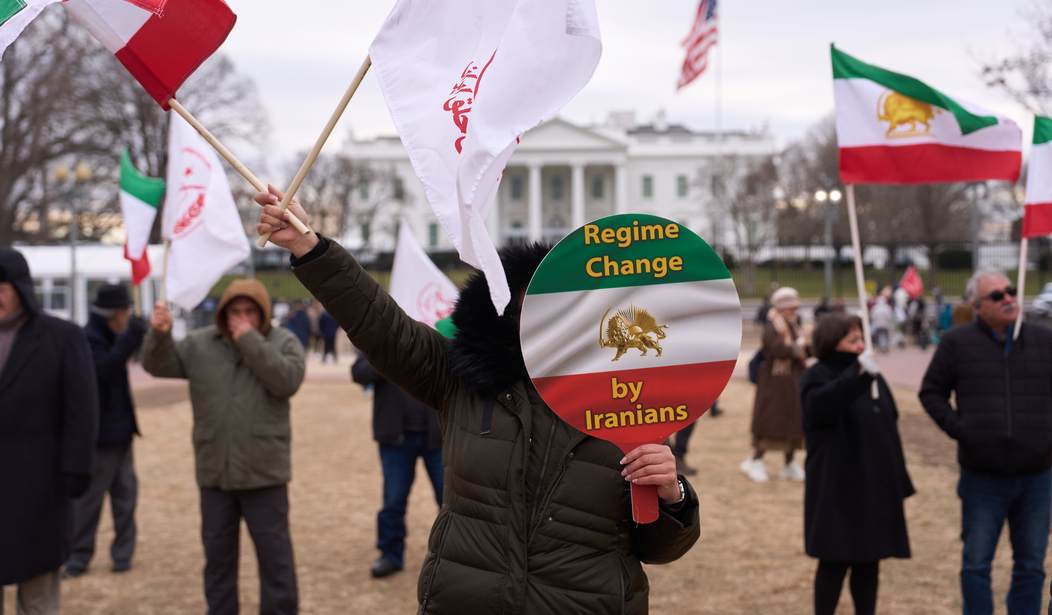

The United States and Israel have been hammering the brutal, theocratic, barbarian regime of the Iranian mullahs and their supporters for two weeks now. It hasn't been easy, and it hasn't been without cost, but if Operation Epic Fury/Operation Roaring Lion is successful, the world's leading state sponsor of Islamic terror will be gone. The old Iran, a destabilizing influence and purveyor of atrocity, will be gone, and the implications of that will be global. President Trump has insisted that regime change isn't the goal of the United States, and he's right; it shouldn't be. But the defenestration of the regime of the mullahs leaves open a big, beautiful door for the Iranian people to take their own country back.
In the place of the theocracy, we hope to see a modern, secular, representative government arise. No more theocracy. No more official state religions. No more mullahs involved in government. Free, open elections. That would be an event that may have even greater implications for the world than the fall of the mullahs: A free, modern country, with vast mineral and energy wealth, able to engage and trade freely in the world's markets.
Now, one group that opposes theocracy, the National Council of Resistance of Iran, has put forth a 10-step plan for the redemption of Iran. Of those 10 steps, the first three are key, as they will shape what the new Iran - the new Persia - will be. Let's have a look at those three proposed steps.
Stage I: The Immediate Transitional Period
The first phase would occur immediately following the overthrow or collapse of the ruling establishment. According to the proposal, a provisional government would administer the country for a maximum of six months.
There is already a candidate waiting in the wings to help, to provide some interim leadership, for Iran: The Crown Prince, Reza Pahlavi, who has vowed to return to Iran should the mullahs fall. But some caution is in order here: While Pahlavi, son of the last Shah, has expressed no aspirations to be seated on a throne, what Iran will need is not a return to old times. No kings, if you like. What Iran needs is a modern, representative government, but then, Reza Pahlavi has lived most of his life in countries with such governments, and should be able to plainly see the advantages.
The main goal of Stage I, though, should be to set the country up for Stage II.
Stage II: Preparing for Free and Fair Elections
The second phase would involve organizing nationwide elections based on universal suffrage. Iran has a politically sophisticated population with a deep history of civic engagement. What it lacks is the institutional infrastructure for genuinely competitive elections free from ideological vetting or clerical oversight.
The provisional government would therefore work with international election observers and democratic institutions to ensure that the vote is transparent, inclusive, and credible. Iranians both inside and outside the country would participate in shaping the nation’s future.
This is the critical phase. The people of Iran should be able to trust the results of this election. The people of the world should also be able to trust the results of this election, and it should be a free and open election; although it seems worth considering a policy that no member of the previous regime should be eligible to run for any office. Let that division be drawn very plainly, to ensure Iran moves forward, not back.
Also, any Iranian expat who returns to Iran within the transitional period should be offered the franchise as well. Many of these people are those who fled the regime in 1979 when the Islamists took over, or the descendants of those people. As such, they will be highly motivated to make sure that the election gives Iran a modern government.
Read More: U.S. Slaps Massive Price Tag on Iran's New Supreme Leader
The Conversation Trump Just Had About Kharg Island Blows Up the Liberal Media Narrative
Finally, once a new Parliament, or Congress, or Althing, or whatever they may want to call it is seated, the primary task becomes shaping a new Iran, with a constitution and a governing system that should last a century or more, at least.
Stage III: A Constituent Assembly and a New Constitution
The elections would produce representatives to a constituent assembly, the body responsible for drafting a new constitution for a democratic Iranian republic.
This phase is critical because it shifts the transition from revolutionary upheaval to constitutional governance. The assembly would debate the structure of the future state: the separation of powers, protections for individual rights, the role of the judiciary, and the mechanisms that ensure civilian control over the military.
Fascinating and pleasing as it would be for the new Iranian government to simply translate the United States Constitution and the Bill of Rights into Farsi and adopt them as-is to shape their new nation, that probably won't happen. Iran, the new, free, secular Iran, will need a government that works for that new Iran, and what will likely emerge will be some form of a parliamentary system. But here, again, is where caution is in order: The new constitution must protect the inalienable human rights of all Iranians, including religious minorities: No state religion, no remnants of theocracy. Only liberty. Only freedom of conscience. For all Iranians - for all of the Persian people, and for everyone who does or will live in the new Iran.
This can't be done by the United States. It can't be done by Israel. Any attempts to impose this on Iran from outside won't succeed. But the Iranian people will, if all this works, be handed a golden opportunity to remake their country, and if they succeed, if a new, free Iran arises, phoenix-like, from the ashes of the theocracy, the world will be forever changed - for the better.