
In Part I of this series, we looked at the many and varied uses to which petroleum is put, and how our comfortable, modern lifestyle is dependent on this substance, above all things. In Part II, we looked at the costs of wind power compared to traditional energy sources; the environmental costs as well as the monetary costs.
Now, in this final part, we'll take a look at the environmental and monetary costs of solar power, and how, of the two most popular "green" energy sources - wind and solar - solar is the worst choice for most applications.
First, let's look at the practical aspects: Is solar really an affordable source of electricity? In a recent piece at one of my favorite energy blogs, Master Resource, author David Bergeron shares some experiences.
I just returned from the Intersolar & Energy Storage North America conference in San Diego where the keynote address focused on how the long-duration storage industry can move forward under the headwinds of the current administration. Their strategy? Better messaging, shifting from climate-change arguments to affordability, reliability, and resilience.
But messaging isn’t the problem. The economics, the numbers, are. If solar is truly affordable, reliable, and resilient, the suppliers should say so plainly: in cents per kWh, free of explicit subsidies and mandates.
This is a key concept. The left, no matter what the issue, always seem to assume the same thing when their agenda fails: That the problem isn't the message, it's the messaging. Solar power, as I have always stated, is good in niche applications. We know people here in the Great Land who live off-grid and for them, in our long, long summer days, solar is pretty workable. In winter, though, they are on diesel or propane generators. But for grid-scale applications, or even home applications that are on grid? The numbers simply don't work.
At Intersolar, I went to a few vendors promoting residential solar-and-battery systems and asked a simple question: “If I go completely solar with battery backup, what is my approximate cost of energy (cents/kWh), assuming normal amortization and maintenance?” No one I spoke to could answer that basic, simple question.
I'll take a little issue with Mr. Bergeron's wording here; it's not that the couldn't answer his question. It's just as likely that they simply didn't want to.
As a residential customer, I can buy reliable electricity from many utilities for 10–15 cents/kWh (25–50 cents in California). So what is the delivered cost of residential solar with battery backup? My simple calculation indicates it might be 15–30 cents/kWh for residential systems in a sunny region, depending on the size of the battery. But that system would still not be as reliable as grid power. You can add a backup generator, but the cost per kWh will increase another 10 cents or so.
Math is harsh. Numbers are harsh. It's small wonder the vendors of solar panels and batteries don't want to mention this.
Read More: Fossil Fuels v. Green Energy, Part I - Oil Is Everywhere
Fossil Fuels v. Green Energy, Part II - The Horrible Cost of Wind Power
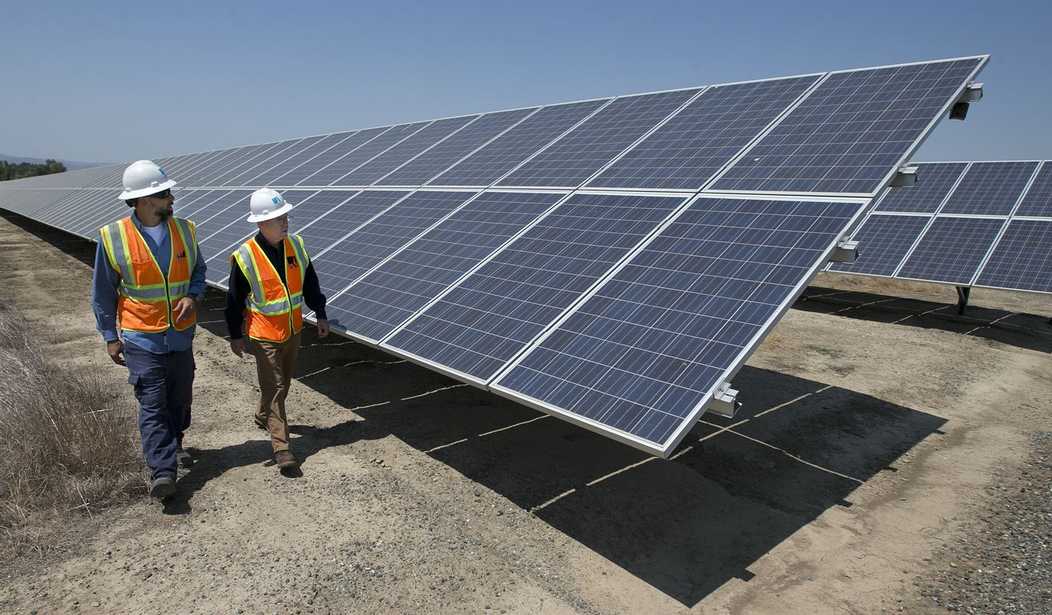
Note that none of these costs take into account the expense of building and maintaining these solar panels, many of which are built in China. None of these costs take into account the amount of land these panel farms take up. Even a small one takes up considerable space:
And here's the thing: The land these massive solar farms take up can't be used for anything else. At least, with the giant, ugly, impractical wind farms, the land around them is still available for some use. I've seen crops planted between the windmills, and I've seen cattle grazing. The small town where two of our four kids live, in eastern Iowa, is on the edge of wide tracts of flat land occupied by windmills, and most of that land has corn, soybeans and hay planted around the windmills.
Solar farms can't be used for any other purpose. Wildlife avoid them, for the most part. And some kinds of solar facilities, for instance, the installations that use banks of mirrors to concentrate sunlight, are notorious for killing birds and other flying creatures in mid-air - they are cooked in flight.
That's not very environmentally conscious. Mr. Bergeron concludes:
So when the solar lobby comes to town claiming solar is affordable, reliable, and resilient, a simple question should follow: What is the delivered cost per kWh, and how much of that price depends on subsidies, mandates, or special rate structures? If the answer is unclear, the claim is marketing, not economics.
And, if the climate scolds claim that solar power is going to save the planet from increasing in temperature by a degree or two in the next thousand years, there are these numbers to counter them with - and it doesn't work out well for them.
Here's another thing: If the advocates for reduced emissions, "green energy" as well as the more vocal climate scolds, really wanted this - if they really wanted reliable, clean, affordable electricity - they would be screaming for more nuclear power plants. They aren't, and that, really, tells you all you need to know.