
Wherever I’ve lived for the last sixty-some years, the one constant I’ve had around was a bird feeder, or two, or three. When we first moved to the Great Land, I bought a couple of feeders, one of which hangs even now right outside the door to the office. One can buy special seed cakes that are treated with a spicy coating that doesn’t bother birds, but which mammals, ranging from squirrels to bears, are deterred by. That’s handy in these parts.
That feeder almost immediately attracted the attention of a local nesting pair of one of my favorite birds – chickadees.
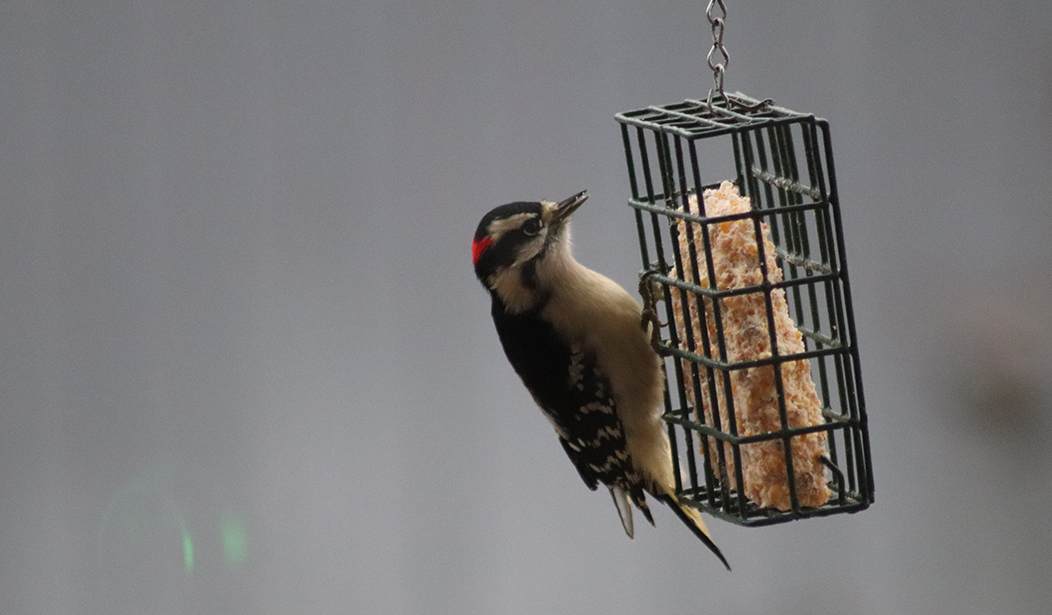
The Black-Capped Chickadee is ubiquitous across the northern part of North America. We have the Boreal Chickadee in these parts, too, although we only see them in the depths of winter when the cold and snow push them south. We’ve also have any number of Red-Breasted Nuthatches, and we over the last few days, we have had Pine Grosbeaks and Redpolls hanging around. We have woodpeckers, too, both Downy and Hairy Woodpeckers, as well as a few others that don't come around to the feeder.
Everywhere I’ve lived, I’ve generally run a bird feeder. In our old Colorado home, where we lived for so long, we had mostly house finches and chickadees. As a kid back in Allamakee County, Iowa, we had chickadees, goldfinches, cardinals, and what I’ve long considered the most beautiful of North America’s songbirds, the Rose-Breasted Grosbeak, which sadly doesn’t range this far north.
I like chickadees. I know I’m anthropomorphizing their behavior some, but to me, they always seem so steadily cheerful. Even in temperatures of 10 or 15 degrees below, these tiny bundles of feathers are out and about with the sunrise, calling, exploring, and looking for food. They are frequently first at the feeder in the morning and last to leave at night. It’s fun to have them around, and we’re looking forward to having more of their cousins visit as well. But boy, on nights like the ones we’ve been having lately, when it’s been dropping to 25 below, it makes me wonder how they don’t just freeze solid. I mean, 10 below is one thing, but 25 below is “spit, and it hits the ground solid” territory.
Read More: Photographs and Memories: Colder Weather
Which brings me to a chilly, rainy-day elk hunt in Colorado, many year ago now. I was looking for a cow elk for the freezer, out in a place near Eagle called Hardscrabble Mountain, and never was a terrain feature more aptly named. The morning had started wet and windy. It got worse.
About ten o’clock in the morning, the wind picked up, from a gale to a hurricane. Since I was hunting into the wind, like any good, savvy pursuer of hoofed game, the ice-cold snow-rain was now blasting me in the face. Every step sent a cascade of wet, sticky snow down on me from the branches of the cedars.
I rounded a small bend on the sort-of trail, and there in front of me was a larger-than-normal cedar. Overhanging branches and dense needles had left an almost dry, sheltered spot about four feet wide under the limbs. Enough is enough, I told myself, and crawled into the shelter to wait out the worst of the storm. Any elk in the area were no doubt doing the same thing.
The ground wasn’t too wet to sit on, especially since I was soaked through anyway. I sat down and started to shiver myself back to some semblance of warmth. It was a few minutes before I noticed that I had company in the shelter of the cedar.
Dark-eyed juncos are bright, cheery little birds, a little smaller than a sparrow, mostly gray with a splash of white on either side of the tail. Bright, charming mites smaller than a sparrow, they add a note of cheer to tree lines, flitting from tree to tree and punctuating the day with sparks of sound.
Read More: Photographs and Memories: Sweet Summer Berries
This junco wasn’t bouncing from tree to tree in search of seeds or insects. He was interested in the same thing I was – shelter from the howling wind and wet. As I sat down, he regarded me philosophically for a moment and then went back to his half-doze, inside a coat of feathers puffed out against the cold.
We made an odd pair, the two of us sharing the shelter of a cedar.
He seemed to understand that I was no threat to him, even though I was a member of a species dangerous to many larger and more formidable animals than he; Man, an apex predator, equipped with binoculars, compass and maps, knife, and a modern rifle capable of reaching three hundred yards to kill an 800-pound elk. The junco was an ounce, perhaps, of fluff, feathers, muscle, and bone. And yet as I sat watching the junco doze, it struck me that perhaps my vaunted human “superiority” wasn’t all it seemed.
Think about that for a moment. For all humanity’s vaunted technology, for all my polypropylene long johns, wool clothing, heavy leather/Gore-Tex boots, and all my modern equipment to aid me in my hiking and hunting, this bird – this tiny bird – was better suited to survival in this storm than I. He had no equipment, no tools for survival, just his wits, his instincts, and his feathers ruffled up against the cold.
That little bird was, by biology alone, better suited to survive that day than I was. The chickadees, nuthatches, and our other birds here in Alaska are likewise better suited, by biology alone, to survive the sub-Arctic nights than we are. Except, of course, for our brains, which give us fire, clothing, and other technologies that enable us to live anywhere on the planet.
But the birds do it with nothing more than their feathers and their racing metabolisms. It makes me marvel at them, which is just another reason I like having them around.